
A Middle Tennessee Garden Designer's Week-by-Week Maintenance Guide from March Through May
Late February is the single most important maintenance window of the year in Middle Tennessee. If you're reading this in early March, you're not late, but you're close. The decisions you make in the next twelve weeks will determine whether your garden looks composed or chaotic by June. Whether your hydrangeas bloom or sulk. Whether your roses explode or limp. Whether your ornamental grasses stand tall through October or flop by August.
I'm a garden designer and I approach every landscape like a composition. But composition means nothing if timing is wrong. A painting doesn't care what month you finish it. A garden does. Every plant in your beds is running on a biological clock calibrated to Nashville's specific conditions: Zone 7a, last frost around April 15, limestone-underlaid clay soil that runs alkaline, and a growing season that shifts earlier every year.
This is the guide I wish someone had handed me when I started designing gardens in Middle Tennessee. It's not a generic checklist. It's a week-by-week decision guide that tells you not just what to do, but why this week, and what happens if you miss it. At the cultivar level. For Nashville soil specifically.
Print it. Bookmark it. Tape it to your potting bench.
Before You Touch a Single Plant IN YOUR GARDEN: The Two Things You Should Have Done Yesterday
Get a Soil Test. Not Next Month, Now.
I cannot overstate this. Everything you do in your garden this spring, every fertilizer choice, every amendment, every plant you buy, should be informed by a soil test. Without one, you're guessing. And in Nashville, guessing usually means adding lime to soil that's already alkaline, or dumping fertilizer on beds that are already phosphorus-loaded.
The University of Tennessee Soil, Plant and Pest Center is right here in Nashville at the Ellington Agricultural Center on Marchant Drive. A basic nutrient test is $15. You'll get results back in about a week by email, including pH, phosphorus, potassium, calcium, magnesium, zinc, manganese, iron, and boron, plus specific lime and fertilizer recommendations.
Here's what most homeowners here don't realize: Middle Tennessee soil sits on a limestone shelf. That means our clay typically runs neutral to alkaline: pH 6.5 to 7.5, sometimes higher. This is the opposite of what most national gardening advice assumes. When a generic garden blog tells you to "add lime to your beds in spring," they're writing for New England. If your Nashville soil is already at 7.2 and you add lime, you're locking up iron, manganese, and other micronutrients your plants desperately need. Your azaleas turn yellow. Your hydrangeas refuse to blue. Your Japanese maples look chlorotic. And you have no idea why.
A $15 soil test prevents hundreds of dollars in wasted amendments and dead plants. Get the box from your local UT Extension office, collect samples from six inches down in several spots across your beds, and send it in this week. By the time you need to fertilize in mid-to-late March, you'll have your results.
Sharpen Your Tools. Seriously.
This sounds trivial. It isn't. A dull pair of bypass pruners crushes plant tissue instead of cutting it cleanly, which creates ragged wounds that invite disease. You're about to prune roses, hydrangeas, and perennials. You want clean cuts that heal fast. Sharpen your bypass pruners, your loppers, and your hedge shears. Clean them with rubbing alcohol or a 10% bleach solution between plants, especially between roses; you do not want to transfer black spot from one bush to the next.
If your pruners are old and the blade doesn't hold an edge anymore, invest in a quality pair. The Nashville Rose Society specifically recommends Felco pruners; they're what the professionals use, and they last decades if maintained.
Early March (Weeks 1–2): The PLANT Cutback Window
This is the most labor-intensive two weeks of the entire garden year. Almost everything that needs cutting back needs it now, before new growth gets in the way. If you do nothing else from this entire guide, do this section.
Ornamental Grasses: Cut Them to the Ground, But Do It Right
If you left your ornamental grasses standing through winter (and you should have because they provide texture, feed birds, shelter beneficial insects, and insulate crowns from freeze damage), now is the moment to take them down. In Nashville's Zone 7a, warm-season grasses typically start pushing new growth in mid-to-late March. You want to beat that timeline.
The rule: cut warm-season grasses to 4–6 inches above the ground before you see new green shoots at the base. Once those green shoots are 2–3 inches tall, you risk cutting them off, which weakens the plant.
For your specific grasses:
Miscanthus (Miscanthus sinensis — 'Morning Light', 'Gracillimus', 'Adagio'): These are large grasses and the old foliage is tough. Bundle the entire clump with a bungee cord or twine about halfway up, then cut below the cord at 4–6 inches from the ground. The bundle holds together for easy cleanup. Use electric hedge shears for large clumps; hand pruners will destroy your wrists.
Switchgrass (Panicum virgatum — 'Shenandoah', 'Northwind', 'Heavy Metal'): Same approach as Miscanthus, but these are slightly more upright so they're easier to manage. Cut to 4–6 inches.
Muhly Grass (Muhlenbergia capillaris): Those glorious pink cloud seed heads are finished by now. Cut the whole plant to 3–4 inches. Muhly is a moderate-sized grass so hand shears work fine.
Little Bluestem (Schizachyrium scoparium): One of our best natives. Cut to 3–4 inches. If the clump is more than 3–4 years old and the center looks thin or dead, this is the year to divide it; dig the whole clump, pull apart the living sections from the edges, and replant.
Fountain Grass (Pennisetum — 'Hameln' and other dwarf cultivars): Cut to 2–3 inches. These are smaller and more delicate than Miscanthus.
Cool-season grasses are different. If you have Blue Fescue (Festuca glauca 'Elijah Blue') or similar, don't cut them to the ground; they're semi-evergreen. Instead, put on a leather glove and comb your fingers through the clump, pulling out the dead blades. Think of it like brushing out tangles. Trim any brown tips lightly with shears. Every 2–3 years, divide Blue Fescue in early spring when you notice the center dying out.
Last Year's Perennials: The Great Cutback
If you left your perennial foliage standing through winter (again, good practice because it provides habitat and insulation), it all comes down now. Work through your beds systematically.
Cut to the ground (2–3 inches):
Black-eyed Susans (Rudbeckia)
Coneflowers (Echinacea — 'Magnus', 'PowWow Wild Berry', 'Cheyenne Spirit')
Bee Balm (Monarda — cut and remove debris; Monarda is mildew-prone and old foliage harbors spores)
Joe Pye Weed (Eutrochium)
Asters
Goldenrod (Solidago)
Catmint (Nepeta — 'Walker's Low', 'Cat's Meow')
Tall Garden Phlox (Phlox paniculata — remove all old stems; like Monarda, phlox is mildew-prone)
Daylilies (Hemerocallis) — pull or cut the dead foliage fans
Baptisia (False Indigo) deserves special attention. If you didn't cut it back in fall, the old stems and seed pods are a blackened mass by now. Cut everything to the ground 2–3 inches. Here's the design note that matters: Baptisia flops. It's the number-one complaint about this otherwise magnificent native perennial. The flopping isn't random, it happens when the plant is in too much shade, in overly rich soil, or when it's never been supported early. If your Baptisia flopped last year, right now , this week, install a peony ring or grow-through grid over the crown, before the new shoots emerge. Those shoots grow fast once they start, and by the time you notice them leaning, it's too late. The support needs to be in place before the plant is 6 inches tall so the stems grow up through it naturally.
Don't cut these yet:
Lenten Rose (Helleborus): These are blooming right now or about to. Remove only the tattered, damaged old leaves to showcase the flowers, but leave healthy green foliage intact.
Coral Bells (Heuchera): Semi-evergreen. Just clean out dead or ratty leaves. Don't cut to the ground.
Creeping Phlox (Phlox subulata): Evergreen groundcover. Leave it alone until after it blooms in April, then shear it back by half.
Lavender: Never cut into old wood — only trim green growth. Wait until you see new green growth pushing, then trim to just above it.
Roses: The Forsythia Rule (Modified)
The old Nashville wisdom is "prune roses when the forsythia blooms." This is a decent approximation, but it's gotten unreliable as some newer forsythia cultivars bloom too early. The Nashville Rose Society's guidance is more precise: prune hybrid teas and floribundas around the third week of March, depending on the weather.
But here's what you can do right now, in early March:
Knock Out Roses and landscape shrub roses: These are the most forgiving. You can prune them now, ate February through mid-March. Cut the entire plant back by one-third to one-half, to about 12–18 inches tall. Remove any dead or crossing canes. Open up the center for airflow. Knock Outs bloom on new wood, so anything you cut now will be replaced with flowering growth. If the bush has become a monster, you can cut it back harder, even to 12 inches, and it will recover beautifully.
Hybrid Teas, Grandifloras, and Floribundas: Wait two more weeks. Around the third week of March in Nashville, you'll see buds starting to swell on the canes, small red bumps pushing outward. That's your signal. Prune to an outward-facing bud, at a 45-degree angle, about a quarter inch above the bud. Remove all dead wood; cut down the cane until you see white or only slightly discolored pith in the center. If the pith is brown, keep cutting lower. Remove any canes thinner than a pencil. Open the center of the bush for airflow. The goal is 3–6 strong, healthy canes arranged in a vase shape.
After pruning hybrid teas, the Nashville Rose Society recommends working one cup of Alfalfa Meal or two cups of Mills Mix into the soil around each bush. Then spray with a fungicide. Then re-cover with mulch. Do not pull mulch away from the crown yet. Nashville's last frost date isn't until mid-April, and a late freeze can kill new growth. Gradually pull mulch back from the crown after April 15.
David Austin English Roses: Nashville rosarians have found that pruning and feeding Austins in mid-February makes a noticeable difference. If you haven't done this yet, do it now in early March; you're only slightly behind. Cut back by about one-third, remove dead or weak growth, feed, and mulch.
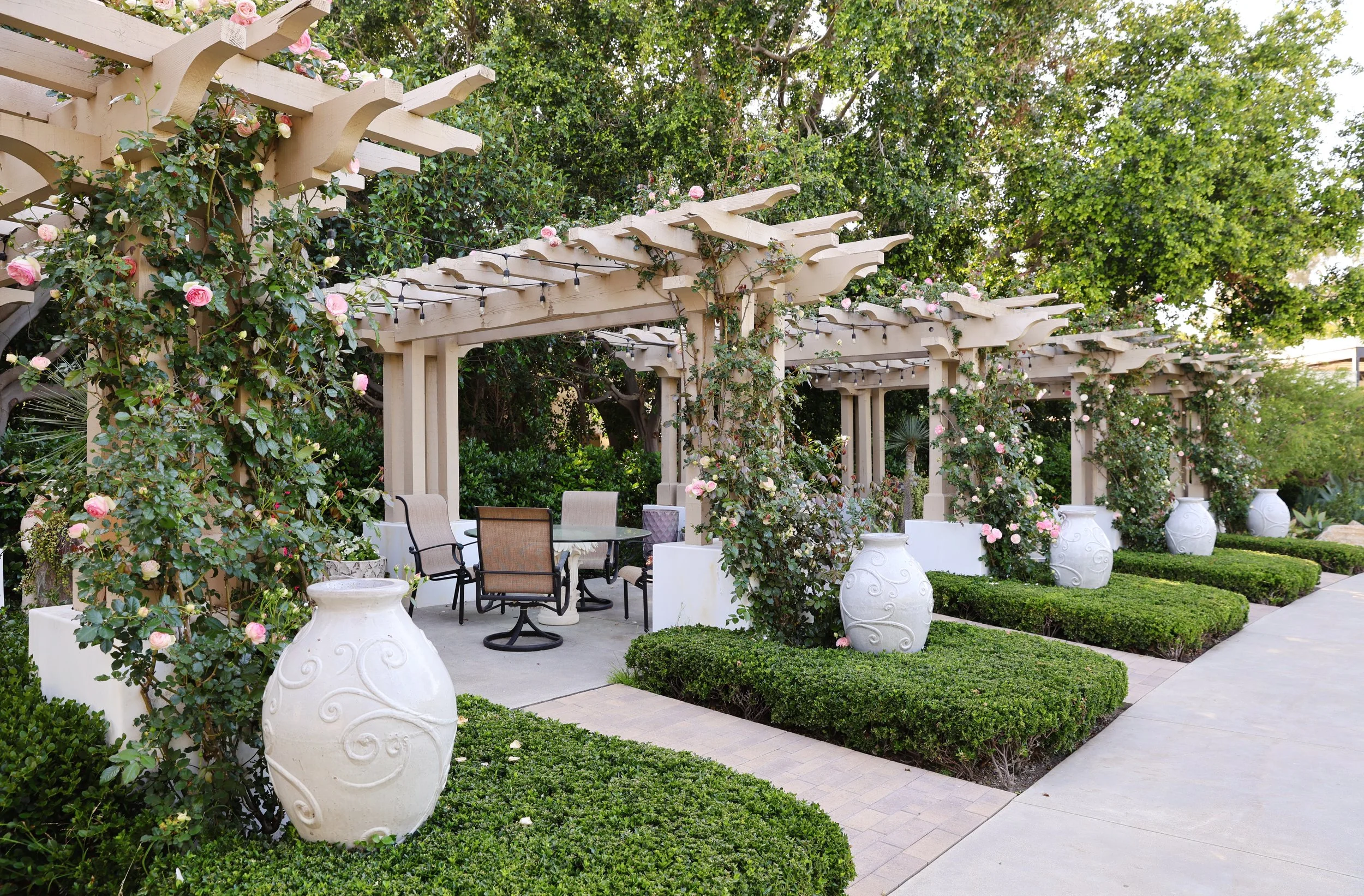
Climbing Roses: Don't prune a climbing rose that's less than three years old, just remove dead or damaged canes. For established climbers, leave the main structural canes intact (train them horizontally for maximum bloom) and cut the lateral shoots, the smaller side branches, back to 2–3 buds, about 6 inches.
Once-blooming Old Garden Roses: Leave these alone in spring. They bloom on old wood. Severe spring pruning sacrifices this year's flowers. Prune them after they flower in late spring or early summer.
Crepe Myrtles: Let's Talk About Crepe Murder
I have to address this because it's one of the most visible and most damaging pruning mistakes in Nashville. Every February, you see it: crepe myrtles hacked back to thick, stubby knobs, every branch cut to the same height, the entire canopy removed. Landscaping crews do it to dozens of properties in a single day. It's fast. It's dramatic. And it's called "crepe murder" for a reason.
Here's what topping does to a crepe myrtle. It forces a flush of thin, weak shoots from the cut points. Those shoots grow fast but can't support the weight of the flower clusters, so the branches droop and splay outward — the opposite of the graceful vase-shaped canopy you're trying to achieve. It also creates permanent knobby scars at every cut point that thicken over the years into ugly, swollen fists of scar tissue. A topped crepe myrtle never recovers its natural architecture. Once it's been butchered, the damage compounds every year.
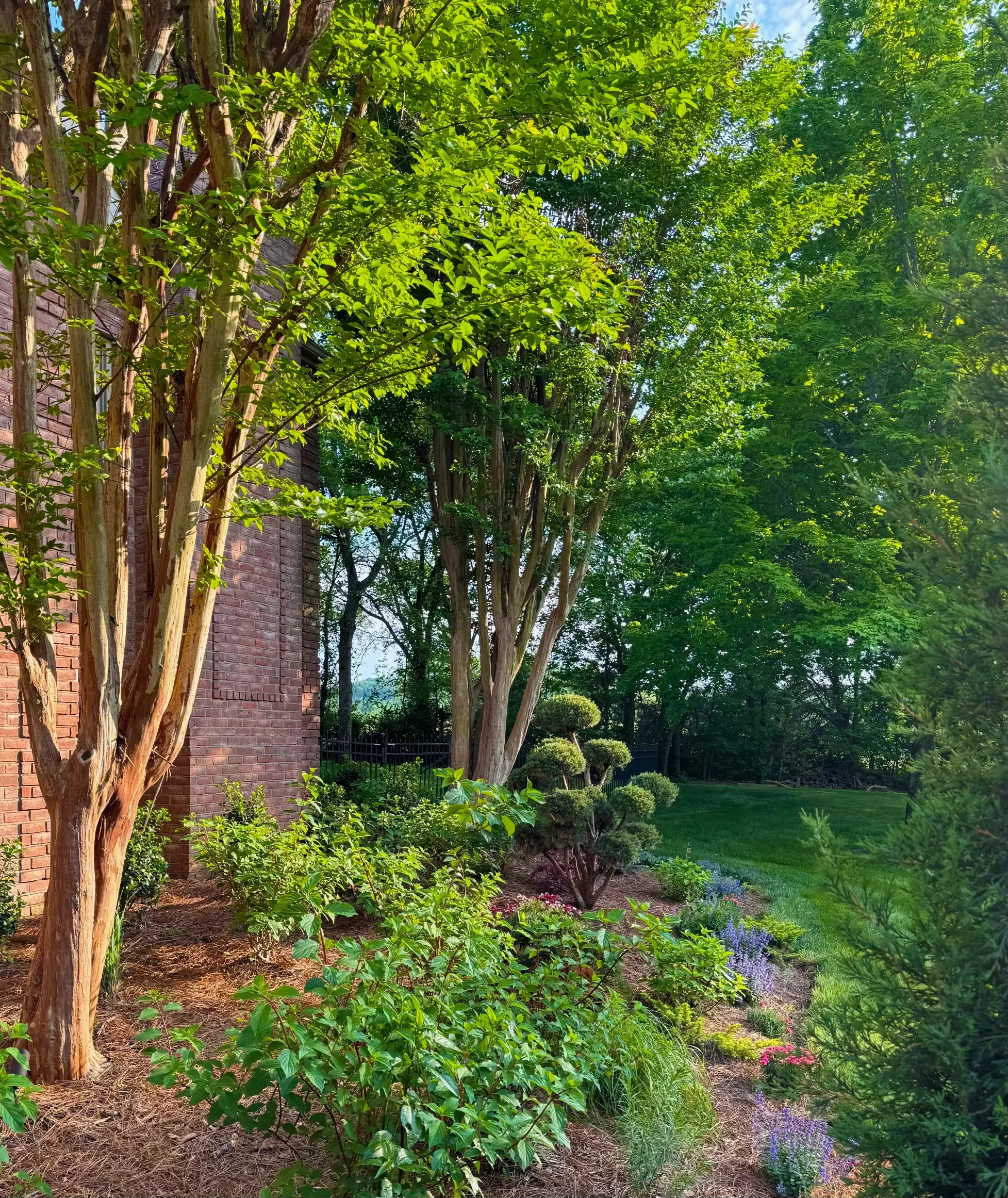
Gorgeous crepe myrtles allowed to grow to their full potential will perform and bloom year after year.
What you should actually do in late winter:
Remove suckers. The shoots growing from the base. Remove any dead, damaged, or crossing branches. Remove interior twiggy growth to open up the canopy for airflow and light (this also reduces powdery mildew, which crepe myrtles are prone to in Nashville's humidity). If lower branches block a walkway or sightline, you can remove entire limbs cleanly at the branch collar. This is called "limbing up" and it's how you create that beautiful multi-trunk form. You can also remove spent seed heads from last year's flowers by snipping just below the cluster, though this is cosmetic and optional.
What you should never do: Cut the main branches back to stubs. Reduce the height by topping. Shear the canopy into a flat-topped shape.
If your crepe myrtle is simply too large for its location, the honest answer is that it's the wrong plant in the wrong spot. Crepe myrtles range from dwarf cultivars at 3–4 feet (Lagerstroemia 'Pocomoke', 'Chickasaw') to full-sized trees at 25–30 feet ('Natchez', 'Muskogee', 'Tuscarora'). The cultivar determines the mature size. If you have a 25-foot 'Natchez' planted five feet from your front window, no amount of annual hacking will make it a 10-foot shrub. It will fight you every year and look worse every year. The better investment is to remove it and plant a cultivar that fits the space, or to accept its size and limb it up so the canopy is above the window line.
A note on disease-resistant cultivars: If you're planting a new crepe myrtle in Nashville, choose a cultivar bred for resistance to powdery mildew and Cercospora leaf spot, both of which thrive in our humidity. The National Arboretum introductions, named after Native American tribes, are among the best: 'Natchez' (white, large), 'Muskogee' (lavender, large), 'Tuscarora' (coral-pink, large), 'Sioux' (dark pink, medium), 'Acoma' (white, semi-dwarf), and 'Tonto' (fuchsia, semi-dwarf). These cultivars have genuine disease resistance bred into them, unlike many of the generic unnamed crepe myrtles sold at big-box stores.
Mid-March (Weeks 3–4): Soil Work, Compost, and the Hydrangea PRUNING Decision
Compost: Your Best Amendment
Now that beds are cleaned up, this is the ideal moment to top-dress with compost. If you love compost and pine straw like I do, this is your season.
For established perennial beds: Spread 1–2 inches of finished compost around your plants, keeping it a few inches away from stems and crowns to prevent rot. Don't dig it in aggressively around established perennials; you'll damage root systems. Just lay it on the surface. Earthworms and rain will work it into the soil over the coming weeks. This single application feeds your beds gently all season while improving soil structure, and in Nashville's heavy clay, improving structure is everything.
For new beds or beds that performed poorly last year: Work 2–3 inches of compost into the top 6–8 inches of soil. If your soil test revealed heavy clay with poor drainage (common in Davidson and Williamson Counties), this is also the time to add coarse organic amendments, not sand (which can make clay worse), but chunky compost, aged bark fines, or expanded shale to physically open the soil structure.
A note on Nashville compost sources: The Compost Company in Ashland City (with a new location in Antioch) produces STA-certified premium compost from locally collected organic waste. They carry screened compost, garden blends, and topsoil mixes specifically formulated for Middle Tennessee conditions. Compost Nashville is another local option that delivers finished compost. For a luxury residential property, I prefer premium double-screened compost for its uniform texture and clean appearance in formal beds.
Why compost matters more than synthetic fertilizer in Nashville clay: Synthetic fertilizers deliver a chemical punch but do nothing for soil structure. Nashville's alkaline clay soil needs biology: the microbial activity that compost feeds. Over time, regular compost application transforms our dense, airless clay into living soil that drains better, holds moisture more evenly, and makes nutrients more available to roots. One to two inches of quality compost annually is worth more than any bag of synthetic 10-10-10 you can buy.
The Hydrangea Pruning Decision (Don't Get This Wrong)
More hydrangeas are ruined by incorrect pruning than by any pest or disease. The reason is simple: different hydrangea species bloom on different wood, and the pruning rules are opposite. Get this wrong, and you'll have green leaves and zero flowers all summer. Here's the breakdown for Nashville:
Panicle Hydrangeas (Hydrangea paniculata — 'Limelight', 'Little Lime', 'Quick Fire', 'Bobo', 'Strawberry Sundae'): Prune NOW, in late winter or early spring. These bloom on new wood, meaning this year's growth. You can prune them hard and they'll still flower. Cut back stems to just above a fat bud. Remove any crossing or weak branches. If you want the plant smaller and tighter, cut it back by one-third to one-half. If you want enormous flower heads (for cutting, for example), cut harder; the fewer stems, the bigger the individual blooms. These are the most forgiving hydrangeas to prune.
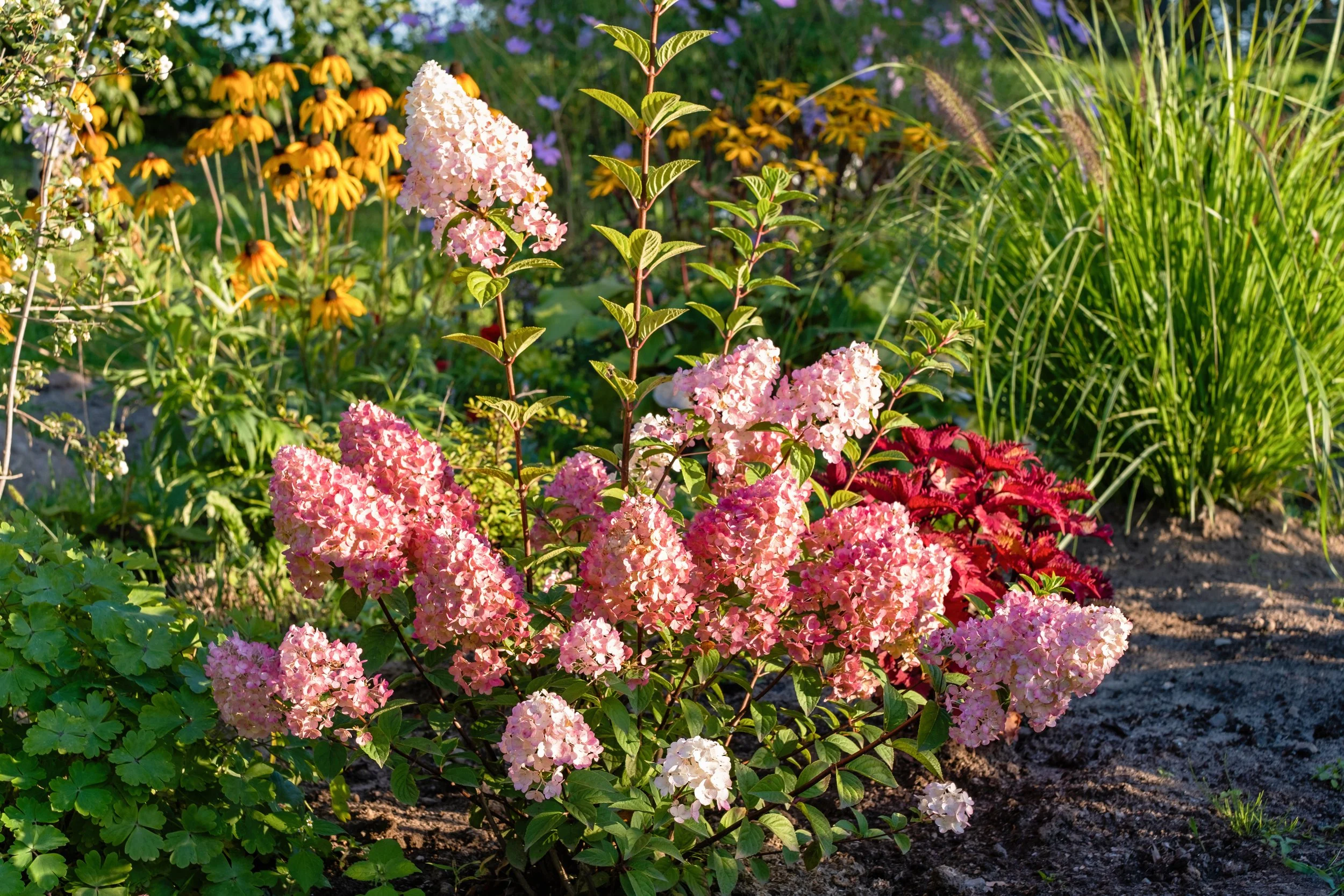
White-to-pink panicle hydrangeas. Cultivars displaying this color transition include Firelight Tidbit and Strawberry Sundae. All panicle hydrangeas grow on new wood and should be pruned in late winter or early spring.
Smooth Hydrangeas (Hydrangea arborescens — 'Annabelle', 'Incrediball', 'Invincibelle Spirit'): Prune NOW, hard. These also bloom on new wood. Cut them to 6–12 inches above the ground. This stimulates vigorous new stems that produce those giant white or pink snowball heads. Older cultivars like 'Annabelle' are notorious for flopping; the stems aren't strong enough to hold up those massive blooms after rain. Cutting hard in spring encourages thicker, sturdier new canes. If flopping is chronic, consider replacing with 'Incrediball' or 'Invincibelle Limetta', which were bred for stronger stems.
Bigleaf Hydrangeas (Hydrangea macrophylla — the classic mophead and lacecap types in blue and pink): DO NOT PRUNE NOW. This is the hydrangea most people get wrong. Traditional bigleaf hydrangeas bloom on old wood; the flower buds for this summer's blooms are already formed on last year's stems, sitting dormant right now inside those fat terminal buds. If you cut the stems back now, you cut off every single flower bud. The only spring pruning you should do is remove completely dead stems (they'll be brown and brittle with no green buds) once the plant starts leafing out in April, and you can clearly see which stems are alive.
The exception: Reblooming bigleaf hydrangeas like the 'Endless Summer' series bloom on both old and new wood. They're more forgiving. But even with these, leave them alone in spring beyond removing dead wood; you'll get the best show by preserving the old-wood buds for early flowers plus new-wood buds for later flowers.
Oakleaf Hydrangeas (Hydrangea quercifolia — 'Alice', 'Snow Queen', 'Ruby Slippers', 'Gatsby Pink'): DO NOT PRUNE NOW. These bloom on old wood, like bigleaf hydrangeas. They also have gorgeous exfoliating bark and incredible fall color. Leave them alone in spring. If you need to shape them, do it right after flowering finishes in early-to-mid summer.
Here's a designer's shortcut for remembering this: If it has a cone-shaped flower head or a giant white snowball, prune now. If it has blue, pink, or purple mopheads or lacecaps, or oakleaf-shaped leaves, don't touch it. (For a deeper dive into which cultivars I actually recommend for Nashville clay, see my full plant guide.)
Other Shrubs: The Spring-Bloomer Rule
The same old-wood / new-wood logic that governs hydrangeas applies to every flowering shrub in your landscape. And this is where I see the second most common pruning mistake in Nashville, right after crepe murder.
The rule is simple: if it blooms in spring, it set its flower buds last year. Don't prune it now.
Do NOT prune these in late winter or early spring:
Azaleas and rhododendrons: Their flower buds are already formed and visible; those fat, rounded buds at the branch tips. If you shear them now, you shear off the entire spring show. Prune azaleas after they finish blooming, typically late April through May. Same for rhododendrons. If you need to rejuvenate an overgrown azalea, you can cut it back hard, even to 12 inches, right after bloom, and it will regrow. But doing that in February means no flowers for at least a year.
Forsythia: Already budded for spring bloom. Prune after flowering if you need to control size. Forsythia blooms on one-year-old wood, so the best approach is to remove the oldest canes at the base after bloom, which encourages fresh new growth that will flower the following spring.
Flowering quince (Chaenomeles): Old wood bloomer. Leave it alone until after it flowers.
Lilac (Syringa): Prune immediately after blooming — lilacs set next year's flower buds within weeks of finishing. If you prune in fall or winter, you're cutting off next spring's flowers.
Bridal wreath spirea (Spiraea prunifolia, S. × vanhouttei): The cascading white spring spirea varieties bloom on old wood. Prune after flowering. Don't confuse these with the summer-blooming spireas — they're different plants with different rules.
Viburnum (most spring-blooming species): Leave alone until after flowering.
DO prune these now — they bloom on new wood:
Butterfly bush (Buddleia): Cut back hard to 12–18 inches in late February or early March. It blooms on new summer growth and will come back vigorously. In Nashville, butterfly bush can become rangy and woody if you don't prune hard annually. Some gardeners cut it almost to the ground; it recovers.
Beautyberry (Callicarpa americana): Cut to 12–18 inches in late winter. It blooms and fruits on new wood. Hard pruning produces a more compact plant with better berry production.
Summer-blooming spirea (Spiraea japonica — 'Little Princess', 'Goldflame', 'Magic Carpet'): These are the low, mounding spireas with pink or red flowers in summer. Prune in late winter and cut back by about one-third to shape, or cut harder to rejuvenate. They bloom on new growth.
Rose of Sharon (Hibiscus syriacus): Blooms in late summer on new wood. Prune in late winter to shape and remove dead or crossing branches.
Vitex (Vitex agnus-castus): Summer bloomer on new wood. Cut back hard, even to a low framework of 12–18 inches, in late February. It comes back strong and blooms all summer. Trained as a small tree form, remove lower suckers and shape the canopy.
The general principle: Walk your property right now. Anything with visible buds swelling at the tips, leave it. Anything that's fully dormant with no visible bud activity and you know blooms in summer, prune it now.
Fertilizing: Timing and What to Use
Mid-to-late March, when you start seeing new growth pushing on perennials and shrubs, is the time to fertilize, not before. Fertilizing dormant plants is wasted effort; the roots aren't actively taking up nutrients yet.
For perennial beds: A single application of balanced, slow-release granular fertilizer (something like a 5-5-5 or 10-10-10 organic formula) broadcast lightly across the bed when new shoots are emerging is sufficient for most perennials. Spread it thinly around the root zones, keep it off the crowns, and water it in. If you top-dressed with compost earlier this month, many perennials won't need additional fertilizer at all; compost is gentle, complete nutrition.
Heavy feeders that want extra attention: Daylilies, peonies, garden phlox, and chrysanthemums benefit from a second feeding in early summer.
For roses: After spring pruning, feed with a rose-specific fertilizer or a combination of organic amendments. The Nashville Rose Society's approach: alfalfa meal or Mills Mix worked into the soil at pruning time, then regular feeding through the growing season beginning after last frost. Roses are heavy feeders and Nashville's alkaline clay can lock up iron and other micronutrients; if your roses show chlorosis (yellow leaves with green veins), a chelated iron supplement may be needed. Your soil test will tell you.
For acid-loving plants (azaleas, rhododendrons, camellias, blueberries, gardenias, Japanese maples): Use a fertilizer formulated for acid-loving plants, like Holly-tone. In Nashville's alkaline soil, these plants often struggle with nutrient availability rather than actual nutrient deficiency; the nutrients are in the soil but tied up at high pH. Regular applications of sulfur or acidifying fertilizers help, but this is a long game, not a one-time fix.
For hydrangeas: A balanced slow-release fertilizer in spring when new growth appears is sufficient. Avoid high-nitrogen fertilizers, which push leaf growth at the expense of flowers. If you want blue flowers on bigleaf hydrangeas, you need acidic soil (pH below 6.0) with available aluminum; in Nashville's alkaline conditions, this requires aluminum sulfate applications and possibly soil sulfur. Pink flowers happen naturally in our high-pH soil. This is a whole topic unto itself, but the point is: flower color in bigleaf hydrangeas is about soil chemistry, not fertilizer brand.
Late March into April: Mulching, Pre-Emergent, and What the Transplants Need to Know
Mulch: When, What Kind, How Much
When to mulch: After you've finished pruning, cleaning beds, applying compost, and fertilizing. In Nashville, that's typically late March to early-to-mid April. Don't mulch too early; let the soil warm up first. A thick layer of mulch on cold, wet soil keeps it cold and wet longer, which delays root growth.
How much: 2–3 inches. No more. The "mulch volcano" you see piled a foot deep against tree trunks and shrub bases at commercial properties? That's malpractice. Excessive mulch smothers roots, traps moisture against bark, causes crown rot, and creates habitat for voles. Two to three inches is the sweet spot, enough to suppress weeds, retain moisture, moderate soil temperature, and break down into organic matter.
Keep mulch pulled back 3–4 inches from the base of all shrubs, perennial crowns, and tree trunks. Mulch touching bark or crowns invites rot and disease.
What kind — and this is where it gets interesting:
Pine straw (pine needles): I love pine straw and I think it's criminally underused in Nashville landscapes. Here's why: it's lightweight, it spreads easily, it interlocks and stays in place on slopes where hardwood mulch washes away, it looks natural and elegant in woodland and cottage-style plantings, and it breaks down slowly enough to last a solid season. The old myth that pine straw dramatically acidifies soil has been largely debunked; dried pine needles are nearly neutral. However, Turf Managers here in Nashville rightly points out that pine straw does contribute a gentle acidity as it breaks down, which is actually beneficial in our alkaline Middle Tennessee soil. It's particularly good around acid-loving plants like azaleas, rhododendrons, and camellias, where that slight acidifying effect is welcome. Nashville has abundant pine trees, so locally sourced pine straw is readily available. It does need refreshing more frequently than hardwood mulch, so plan to top-dress twice a year for the best appearance.
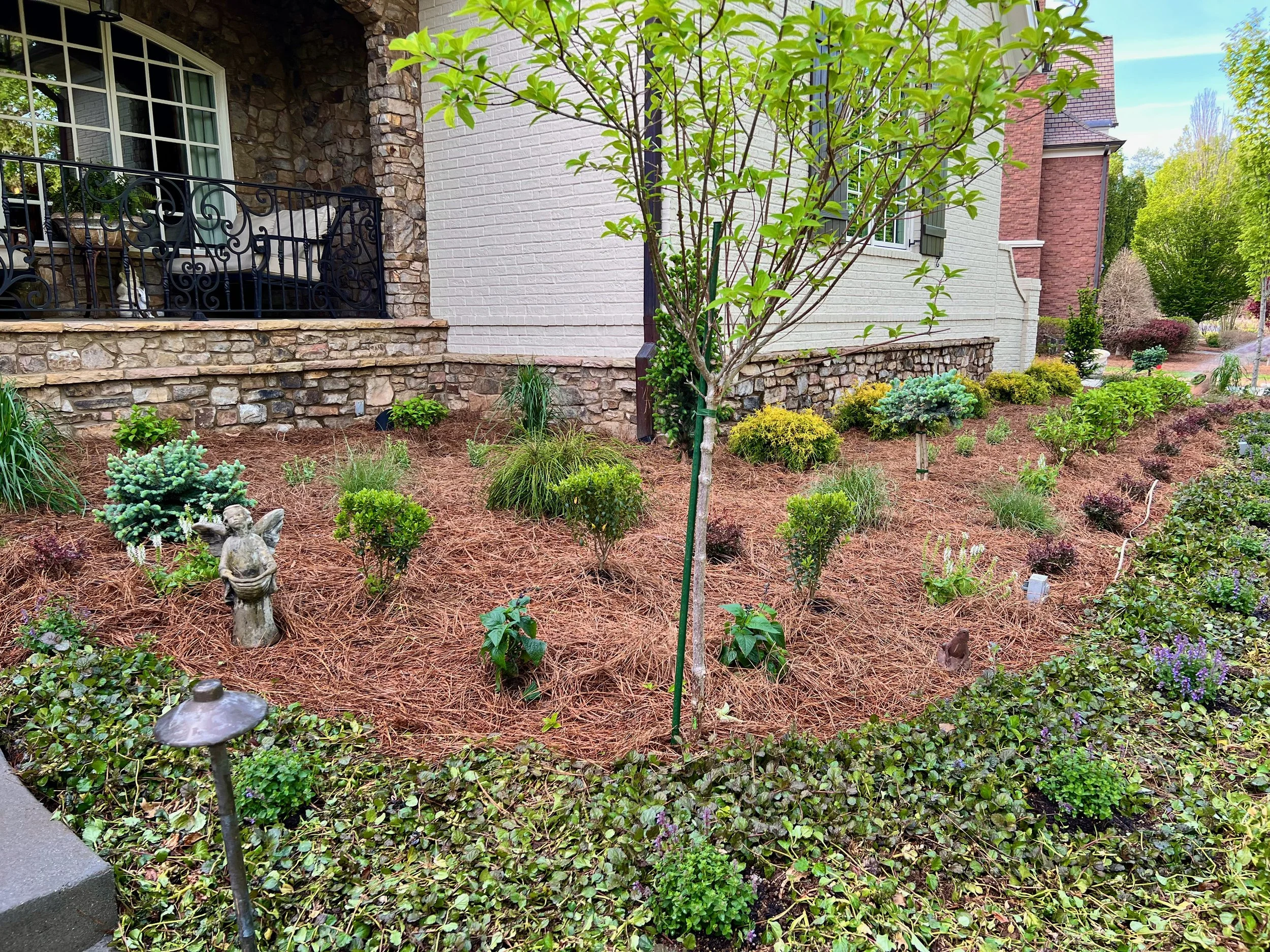
Long pine needle mulching applied within landscaping beds with acid-loving spring plantings.
Shredded hardwood mulch: This is what most Nashville landscapes use, and for good reason. It stays put, suppresses weeds effectively, holds moisture well, and as it decomposes, it enriches the soil with organic matter. It provides a polished, manicured look that suits the formal gardens. I prefer natural (undyed) shredded hardwood or shredded pine bark; dyed mulches contain coloring agents that don't break down as naturally, and the fire-engine-red stuff makes me cringe from a design standpoint. Shredded hardwood lasts about a year before it needs refreshing.
What I typically recommend for my clients: Pine straw in naturalistic areas, woodland gardens, and around acid-loving specimens. Shredded hardwood or pine bark in formal beds, foundation plantings, and high-visibility areas. Sometimes a combination: hardwood near the house, pine straw in the outer garden. There's no one-size-fits-all answer. The right mulch is the one that matches the design intent, the soil needs, and the maintenance commitment.
Compost as mulch: You can use finished compost as a mulch layer as well; it feeds and protects simultaneously. This is what I prefer in perennial beds where I want maximum soil improvement. The tradeoff is that it breaks down faster than wood mulch and doesn't suppress weeds as effectively, so it works best as a thin top-dress under a conventional mulch layer.
Evergreens: Spring Shaping and Maintenance
Evergreen shrubs and hedges are the structural backbone of most Nashville landscapes; the elements that hold the garden together through winter when everything else has dropped its leaves. Spring is the window to shape them, but the timing and technique vary by species.
Hollies (Ilex — Burford, Dwarf Yaupon, 'Hoogendorn', 'Steeds', 'Nellie R. Stevens'): Late March through mid-April is ideal for shaping hollies. They tolerate pruning well and will flush new growth quickly in spring warmth. For a formal hedge, shear to shape — but always cut the top slightly narrower than the base so sunlight reaches the lower branches. A holly hedge that's wider at the top shades out its own lower foliage, which eventually thins and goes bare. For a more natural look, use hand pruners to selectively remove individual branches. This maintains the plant's organic form while controlling size. Hollies are one of the few evergreens that can be cut back hard into old wood and recover, so if yours are badly overgrown, late March is the time to take them back dramatically. They'll look rough for one season and be beautiful by the following year.
Boxwood (Buxus): If you're still growing boxwood in Nashville, and many properties do, especially in the established neighborhoods, spring maintenance is critical for keeping it healthy. Thin the interior of the plant in late March or early April by reaching in with hand pruners and removing some of the dense interior growth. This is different from shearing the outside. The goal is to open the plant up so air and light reach the center, which helps prevent the fungal issues boxwood is increasingly prone to in our humidity. Boxwood blight (Calonectria pseudonaviculata) is present in Tennessee, and poor airflow is one of the biggest risk factors. If you see dark leaf spots and rapid defoliation, bag and remove the affected material; don't compost it. For the record, I've been steering clients toward Distylium 'Vintage Jade' and dwarf hollies as boxwood alternatives in new plantings, especially in humid or shaded locations.
Arborvitae and Junipers (Thuja, Juniperus): These are the workhorses of Nashville privacy screens. Light shearing in late spring, after the new growth has emerged and hardened slightly, keeps them dense and tidy. The critical rule with all conifers: never cut back into brown, bare interior wood. Unlike hollies, most conifers will not regenerate from old wood. If you cut past the green growth into the brown interior, that section stays bare permanently. This means you need to shear consistently every year or two to keep the green growth layer from migrating outward while the interior goes bare. If an arborvitae has already lost its lower branches to shade or neglect, there's no pruning fix. The better solution is to plant lower evergreen shrubs in front to screen the bare trunks.
Green Giant Arborvitae (Thuja 'Green Giant'): These grow fast — 3 to 5 feet per year when young — and people often underestimate how quickly they'll fill in. If yours are getting too wide and encroaching on a walkway or property line, shear the sides in late April or early May. Don't top them unless absolutely necessary. A topped arborvitae loses its natural pyramidal form and looks permanently awkward. If height is an issue, you likely planted the wrong cultivar for the space. 'Green Giant' wants to be 40–60 feet tall. If you needed a 15-foot screen, 'Emerald Green' (Thuja occidentalis 'Smaragd') or Juniper 'Taylor' would have been the better choice.
A design note on evergreen shearing: I see a lot of Nashville properties where every evergreen shrub has been sheared into a ball or a box, regardless of its natural form. This is the landscape equivalent of giving every person the same haircut. Some shrubs, like formal hollies or boxwood, take well to shearing because that's their architectural role. But others, like Japanese Plum Yew, Distylium, or Oakleaf Hydrangea, have a natural, flowing habit that's part of their beauty. Shearing them into geometric shapes destroys the texture and character that made them worth planting. Before you pick up the hedge trimmer, ask yourself: is this plant supposed to be formal, or is it supposed to flow? The answer should dictate the tool in your hand.
Trees: What's DIY and What Needs a Professional
Spring is when most people notice their trees: the dead branch that winter storms revealed, the limb that's hanging over the roof, the canopy that's gotten so dense the lawn underneath has given up. Here's how to think about tree work in spring.
What you can do yourself:
Remove any dead, broken, or hanging branches you can safely reach from the ground with a pole pruner or loppers. Cut back to the branch collar, that slightly swollen ring where the branch meets the trunk or a larger branch. Don't leave a stub, and don't cut flush with the trunk. The collar contains the tree's healing tissue, and a clean cut at the collar will seal over within a season or two. Remove suckers, the vigorous shoots that sprout from the base of the trunk or from roots. Crepe myrtles, crabapples, and ornamental cherries are notorious for suckering. Pull suckers when they're young and green if possible; pulling tears out the dormant buds more effectively than cutting, which can stimulate more suckers.
What you should call an arborist for:
Any branch you can't reach from the ground. Anything involving a chainsaw and a ladder. That combination injures and kills homeowners every year. Any branch over 4 inches in diameter. Anything near power lines. Any tree that shows signs of structural damage: large cracks in the trunk, major limbs splitting from the union, fungi or conks growing from the trunk or roots (which often indicate internal decay). Any tree that has been damaged by ice storms. Nashville gets them, and the damage is often worse than it looks.
When to prune specific Nashville trees:
Oaks: Prune in late winter (now through early March) while dormant. Avoid pruning oaks from April through July ; open wounds during warm months can attract the beetles that carry oak wilt, a devastating vascular disease. Tennessee has confirmed oak wilt cases, and it spreads through both root grafts and insect vectors. If you must prune an oak in the growing season (storm damage, for example), seal the wound immediately with pruning paint; one of the very few situations where pruning paint is actually recommended.
Maples: Prune in late summer through early fall if possible. Maples pruned in late winter "bleed" heavily. The sap runs from the cut wounds. The bleeding doesn't harm the tree, but it's messy and alarming-looking. If you need to remove dead or dangerous branches now, go ahead;the tree will be fine. But elective shaping is better done later in the year.
Fruit trees (apples, pears, peaches, plums): Prune in late winter while fully dormant, now through early March in Nashville. Remove dead wood, crossing branches, and water sprouts (the vigorous vertical shoots growing from horizontal branches). Open the center of the tree for light and airflow. Peaches and nectarines need more aggressive annual pruning than apples; they fruit on one-year-old wood, so you want to encourage new growth every year.
Dogwoods, redbuds, and other spring-flowering trees: Like spring-blooming shrubs, these bloom on old wood. Don't prune now unless you're removing dead or damaged branches. Shape them after they flower. Dogwoods in particular are susceptible to dogwood anthracnose, and the disease enters through wounds, so prune only when necessary, and make clean cuts.
A word about "topping" shade trees: Don't. If someone suggests topping your oak, maple, or tulip poplar, find a different tree service. Topping removes the tree's main structural branches and forces a dense cluster of weakly attached new shoots that are far more likely to break in storms than the original branches were. It's the same destructive logic as crepe murder, applied to large trees with larger consequences. A topped tree is more dangerous than the tree you started with, costs more to maintain over time, and never regains its natural form. A certified arborist will reduce the canopy by selectively removing individual branches, a technique called "crown reduction", which maintains structure while reducing overall size and wind load. If cost is a concern, the International Society of Arboriculture has a free "Find an Arborist" tool on their website where you can verify credentials.
What Nashville Transplants Need to Know (If You Just Moved Here)
Nashville is the fastest-growing city in America, and half the homeowners in Williamson County came from somewhere else. If you've just relocated from the Pacific Northwest, the Midwest, the Northeast, or California, your garden instincts are probably miscalibrated for Middle Tennessee. Here's what's different:
Your soil is not what you're used to. Nashville sits on a limestone basin. The soil is dense, alkaline clay: heavy, sticky when wet, rock-hard when dry, and fundamentally different from the acidic loam of Oregon, the sandy soil of Florida, or the rich prairie topsoil of the Midwest. Everything you know about soil amendments may need inverting. Don't add lime. Don't assume your soil is acidic. Get the soil test.
Our summers are brutal. Zone 7a tells you about our winter cold, but it says nothing about the relentless humidity and heat from June through September. Plants that thrived in Portland's mild summers or Colorado's dry heat may suffer here. Powdery mildew, black spot, and fungal diseases thrive in Nashville's muggy conditions. Choose resistant cultivars and plant with adequate spacing for airflow.
Spring happens fast. In Nashville, you go from "is it spring yet?" to "everything is blooming at once" in about three weeks. This is not a slow coastal spring that unfolds over months. Once the warm-up starts, it accelerates rapidly. If you haven't pruned and prepared by mid-March, you'll be chasing the season all year.
The light changes. Many Nashville neighborhoods, especially the established ones in Belle Meade, Forest Hills, and Oak Hill, have enormous mature tree canopies. The light conditions in your garden shift dramatically from March (before the canopy fills in) to May (full shade under mature oaks and tulip poplars). Right now, before the trees leaf out, walk your property and observe where the sunlight falls. This is the most accurate window for understanding your garden's true light conditions. That sunny spot by the fence may be deep shade by May. A bed that seemed shady all last summer might have six hours of winter sun hitting it right now. Pay attention. This information is more valuable than anything on a plant tag.
Drainage matters more than you think. Nashville's clay holds water. New construction sites are especially problematic; builders often compact the soil with heavy equipment, grade it poorly, and cover it with an inch of topsoil and sod. The result is a lot that doesn't drain. Before you invest in expensive landscaping on a new build, walk your property after a heavy rain and observe: where does water pool? Where does it flow? These observations will save you from planting a $3,000 specimen tree in a spot where it will sit in standing water and die. (If you're not sure what you're looking at, that's exactly what a design consultation is for.)
April: The Last Frost Gauntlet and the Planting Window
The April 15 Line
Nashville's average last frost date falls around April 15–23, depending on your specific microclimate. (Low-lying areas in river bottoms frost later. Urban areas with heat-island effects may clear earlier. Hilltops in Sumner County are different from bottomland in Cheatham County.) This date is an average, not a guarantee. Nashville has had late freezes into the last week of April.
What this means practically: Don't remove winter mulch protection from roses until after April 15. Don't plant frost-tender tropicals, annuals, or warm-season vegetables until after this date. Don't get seduced by the warm spell in early April. Nashville always teases with a few 75-degree days followed by a 32-degree night.
What you CAN plant in April before last frost: Cool-season annuals like pansies, violas, snapdragons, and sweet alyssum are already fine. Hardy perennials, shrubs, and trees can be planted as soon as the ground is workable. Container-grown plants from local nurseries are fair game; they're already acclimated.
Mid-to-Late April: The Spring Planting Window Opens
Once the frost risk passes, you're in the prime planting window. In Nashville, this runs from mid-April through late May; after that, the summer heat makes establishment much harder on new plants.
For trees and shrubs: Dig the hole twice as wide as the root ball but no deeper. In Nashville clay, a common mistake is digging too deep, creating a "bathtub" that fills with water. The root flare, where the trunk widens at the base, should sit slightly above the surrounding grade, not buried below it. Backfill with the same soil you removed (yes, the clay; the roots need to learn to grow in it), amended with some compost if the clay is particularly dense. Water deeply and thoroughly after planting, then mulch.
For perennials: This is the ideal time to plant new perennials and to divide and transplant existing ones that have outgrown their space. Divide daylilies, hostas, and ornamental grasses now while they're still small and manageable. (Don't try to divide Baptisia or other deep-taprooted species because they resent it.)
What Should Be Blooming Already (A Timing Check)
By mid-to-late April, your landscape should have visible signs of spring progression. If these benchmarks aren't happening, something in your care routine may need adjusting:
Daffodils and early tulips: bloomed or finishing
Forsythia and flowering quince: finishing
Redbuds and dogwoods: at peak or approaching it
Azaleas: beginning to bloom in warmer microclimates
Lenten Roses (Helleborus): in full bloom
Creeping Phlox: coloring up on sunny slopes
Brunnera ('Jack Frost'): blue flowers emerging
Early iris varieties: starting to show color
New perennial foliage: visible on most plants
If your early spring-blooming shrubs are leafing out but not flowering, the most common cause in Nashville is incorrect pruning. Someone cut them back at the wrong time (fall or winter) and removed the flower buds. The second most common cause is too much shade. The third is inadequate chill hours in an unusually warm winter, which is happening more frequently.
May: Finishing Touches, Observation, and the Shift to Maintenance
Early May: The Transition
By now, the canopy is filling in, the garden is growing fast, and your role shifts from preparation to management.
Mulch touch-up: If you mulched in late March or early April, check your coverage. Some spots may have thinned, especially on slopes or in areas with heavy rain. Top off any thin areas to maintain the 2–3 inch layer.
Stake and support: Install supports for any tall perennials that will need them: peonies (peony rings should be in place before the stems are 10 inches tall), tall garden phlox, Joe Pye Weed, and tall Rudbeckia cultivars. It is infinitely easier to put supports in early and let plants grow through them than to try to prop up a flopping plant in July.
Deadhead spring bulbs: As daffodils and tulips finish blooming, remove the spent flower heads so the plant doesn't waste energy producing seed. But leave the foliage. The leaves are photosynthesizing and feeding the bulb for next year's flowers. Let the foliage die back naturally. It will yellow and collapse on its own by early June. I know it's ugly. Plant perennials and annuals around your bulb plantings to hide the dying foliage. This is the designer's trick for making bulb gardens work without the aesthetic penalty.
Begin deadheading roses: Once your roses begin their first bloom cycle (usually mid-May in Nashville), deadhead regularly. Cut spent blooms back to just above the first five-leaflet leaf set on an outward-facing node, about a quarter inch above the bud. This encourages the bush to produce new flowering stems. A well-deadheaded Knock Out or hybrid tea in Nashville should produce three full bloom cycles from May through frost.
The Observation Practice
May is the month to walk your garden slowly, every few days, and observe. This is the designer in me talking. Notice what's working: which color combinations are singing, which textures play off each other, and where the eye moves naturally through the composition. But also notice what isn't working: which plants are getting crowded, where gaps open up as spring bulb foliage dies, which spots are now deep shade that were sunny in March.
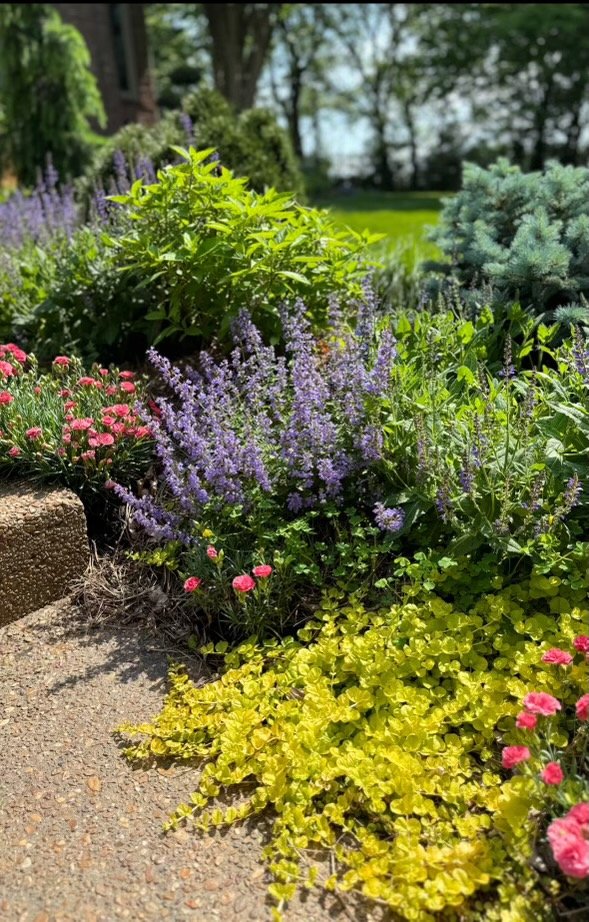
The spring growth allows us to watch and observe the growth of our plantings. How are the plants thriving or not thriving in the space? Is the color palette working? Now is the time to document any future changes we make to the garden.
Take photos. Take notes. The decisions you observe now become the design changes you make next fall or next spring. A garden is never finished. It's a living composition that evolves. The best gardens are made by people who pay attention.
Late May: The Heat Preview
By the last week of May, Nashville starts to feel like summer. Temperatures regularly hit the 80s, humidity rises, and the growing season shifts into a different gear. If you've done the work outlined in this guide: soil tested, pruned correctly, composted, fertilized thoughtfully, mulched properly, and planted in the right window, your garden is set up for success through the summer.
The things that will matter most from June forward: water deeply and infrequently (an inch per week, preferably in the morning, at the soil level rather than overhead), stay ahead of disease (powdery mildew and black spot thrive in Nashville's humidity, fungicide programs for roses should already be in place), and continue deadheading to keep perennials and roses blooming.
The Quick-Reference SPRING MAINTENANCE Calendar
For those who want the whole guide at a glance, pinned to the potting bench:
Early March (Weeks 1–2): Soil test (if you haven't already). Sharpen and clean tools. Cut back all dormant ornamental grasses to 4–6 inches. Cut back last year's perennial foliage. Prune Knock Out and landscape roses. Install peony rings and Baptisia supports over dormant crowns. Remove tattered Helleborus foliage to show flowers. Prune crepe myrtles properly (remove suckers, dead wood, interior twiggy growth, do NOT top). Cut back butterfly bush, beautyberry, and summer-blooming spirea hard. Prune fruit trees while dormant. Remove dead or damaged tree branches you can safely reach from the ground. Do NOT prune oaks after early March.
Mid-March (Weeks 3–4): Top-dress beds with 1–2 inches of compost. Prune panicle and smooth hydrangeas. Prune hybrid tea, floribunda, and grandiflora roses when buds swell. Do NOT prune bigleaf or oakleaf hydrangeas. Do NOT prune azaleas, forsythia, lilac, or any spring-blooming shrubs. Apply slow-release fertilizer to perennial beds as new growth emerges. Feed roses after pruning. Prune summer-blooming shrubs (Vitex, Rose of Sharon) if not done earlier.
Late March / Early April: Apply mulch (pine straw or shredded hardwood, 2–3 inches). Shape hollies and formal evergreen hedges. Thin boxwood interiors for airflow. Lightly shear arborvitae and junipers after new growth emerges (never cut into brown wood). Apply pre-emergent herbicide to beds if desired. Observe light patterns before the canopy fills in. Begin planting container-grown perennials, shrubs, and trees.
Mid-April (After April 15): Gradually remove winter mulch from rose crowns. Plant warm-season perennials and annuals after last frost. Divide overgrown daylilies, hostas, and grasses. Assess drainage after heavy spring rains. Prune azaleas and forsythia after they finish blooming.
Late April / Early May: Install remaining plant supports (peonies, tall phlox, Baptisia). Deadhead finished spring bulbs (leave foliage). Begin regular rose deadheading as first blooms finish. Monitor for powdery mildew and black spot on susceptible plants. Shape spring-flowering trees (dogwood, redbud) after bloom finishes if needed.
May: Maintain moisture — 1 inch per week. Continue deadheading roses and early perennials. Top off mulch in thin areas. Observe the garden: take notes and photos for future design decisions. Prune lilacs immediately after blooming. Enjoy the show.
Why Any of This Matters
I've given you thousands of words about pruning timing and mulch depth and soil pH. And all of it is true and all of it matters. But I want to be honest about something: the reason I care about your garden has almost nothing to do with horticulture.
Something happens when a garden starts to take shape. Something nobody planned for.
You start going outside. Not to check a task off a list. Not to mow. You go out with your coffee in the morning because the light is hitting the Muhly grass a certain way and you want to see it. You sit on the patio after dinner because the garden smells different at dusk: the sweet catmint, the daylilies closing, the soil cooling. You notice a swallowtail butterfly working the coneflowers and you stand there watching it for five minutes, and those are the best five minutes of your day, and you didn't plan them.
Your kids go outside. Not because you told them to, but because a toad is living under the hosta and they want to check on it. Your dog finds a sunny patch in the perennial bed and claims it. You eat dinner outside because the garden made the patio feel like a room worth being in. You have conversations with your partner that you don't have inside the house, because something about being surrounded by living things changes the register of how people talk to each other.
This is what I mean when I talk about a garden being a revolution. Not a dramatic, loud one. A quiet one. One that pulls you off the couch and away from the screen and into a physical reality where the sun is on your skin and there are actual sounds, not notifications, but cardinals and wind and water and the rustling of something alive. A reality where time moves at the speed of a season instead of a news cycle.
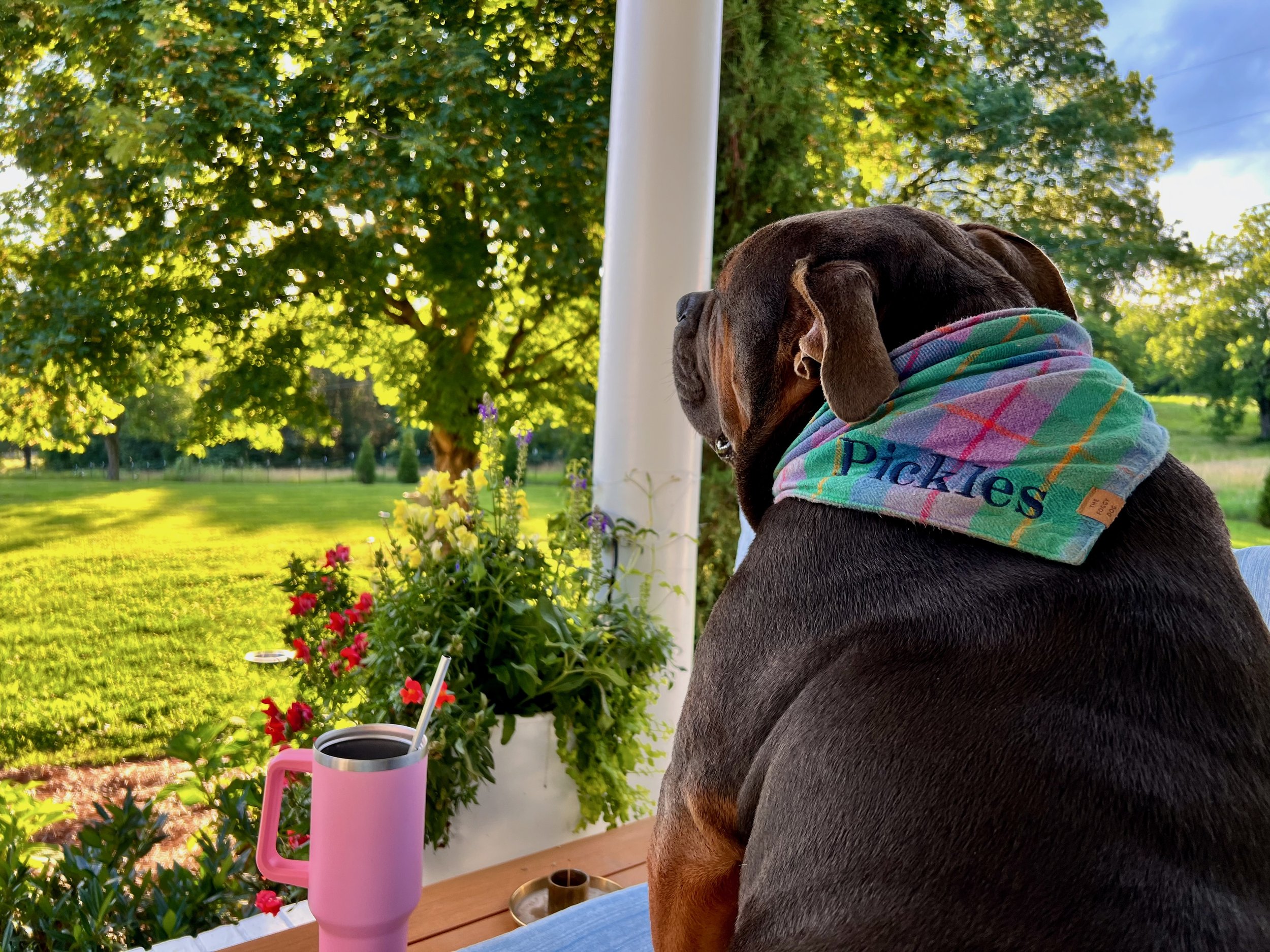
Waiting for the summer sunset on my front porch with my dog, Pickles, an iced tea, and a book is my summertime religion.
We spend so much of our lives in constructed, climate-controlled, digitally mediated environments that we forget what it feels like to simply be outside in a space that was made for us. Not a public park. Not someone else's yard. Yours. A space that reflects how you live, what you love, what brings you peace.
A well-designed garden is not decorating. It's not curb appeal. It's not increasing your property value, although it does that too. It is the creation of a place where your actual life happens, where you breathe slower, notice more, feel the ground under your feet, and remember that you are a living thing in a world of living things. That sounds simple. It is the least simple thing most of us ever do.
Every pruning cut you made this spring, every shovel of compost, every decision about where to put the hydrangeas, it was all in service of that. A place to be alive in.
That's what's worth getting the timing right for.
What TENNESSEE Gardeners Ask Me Every Spring
When should I start spring garden cleanup in Nashville?
Late February through the first week of March. Not April. Not "when it feels warm." Right now. This is the most important maintenance window of the entire year in Middle Tennessee, and most homeowners miss it because they're waiting for spring to feel like spring. By the time the redbuds are blooming and you're thinking about the garden, you're already three weeks behind. The ornamental grasses should be cut. The perennials should be cut. The roses should be pruned or close to it. The compost should be going down. If you do nothing else, do the early March cutback. Everything that happens in your garden from June through October starts with what you do right now.
When should I prune my roses in Nashville?
It depends on which roses you have. Knock Out and landscape shrub roses are the most forgiving; prune them late February through mid-March. Cut back by one-third to one-half, remove dead or crossing canes, open the center. Hybrid teas, grandifloras, and floribundas wait until the third week of March, watch for buds swelling on the canes, small red bumps pushing outward. That's your signal. David Austin English roses do best pruned and fed in mid-February. Climbing roses — leave the main structural canes alone and cut the lateral side branches back to 2–3 buds. And once-blooming old garden roses? Don't touch them in spring. They bloom on old wood. Prune them after they flower in early summer. The Nashville Rose Society recommends working a cup of alfalfa meal or two cups of Mills Mix into the soil around each hybrid tea after pruning. Feed them before you mulch them.
Which hydrangeas should I prune now and which ones should I leave alone?
This is the question that saves or destroys your summer. The rule: if it has cone-shaped flowers or giant white snowballs, prune it now. If it has blue, pink, or purple mopheads or lacecaps, or oakleaf-shaped leaves, don't touch it. Panicle hydrangeas, 'Limelight,' 'Little Lime,' 'Quick Fire,' 'Bobo', prune hard now. They bloom on new wood. Smooth hydrangeas, 'Annabelle,' 'Incrediball', prune hard now, to 6–12 inches. Also new wood. Bigleaf hydrangeas, the classic mopheads in blue and pink, do NOT prune. The flower buds for this summer are already formed on last year's stems. Cut those stems and you cut every flower. Oakleaf hydrangeas, same. Old wood bloomers. Leave them alone until after they flower. If you remember nothing else: cones and snowballs, cut. Mopheads and oakleafs, hands off.
Should I top my crepe myrtle?
No. What you're describing is called crepe murder and it's one of the most visible and most damaging pruning mistakes in Nashville. Topping forces weak shoots from the cut points that can't support the flower clusters, creates permanent knobby scar tissue, and destroys the natural architecture of the tree. A topped crepe myrtle never recovers its form. What you should do: remove suckers from the base, remove dead or crossing branches, thin interior twiggy growth for airflow, and limb up lower branches if they block sightlines. That's it. If your crepe myrtle is too big for its spot, the honest answer is it's the wrong cultivar in the wrong location. 'Natchez' wants to be 25–30 feet. 'Acoma' tops out at 10. The cultivar determines the size. No amount of annual chainsaw work changes that.
When is the last frost date in Nashville?
April 15–23, depending on your microclimate. Low-lying areas and river bottoms frost later. Urban areas with heat-island effects may clear earlier. Hilltops in Sumner County are different from bottomland in Cheatham County. This is an average, not a guarantee. Nashville has had late freezes into the last week of April. Don't plant frost-tender annuals, tropicals, or warm-season vegetables until after April 15 at the earliest. Don't get seduced by the 75-degree days in early April. Nashville always follows those with a 32-degree night. The garden centers put out tropical annuals in March because they want your money. The weather doesn't care about their business model.
When should I fertilize in Nashville?
Mid-to-late March, when you see new growth pushing on perennials and shrubs. Not before. Fertilizing dormant plants is wasted product; the roots aren't actively taking up nutrients yet. For most perennial beds, a single application of balanced, slow-release organic fertilizer (5-5-5 or 10-10-10) when shoots are emerging is sufficient. If you top-dressed with compost earlier in the month, many perennials won't need additional fertilizer at all; compost is gentle, complete nutrition. For roses, feed after pruning with alfalfa meal or Mills Mix. For acid-loving plants like azaleas, rhododendrons, camellias, Japanese maples, use Holly-tone or a similar acidifying fertilizer. And always, always base your fertilizer decisions on a soil test, not a guess. Nashville's alkaline clay locks up nutrients in ways that generic fertilizer advice doesn't account for.
What kind of mulch should I use in Nashville?
I use two kinds and I choose between them based on the design intent. Pine straw in naturalistic areas, woodland gardens, and around acid-loving plants, it interlocks on slopes, stays put, looks natural, and contributes a gentle acidity as it breaks down, which is actually beneficial in our alkaline soil. Shredded hardwood mulch in formal beds, foundation plantings, and high-visibility areas, it provides a polished, manicured look and breaks down into soil-building organic matter. Two to three inches. No more. Keep it 3–4 inches away from trunks, stems, and crowns. And never dyed mulch. The fire-engine-red stuff makes me cringe from a design standpoint and the dyes don't break down as naturally. The mulch volcanoes you see piled a foot deep against tree trunks at commercial properties? That's malpractice. It smothers roots, traps moisture against bark, causes crown rot, and creates habitat for voles.
Can I prune my azaleas in spring?
Not before they bloom. Azaleas set their flower buds the previous year, those fat, rounded buds at the branch tips right now ARE this spring's flowers. If you shear them in February or March, you shear off the entire show. Wait until they finish blooming, typically late April through May, and prune then. If you need to rejuvenate a badly overgrown azalea, you can cut it back hard, even to 12 inches, immediately after bloom and it will regrow. But doing that in winter or early spring means no flowers for at least a year. The same rule applies to forsythia, lilac, flowering quince, bridal wreath spirea, and most viburnums. If it blooms in spring, the buds are already there. Leave it alone until after it flowers.
When should I plant new trees and shrubs in Nashville?
You have two windows. The spring window runs from mid-April through late May, after last frost, before summer heat makes establishment brutal. The fall window, October through November, is actually better. The soil is still warm, roots establish through our mild winter, and by the time the first Nashville summer arrives, the plant has months of root development that a spring planting doesn't. If you can wait until fall for your major woody plants, do it. For perennials, spring is fine, divide and transplant daylilies, hostas, and ornamental grasses now while they're still small. Don't try to divide Baptisia, it has a deep taproot and resents it.
How do I know if my soil needs compost or fertilizer?
Get the $15 soil test from the UT Extension. It'll tell you exactly what you have and what you need. But as a general rule for Nashville clay: compost first, fertilizer second. Compost improves soil structure, it physically changes the clay over time, creating air pockets that improve drainage and root growth. Fertilizer feeds the plant but does nothing for the soil. Nashville's heavy clay needs structure more than it needs nutrients. One to two inches of quality compost top-dressed over your beds annually is the single best thing you can do for your garden. It feeds the soil biology, the earthworms and microbes, that transform dense, airless clay into living soil. No bag of synthetic fertilizer does that.
Why do my ornamental grasses flop?
Three possible reasons. One: too much shade. Most warm-season grasses need full sun, six or more hours, to develop strong, upright stems. In partial shade, they stretch toward light and fall over. Two: too much nitrogen. Heavy fertilizing pushes fast, weak growth. Most grasses don't need fertilizer at all in Nashville's nutrient-rich clay. Three: you didn't cut them back hard enough in late winter. Grasses should be cut to 4–6 inches in early March before new growth emerges. If you left last year's growth standing too long and new shoots are growing through it, the old growth weighs the plant down. And if your Baptisia is the thing that's flopping, that's a support issue. Install a peony ring or grow-through grid over the crown right now, before the shoots are six inches tall. Once Baptisia starts leaning, it's too late.
Should I prune my fruit trees now?
Yes. Late winter while fully dormant is the ideal pruning window for apples, pears, peaches, and plums in Nashville. Remove dead wood, crossing branches, and water sprouts — the vigorous vertical shoots growing from horizontal branches. Open the center of the tree for light and airflow. Peaches and nectarines need more aggressive annual pruning than apples because they fruit on one-year-old wood. You want to encourage fresh growth every year. Do this now, through early March. Don't prune fruit trees once they start blooming.
When should I prune my oaks?
Now. Late winter through early March while dormant. And then stop. Do not prune oaks from April through July. Open wounds during warm months attract the beetles that carry oak wilt, a devastating vascular disease that Tennessee has confirmed cases of. It spreads through both root grafts and insect vectors. If you must prune an oak during the growing season, storm damage, for instance, seal the wound immediately with pruning paint. That's one of the very few situations where pruning paint is actually recommended.
What should be blooming in my Nashville garden by mid-April?
If your garden is healthy and well-maintained, you should see: daffodils and early tulips finishing, forsythia and flowering quince finishing, redbuds and dogwoods at or near peak, azaleas beginning to bloom in warmer microclimates, Lenten Roses in full bloom, Creeping Phlox coloring up on sunny slopes, Brunnera 'Jack Frost' showing blue flowers, early iris starting to show color, and new perennial foliage visible on most plants. If your spring-blooming shrubs are leafing out but not flowering, the most common cause is incorrect pruning. Someone cut them at the wrong time and removed the flower buds. Second most common: too much shade. Third: inadequate chill hours from an unusually warm winter, which is happening more frequently in Nashville.
One Last Thing
Everything in this guide is designed to put your garden in the strongest possible position for summer. But here's what no guide can tell you: what your specific property needs, with its specific soil, its specific light, its specific drainage, its specific microclimates, and the specific composition you're trying to create.
A garden is not a list of tasks. It's a living, evolving work that responds to the hand that shapes it. The best spring maintenance in the world is still just maintenance if it isn't in service of a vision. And the best vision accounts for the site, the soil, the light, the architecture, the way you move through the space, and the feeling you want when you step outside.
That's what I do. If you'd like someone who thinks about gardens this way, not as a collection of plants, but as a composition, I'd love to hear about your property.