
The Garden Is the Art: On Composition, Chaos, and the Oldest Installation on Earth
Why gardens are the most complete artwork a human being can make — and why the people who understood this best were painters.
I have a confession that will probably make some fellow MFAs uncomfortable.
I left the studio.
Not because I stopped being an artist. Because I found a bigger canvas. One that breathes, grows, dies back, returns, smells like warm earth after rain, sounds like switchgrass in an October wind, and has never once stayed the way I left it. I paint. I make sculpture. But the work that asks the most of everything I learned — about composition, color, scale, the way light behaves across a surface, the way a human body moves through space — is the work I do in the ground.
I design gardens. And I need to tell you something about gardens that I think we've collectively forgotten.
The First Installation Art Wasn't in a Gallery. It Was in Mesopotamia.
We talk about installation art like it was invented in the 1960s. As if Allan Kaprow and the Happenings crowd discovered that art could be immersive, environmental, something you walk into rather than stand in front of.
They didn't discover it. They remembered it.
The sacred gardens of ancient Mesopotamia — we're talking 2,600 years ago — were total environments designed to engage every sense simultaneously. The plantings were symbolic: date palms for abundance, pomegranates for fertility, cypress for the eternal. Water channels mapped the rivers of paradise. The spatial arrangement encoded cosmology. You didn't look at these gardens. You entered them. You moved through a composed world where scent, sound, shade, light, texture underfoot, and the theological weight of every living element combined into a single, unified, immersive experience.
That is installation art. That is environmental art. That is everything the contemporary art world congratulates itself for inventing, pre-dating it by millennia.
And here's the thing that gets me — the thing I keep turning over — the garden does something that no gallery installation has ever done or can do. It's alive. The materials have their own agenda. They grow toward the light whether you want them to or not. They bloom when the chemistry tells them to, not when you open the exhibition. They die. They come back different. The beetles find them. The hummingbirds find them. A frost rewrites the composition overnight.
No other art form collaborates with that many uncontrollable forces. Not one.
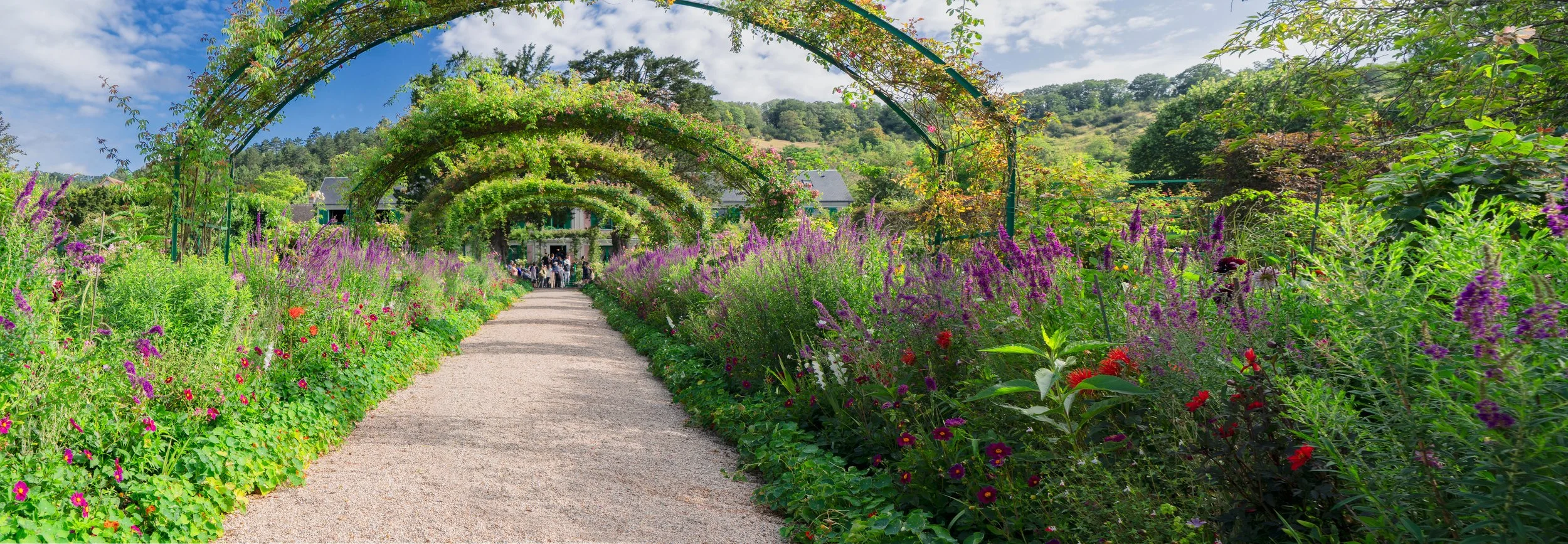
Monet Was Not a Painter Who Gardened. He Was a Gardener Who Painted.
I think we get the story of Giverny backwards.
The conventional narrative goes: Monet, the great painter, made a beautiful garden, and then — lucky us — he painted it. As if the garden was the subject and the paintings were the art.
I think the garden was the art. The paintings were documentation.
Think about what he actually did at Giverny for thirty years. He arranged plantings by color temperature — warm drifts against cool masses, the way he layered pigment. He designed beds to dissolve at their edges, colors bleeding into each other the way they do in the late water lily canvases. The famous Japanese bridge isn't architecture. It's a compositional device — a horizontal line that anchors the reflection, that divides the canvas of the water garden into zones the way a horizon line divides a landscape painting. And the water itself — that mirror — doubles every element, creating a composition that exists simultaneously above and below the surface. The garden is the painting. The painting is a record of the garden. They're the same work in two different media.
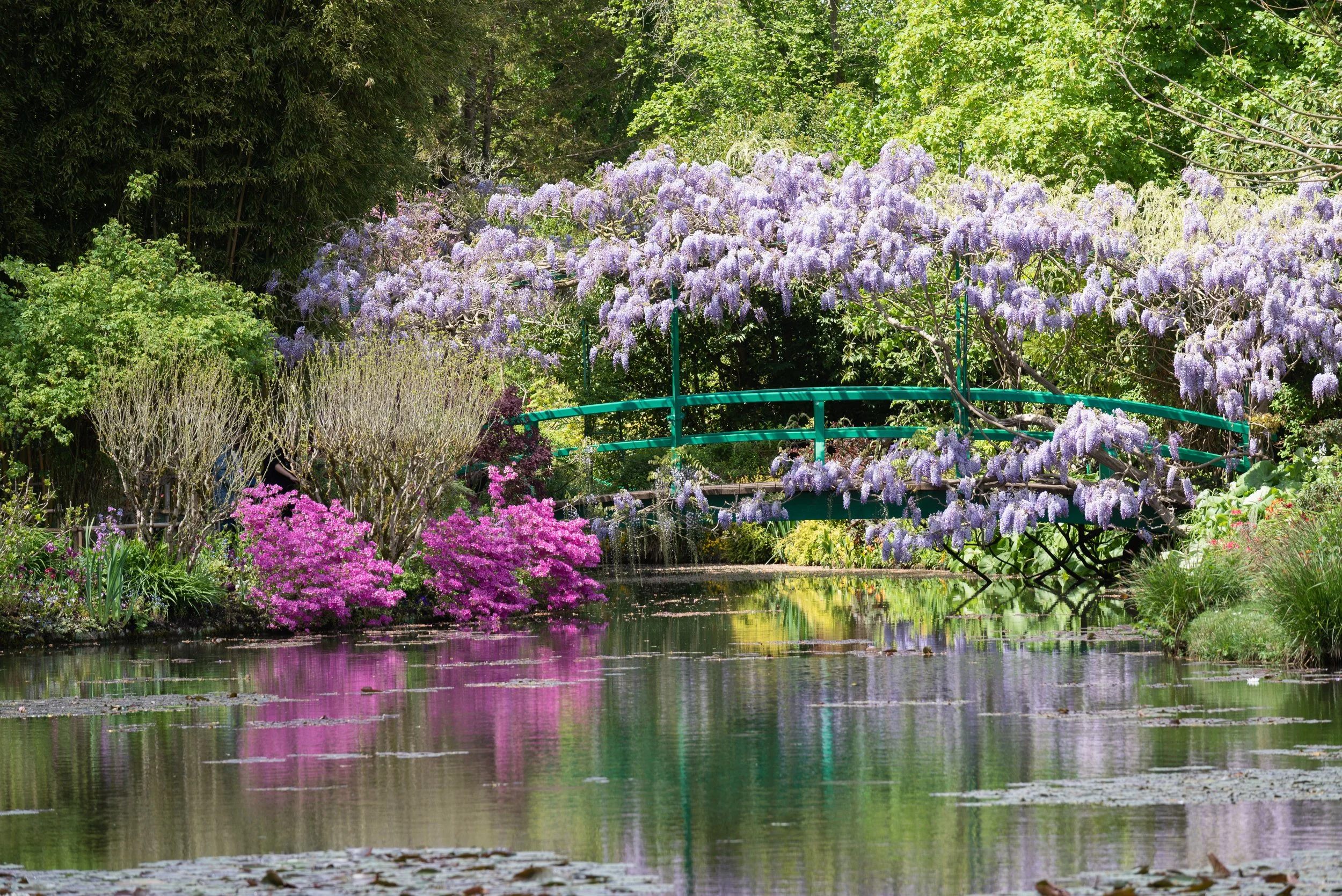
When I walk a property for the first time, this is what's happening in my head. I'm not thinking about plants yet. I'm seeing the space the way I'd see a blank canvas. Where is the weight? Where does the eye enter? What's the dominant color temperature across seasons — and what happens if I push it? Where does the light come from at 8 a.m., and where does it come from at 5 p.m., and how do those two completely different lightings make this the same space and not the same space?
Monet understood that a garden is a painting you walk into. One that repays the same kind of close looking. One that changes with the light the way a Rothko changes depending on where you're standing.
I don't think that understanding is common in my profession. I think most landscape work treats the ground as a surface to be decorated. Monet treated it as a surface to be composed. There's a universe of difference between those two things.
What Bosch Knew About Eden
Hieronymus Bosch's The Garden of Earthly Delights hangs in the Prado, and I have stood in front of it for longer than is probably socially appropriate.
The center panel — the garden itself — does something compositionally that I've never been able to get out of my head. There is no focal point. There is no hierarchy. There is no "subject" in the foreground and "background" receding politely behind it. Every square inch is equally active. Figures, plants, water, animals, and impossible fruits exist at every scale simultaneously. The eye cannot settle. It moves constantly — finding a new relationship, a new interaction, a new strange tenderness between a human and a bird the size of a horse — and every time you think you've seen the whole painting, something in the periphery pulls you in again.
This is how a garden actually works. Not how we photograph gardens — we photograph them with a focal point, a hero plant, a composed vignette framed by the camera. But how we experience them, with our bodies, in motion, over time. You walk through a garden and the composition shifts with every step. What was beside you is now behind you. What was background is now the thing you're standing inside of. A garden has no frame. It surrounds you. You are in the painting.
Bosch painted that quality of total immersion onto a flat surface. A garden designer builds it in four dimensions — three of space and one of time. The question is whether you compose that immersion deliberately, or whether it happens accidentally. Because it happens either way. The question is just whether it's good.
Sarah Sze and the Problem of Every Angle
If you've ever walked through a Sarah Sze installation, you understand something about gardens whether you know it or not.
Sze builds these sprawling, intricate, impossibly precise assemblages that fill a room — paper, wire, plants, fans, projections, everyday objects organized into systems that seem to breathe. There is no "front." You walk around the work and the composition reorganizes from every new vantage point. What looks like chaos from here resolves into crystalline order from three feet to the left. She builds for every scale simultaneously — the whole room, the middle distance, the tiny detail that you only see when you lean in close.
This absolutely wrecked me when I first encountered it, because it described the design problem of a garden more precisely than anything I'd read in any landscape architecture textbook.
A garden is not experienced from a single point. It's experienced from the kitchen window while you're making coffee, barely looking. It's experienced from the front path at walking speed. From the car at 35 miles per hour as you pull in the driveway. From a chair on the patio at eye level with the middle layer of the bed, close enough to watch a hummingbird work a bloom of Red Hot Poker three feet from your face. From a child's height — looking up through the canopy at the sky, which is a composition most adults have entirely forgotten exists.
Each of those is a different composition. Each has to work.
This is why I can spend twenty minutes deciding where a single tree goes. Not because I'm indecisive. Because moving it six feet to the left changes its relationship to the house, to the sightline from the bedroom, to the way it catches afternoon light, to whether it frames or blocks the treeline beyond the property — which is also part of the composition, whether you planted it or not. The Japanese concept of shakkei, the borrowed view, understood this: the landscape beyond your boundary is already in your painting. You either compose with it or you ignore it. Ignoring it is still a choice, and usually a bad one.
Sze taught me that the work has to hold from every direction. A garden that looks beautiful from the back door and meaningless from the street is a failed composition. Not a partial success. A failure. Because the experience of a garden is total, or it isn't.
Goldsworthy, and the Part Where You Let Go
I love Andy Goldsworthy's work for the most uncomfortable reason: it insists on disappearing.
A line of leaves laid on water. An arch of icicles that collapses by noon. A cairn of balanced stones that the river reclaims. He makes his most beautiful things out of materials that are already in the process of leaving, and the transience is the point. The work exists fully only for a moment, and the photograph he takes is not the art — it's the elegy.
Every garden is a Goldsworthy piece whether the designer intended it or not. This is the part that terrifies people who like control, and it is my favorite part.
I plant Hellebore 'Ice N' Roses Red' under a bare Redbud and I know — I know — that in February, those deep red cups blooming against cold ground and naked branches will be the most beautiful thing in the garden. For exactly three weeks. And then the Redbud blooms, and the composition is entirely different. And then the canopy fills in, and the Hellebores disappear into shade, and the garden forgets that moment ever happened. Except it doesn't forget. The moment is designed into the structure. It will return next February and be just as brief and just as complete.
The Baptisia 'Burgundy Blast' I planted as an 18-inch mound is a four-foot structural presence by year three, and the bed's proportions have fundamentally shifted. The Switchgrass 'Northwind' I placed for its summer verticality catches December frost and becomes something I never drew on paper but somehow knew would happen because I've watched these plants long enough to know their trajectories the way you know the arc of a friend's gesture.
This is designing with time as a material. Not fighting it. Not maintaining against it. Working with the understanding that the garden on installation day is a sketch, and the real composition unfolds over years, shaped by frost and drought and the absolute insistence of living things on becoming themselves.
I do this on my own farm. I watch. I watch the light cross a field at a speed you can almost track with your eye in September. I watch a stand of grasses go from green to gold to silver over three months, and I think about where I'd be standing in a painting if this were a painting, and what Monet would do with that gold against the tree line, and what Goldsworthy would say about the fact that it's already gone by the time I've finished thinking about it.
It's all already gone. That's the medium. That's what makes it the bravest art form there is.
The Total Work
Here is what I keep coming back to, the thing I haven't been able to say concisely because it isn't concise. It's the whole argument.
A painting engages the eye. Music engages the ear. Sculpture adds the body moving in space. Food adds taste and smell. Theater adds narrative and time. But a garden — a real garden, a composed garden, a garden that someone built with intention and awareness and a trained eye — engages all of it at once.
Sight: the color, the form, the way light falls through a canopy and dapples a stone path.
Sound: wind through ornamental grasses, water moving over rock, the buzz of a pollinator arriving.
Smell: Vitex in July, the petrichor rising from warm clay after a summer storm, the green sharp scent of rosemary when your hand brushes it on the way to the mailbox.
Touch: the cool shock of flagstone on bare feet in the morning, Lamb's Ear under a child's fingers, the difference between gravel and moss and mulch underfoot.
Temperature: the ten-degree drop when you step from an open sunny path into the shade of a canopy — a physical, felt transition that I design as deliberately as any visual element.
Time: the February Hellebore. The July Vitex. The October switchgrass. The bare architecture of winter branches. The same space, transformed and transformed again, and you are in the middle of it, inside the work, aging with it, changing with it, alive inside something alive.
Wagner called this idea the Gesamtkunstwerk — the total work of art — and tried to achieve it in opera. He got close. But he was working in a theater, with fixed seats and a proscenium arch and an audience that goes home at intermission.
A garden has no proscenium. No intermission. No separation between the work and the one experiencing it. You are in it. It is around you. It is responding to the same weather you are responding to, in real time, right now.
The Mesopotamians knew this. Monet knew this. I know it in my bones.
A Garden Is Not a Decorating Project
I wrote all of this — the art history, the compositional theory, the references to Bosch and Sze and Goldsworthy — not to convince anyone to hire me. I wrote it because I believe it, and because I think we've lost something important in the way we talk about gardens.
Somewhere along the way, the garden got demoted. It became "landscaping" — a service category between painting your house and pressure-washing your driveway. Something you do to improve curb appeal or raise your property value. Something measured in square footage of mulch and number of plants per bed.
That is a profound loss. Because the garden is the oldest continuous art form humans have practiced. It predates easel painting by millennia. It predates architecture as we understand it. It is the original human impulse to take a piece of the living world and compose it into something that means more than the sum of its parts.
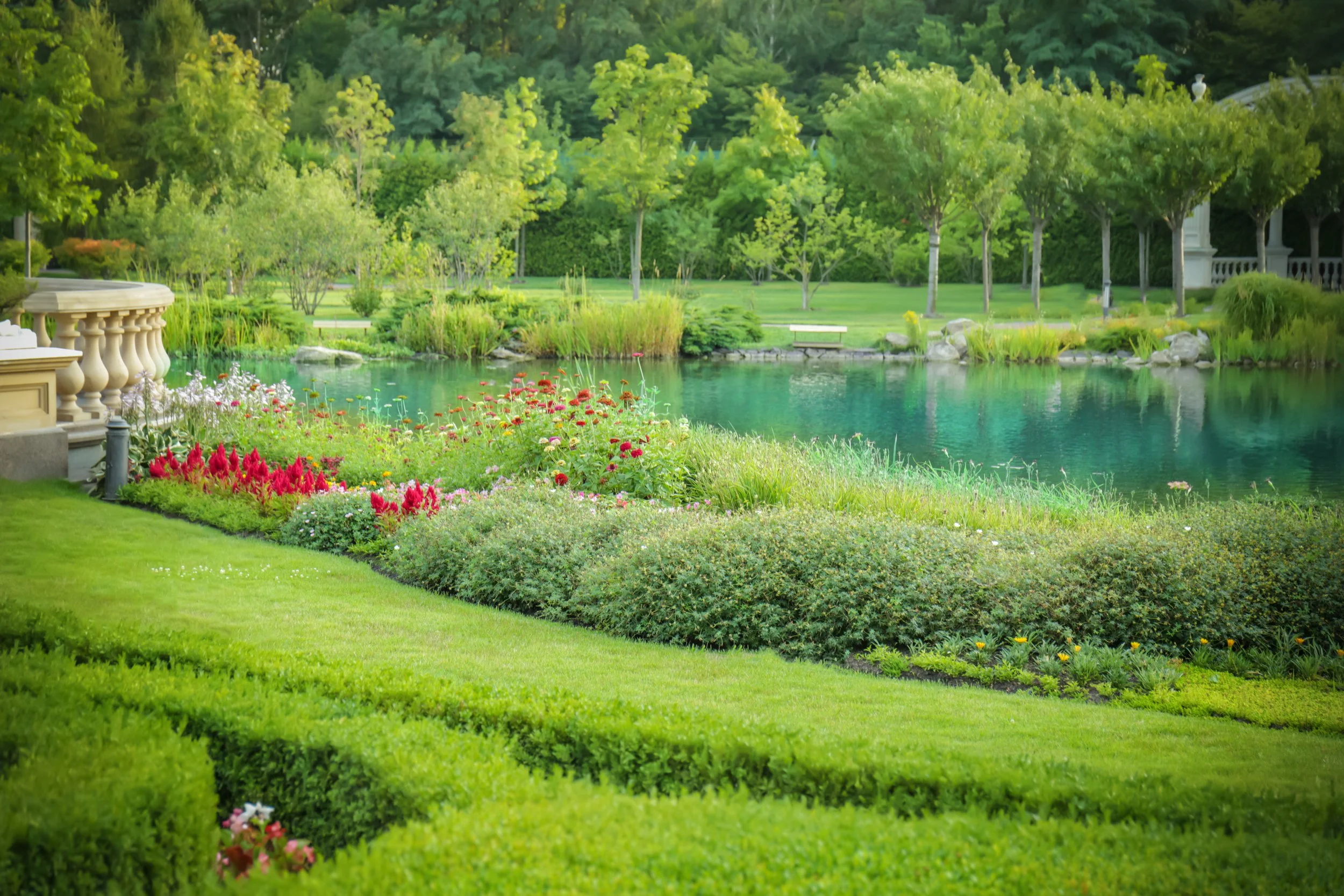
Every time I put my hands in the dirt — on my farm, on a client's property, anywhere the ground will let me — I am participating in a tradition that stretches back to the first human who looked at a wild landscape, imagined it differently, and started moving things around. Not to control nature. To collaborate with it. To make something that is part human intention and part the earth doing whatever it was going to do anyway, and to find the beauty in that negotiation.
That's what a garden is. A negotiation between what you want and what the land will give you. Between your composition and its chaos. Between the thing you designed in January on paper and the thing that's actually growing in August in the heat and the clay and the light.
I wouldn't trade this medium for any other.
If any of this resonated — if you read this and thought yes, this is how I feel about my space, or how I want to feel about it, or I've never heard anyone talk about gardens this way and I want to keep talking — I'd genuinely love to hear from you. Not because I'm looking for a client. Because the people who care about this stuff tend to find each other, and that conversation is one of my favorite things in the world.
Say hello. Tell me what you're noticing in your garden. Tell me what you're reading. Tell me which artist changed the way you see space. I'll tell you about mine.
We'll go from there.