
The Tennessee Pollinator Plant List: 40+ Native Species, Organized by Bloom Season, for Zone 7a / 7b Clay
A designer's cultivar-level guide to building a pollinator garden that feeds the whole food web, from the first mining bee in March to the last migrating monarch in October.
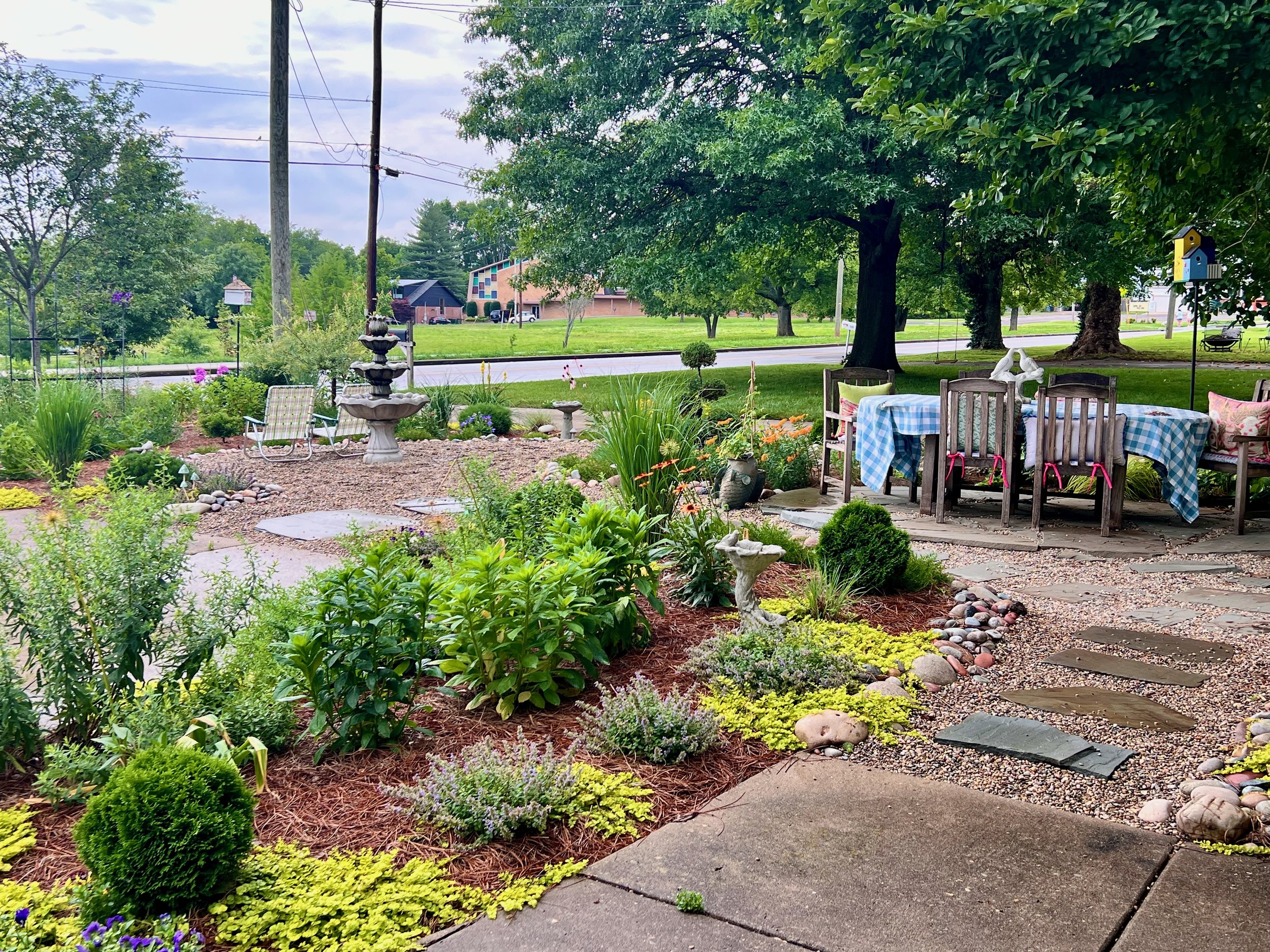
A lawnless front yard pollinator garden coming to life in its first season in the middle of Nashville.
I already wrote about how to design a native pollinator garden that's beautiful, not just beneficial. This is the companion piece. The plant-by-plant reference that tells you exactly what to put in the ground, when it blooms, what it feeds, and how it actually behaves in Nashville clay. If that post was the philosophy, this is the field guide.
But before I get into the list, there's something most pollinator garden guides get wrong, and it changes how you think about the entire project.
A Pollinator Garden Isn't Really a Pollinator Garden. It's a Habitat.
Every article you'll read about pollinator gardens talks about bees and butterflies. As if the goal is a pretty border that attracts some nice insects and maybe a hummingbird, and then the job is done.
That's a fraction of what actually happens when you plant natives in Tennessee clay.
What happens is an ecosystem. A literal food web, with layers you didn't plan for and can't fully control.
You plant mountain mint because it draws pollinators. It does. More than almost anything else you can grow. But the native bees foraging on your mountain mint become food for the Carolina wren nesting in the brush pile at the edge of your garden. The wren's fledglings attract the black rat snake that patrols your property line.
The caterpillars feeding across your native plants, the tent caterpillars and webworms and moth larvae that thrive in a healthy garden, become food for the yellow-billed cuckoo, a bird most Nashville homeowners have never heard because there's nothing in their yard to support it. The Tennessee Wildlife Resources Agency describes it as common in Tennessee during breeding season but "not easily seen because of its habit of waiting motionless for long periods watching for an insect or caterpillar." A single cuckoo can eat a hundred caterpillars in a sitting.
No. Really.
The spent seed heads of your coneflowers and goldenrod sustain goldfinches and juncos through winter. The leaf litter under your little bluestem shelters overwintering native bees and also the American toad that eats the slugs that would otherwise devour your hostas. The dense root systems of your native grasses stabilize soil for ground-nesting bees, and the tunnels those bees leave behind improve the drainage in your clay.
And then there's the eastern box turtle. Tennessee's state reptile. A species that's declining because of habitat loss, and an animal that depends on the berry-producing shrubs and the insect populations that a native planting supports. A box turtle can live 30 to 50 years in the wild, and some have been documented well past 100. It has such strong site fidelity that it may spend its entire life within a small home range, returning to the same overwintering spots, the same feeding grounds, year after year for decades. If your property provides habitat for one, you may be looking at the same turtle from your porch for the rest of your life.
I know this because I live inside it.
I designed the pollinator garden on my farm to wrap around my front porch and house so I could watch the whole system work from where I actually live. Morning coffee, and the hummingbirds are already on the coral honeysuckle. The swallowtails are on the coneflowers by ten. By July, the mountain mint is so thick with bees and wasps that it hums. That's what I designed for. I call this approach Inhabitation Design.
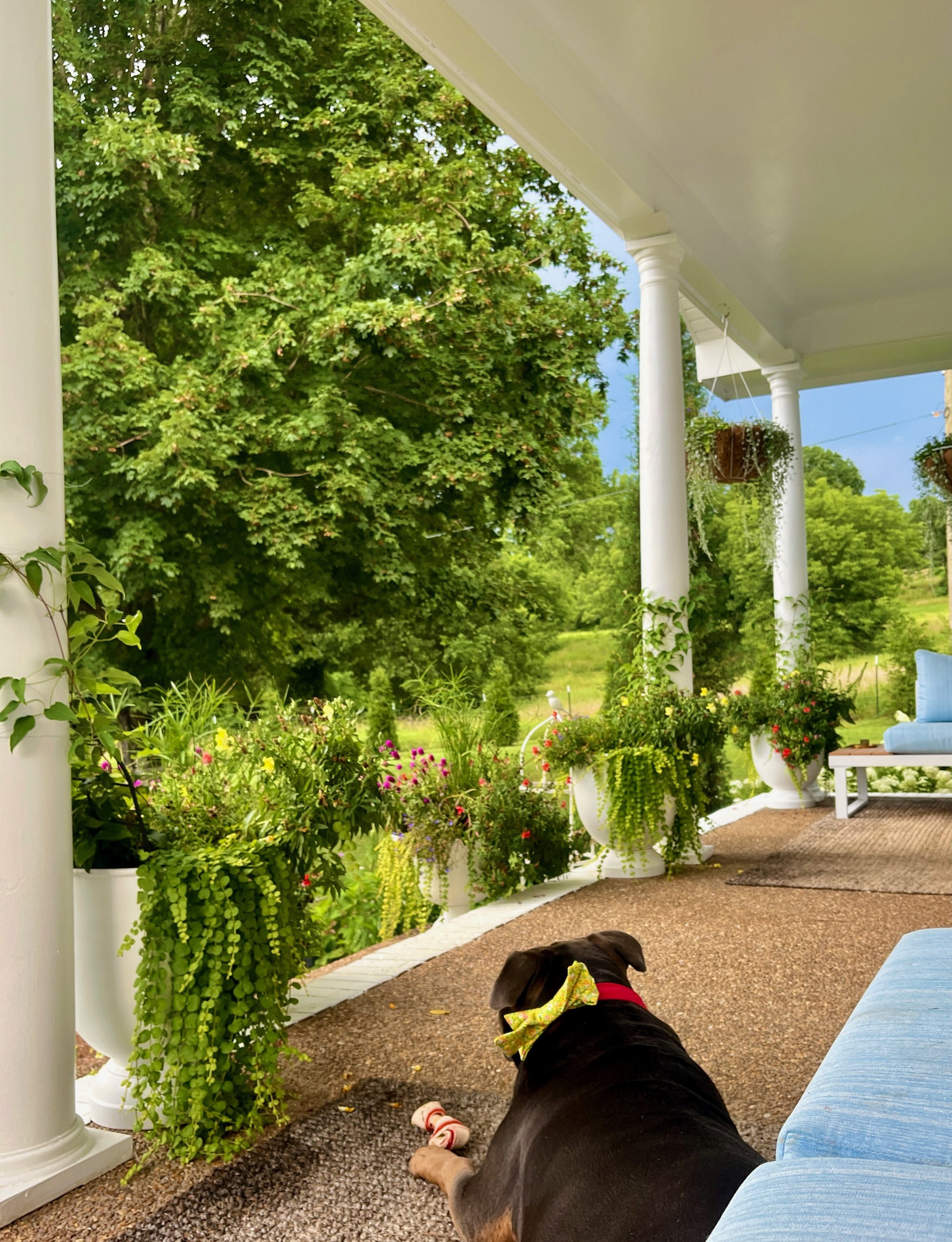
My dog, Pickles, has become an avid birder.
What showed up alongside it is everything else. Teddy the box turtle, who takes up residence under my mountain laurel from June through August every single year. I named him. He comes back. The snake skins I find when I'm weeding, shed by the rat snakes and king snakes that patrol the beds because my garden is full of the things they eat. The paper wasps building under the eaves. The toads I nearly step on in the mulch at dusk.
The wasps that make you flinch are eating the caterpillars that would eat your tomatoes. The snake that startles you is eating the voles that would girdle your young trees. Teddy is eating the slugs and the fallen beautyberries and doing whatever box turtles do under a mountain laurel all summer. I wouldn't trade a single one of them for a tidier yard.
Snakes get a terrible rap, and they deserve better. They provide our gardens, our properties, our world with incredible benefit. They are rodent control, pest management, and a functioning link in the food chain that keeps everything else in balance. And unless you're face to face with a 20-foot anaconda or reticulated python, you are not their prey. The rat snake in your coneflower bed wants your mice. It does not want you.
You can't invite half an ecosystem. It comes as a package, and the package is what makes it work. When you plant a native pollinator garden in Middle Tennessee, you're inviting an entire community of living things to move in. Bees, butterflies, birds, toads, box turtles, beneficial snakes, lightning bugs, predatory wasps that keep your actual pest populations in check, and soil organisms that will improve your clay over years in ways no amendment can match. The garden becomes a living system, and a living system, once established, largely takes care of itself.
Every plant on this list was chosen with that full picture in mind.
How This List Is Organized
By bloom season. Because the single most important thing in a pollinator garden is continuity. An unbroken chain of nectar and pollen from early March through hard frost in late October. A gap of even two weeks in midsummer can cause native bees to abandon your garden and forage elsewhere. Think of it like keeping a restaurant open: if you close for lunch, your regulars go down the street and they might not come back.
For each plant I'm giving you the cultivar or species name, the bloom window in Nashville, what pollinators and wildlife it specifically supports, its height and habit, its honest behavior in our clay, and how I use it in a design. If you want the full list of Nashville-adapted plants beyond just pollinators, my main plant guide is here.
I'm also noting sun requirements honestly, because half the properties I work on in Davidson and Williamson County have significant shade from mature canopy trees, and most pollinator guides pretend shade doesn't exist.
Early Spring: March through April
This is the most critical and most underplanted window. Native bees, including mining bees, mason bees, and early bumblebee queens, emerge when soil temperatures hit the mid-50s. They're coming out of the ground hungry, often before the last frost. If there's nothing blooming, they starve or leave. These early plants are not optional.
Virginia Bluebells (Mertensia virginica)
Bloom: March through April. One of the first natives to appear and one of the most beautiful.
Wildlife value: Early-emerging bumblebee queens and mason bees depend on this plant when almost nothing else is open. Long-tongued bees, anthophorid (digger) bees, skippers, and even sphinx moths visit as well. It's one of the most important early nectar sources in the woodland food web.
Height/Habit: 12 to 18 inches. A spring ephemeral. It blooms, sets seed, and disappears entirely by June. Gone. No trace. This is a design opportunity, not a flaw. I plant it among later-emerging perennials like coneflowers and mountain mint that fill the space once the bluebells vanish.
In Nashville clay: Handles heavy clay and part shade beautifully. Prefers moist conditions in spring, which Nashville's spring rains provide without effort. Thrives under deciduous canopy because it does all its work before the trees leaf out and then goes dormant in the shade, which is exactly what it wants.
Design note: Plant in drifts of 12 or more for real visual impact. The blue-to-pink flower clusters against bare spring ground are arresting. They naturalize gently. More each year without becoming aggressive.
Golden Alexanders (Zizia aurea)
Bloom: April through May. Flat-topped clusters of tiny yellow flowers.
Wildlife value: This is a host plant for the black swallowtail butterfly, meaning the caterpillars eat it. That matters. A pollinator garden that only provides nectar and never hosts larvae is a restaurant with no nursery. Golden Alexanders also draws small native bees, parasitic wasps (beneficial, they control pest caterpillars), and early syrphid flies.
Height/Habit: 18 to 24 inches. Tidy, upright, well-mannered. Self-sows moderately.
In Nashville clay: Native to the Middle Tennessee understory. Handles clay, part shade, and seasonal moisture without complaint.
Design note: Use it in the mid-border to bridge the gap between the spring ephemerals and the summer perennials. Its yellow is warm and works beautifully against the blue of remaining bluebells.
Eastern Columbine (Aquilegia canadensis)
Bloom: April through May. Red and yellow pendulous flowers that look like tiny lanterns.
Wildlife value: One of the earliest nectar sources for ruby-throated hummingbirds arriving on spring migration. Also draws bumblebees with long tongues that work the spurs. The seeds feed small songbirds.
Height/Habit: 12 to 24 inches. Delicate, airy. Self-sows freely in favorable conditions.
In Nashville clay: Prefers well-drained spots in part shade. A slope, a raised edge, a rocky area. In the right spot it's perennial and self-sustaining. In wet flat clay it rots.
Design note: Tuck it into rock crevices, along stone walls, or at the edge of a shaded path. It naturalizes into unexpected spots and that's part of its charm. It looks like it chose to be there.
Bloodroot (Sanguinaria canadensis)
Bloom: March through April. Ephemeral white flowers, sometimes the very first native bloom of the season.
Wildlife value: Critical early pollen source for mining bees (Andrena species) emerging from the ground when almost nothing else is open yet. Bloodroot produces no nectar at all. It relies entirely on pollen to attract visitors, and the mining bees that come for the pollen are its primary pollinators. Sweat bees (Lasioglossum) also collect pollen from it. These are the bees nobody talks about. Small, solitary, ground-nesting. They need bloodroot.
Height/Habit: 6 to 8 inches. Spring ephemeral like bluebells. Blooms, unfurls its lobed leaves, and goes dormant by midsummer.
In Nashville clay: Woodland plant. Shade to part shade. Needs moisture in spring but tolerates dry summer dormancy. Handles clay if there's decent organic matter in the top few inches.
Design note: Plant at the base of trees, along shaded paths, near hellebores and ferns. It's a quiet plant, nothing showy. But when it blooms in March against bare ground, it's the first signal that the garden is waking up.
Late Spring: May through Early June
The garden is filling in. Canopies are leafing out, which means your shade conditions are shifting dramatically. This is when sun-dependent plants need to be in full-sun positions and shade-tolerant species need to be where the canopy will protect them.
Wild Geranium (Geranium maculatum)
Bloom: May. Lavender-pink flowers above deeply cut leaves.
Wildlife value: Native bees, particularly andrenid bees and halictid (sweat) bees. Not flashy to us, but critically important to the small pollinators that do the majority of the actual pollination work in a garden.
Height/Habit: 12 to 18 inches. Lovely mounding habit. Good fall foliage color as a bonus.
In Nashville clay: One of the toughest shade-tolerant natives for clay. Handles dry shade once established, which is the hardest condition in Nashville gardening.
Beardtongue (Penstemon digitalis 'Husker's Red')
Bloom: May through June. White tubular flower spikes above dark burgundy foliage.
Wildlife value: The tubular flowers are specifically shaped for long-tongued bees, particularly bumblebees. Also visited by hummingbirds. The foliage hosts moth caterpillars that become bird food.
Height/Habit: 24 to 30 inches. Upright, structural. The burgundy foliage provides color contrast even before it blooms.
In Nashville clay: Tough. Clay, drought, heat. Self-sows gently, which is what you want in a naturalistic planting.
Design note: I use this in almost every native design because the dark foliage does compositional work that green-leaved plants can't. It anchors a section of the bed the way a dark value anchors a painting.
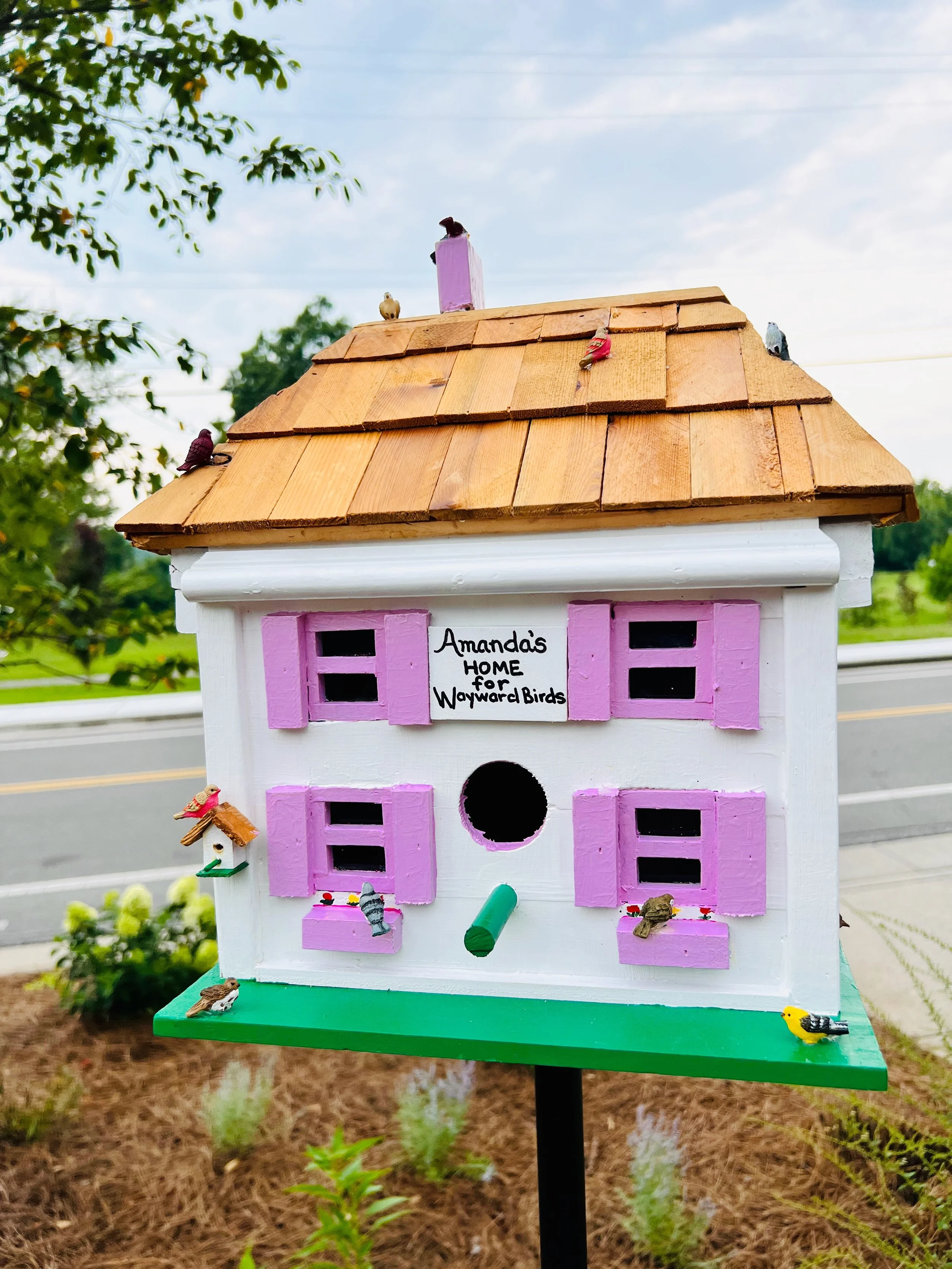
While birds are feeding in pollinator gardens; they are also nesting. I created this custom birdhouse for my client’s birds to have a place to nest and a reason to stay during the spring season.
Spiderwort (Tradescantia ohiensis)
Bloom: May through June. Three-petaled blue-purple flowers that open in the morning and close by afternoon.
Wildlife value: Bumblebees work these flowers intensely in the morning hours. Syrphid flies and small native bees visit throughout the bloom. Deer don't touch it.
Height/Habit: 18 to 24 inches. Can get floppy by midsummer. Cut it back hard after blooming and it'll often rebloom in fall.
In Nashville clay: Native to this exact soil. Handles wet clay, dry clay, sun, part shade. Almost impossible to kill.
Coral Honeysuckle (Lonicera sempervirens)
Bloom: May through July, then sporadically through fall. Tubular red-orange flowers.
Wildlife value: This is the native honeysuckle, not the invasive Japanese one that's eating Tennessee's roadsides. One of the best hummingbird plants available. Trumpet-shaped flowers are perfectly designed for hummingbird bills. The red berries feed migrating songbirds in fall: thrushes, catbirds, waxwings.
Height/Habit: A twining vine, 10 to 20 feet. Needs a support. A trellis, a fence, a dead snag.
In Nashville clay: Tough, adaptable, semi-evergreen in our zone.
Design note: Train it on a fence or arbor. It provides vertical interest in a garden that's otherwise all horizontal perennial beds, and the hummingbird traffic it draws is constant.
High Summer: June through August
This is the main event. The garden should be at full power when the heat is at its worst, because this is when pollinators are working hardest. Building nests, raising young, storing resources for winter. A garden that goes quiet in July is failing at its job.
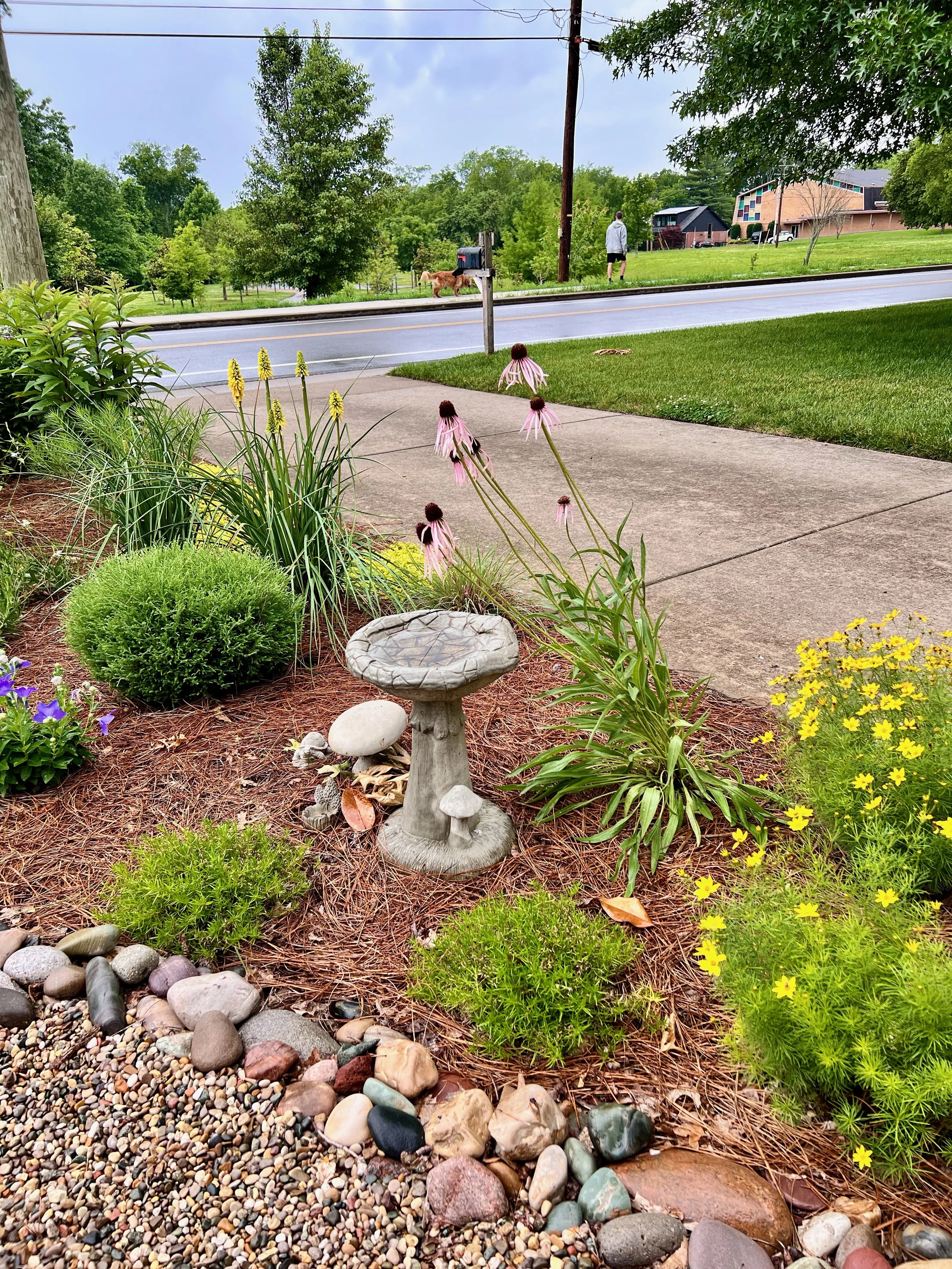
Pale Pink Coneflower, Echinacea pallida, is a gorgeous cultivar with weeping petals.
Purple Coneflower (Echinacea purpurea: 'Magnus', 'Tiki Torch', Kismet Series)
Bloom: June through September. The backbone of any Tennessee pollinator garden.
Wildlife value: Bumblebees, honeybees, sweat bees, mining bees, soldier beetles, and multiple butterfly species including painted ladies, fritillaries, and swallowtails all visit the flowers. Leave the seed heads standing in fall and winter. Goldfinches eat the seeds through January. The dried stems provide overwintering habitat for stem-nesting native bees. This one plant feeds pollinators, seeds birds, and houses next year's bees.
Height/Habit: 2 to 4 feet depending on cultivar. 'Magnus' is the standard large purple. 'Tiki Torch' is warm orange and stunning. The Kismet series gives you yellow and red. Echinacea pallida, the pale coneflower with drooping petals, is the more elegant species for naturalistic plantings.
In Nashville clay: Bulletproof. Drought-tolerant once established. Handles clay without complaint.
Design note: Plant in drifts of 7 or more. One coneflower is a specimen. Seven coneflowers is a statement. They repeat through a border the way a color theme repeats through a painting.
Clustered Mountain Mint (Pycnanthemum muticum)
Bloom: July through September. Small white flowers clustered at the tops of silvery bracts.
Wildlife value: This is the single most productive pollinator plant I know. Stand next to a patch in July and count the species. I've counted over a dozen different insect species on one plant in ten minutes. Bees of every size, parasitic wasps, soldier beetles, syrphid flies, thread-waisted wasps, potter wasps, and butterflies including hairstreaks, skippers, and sulphurs. The insect density it creates makes it a feeding station for insectivorous birds: wrens, phoebes, kingbirds. An entire food web running through a single species.
Height/Habit: 24 to 36 inches. Upright, bushy. The silvery bracts are attractive even before the flowers open, a nice foliage contrast. It spreads by runners, which means it fills in nicely but can be assertive. Give it room or install it where you want a mass.
In Nashville clay: Native. Thrives. Handles drought, heat, clay, humidity. Not even slightly fussy.
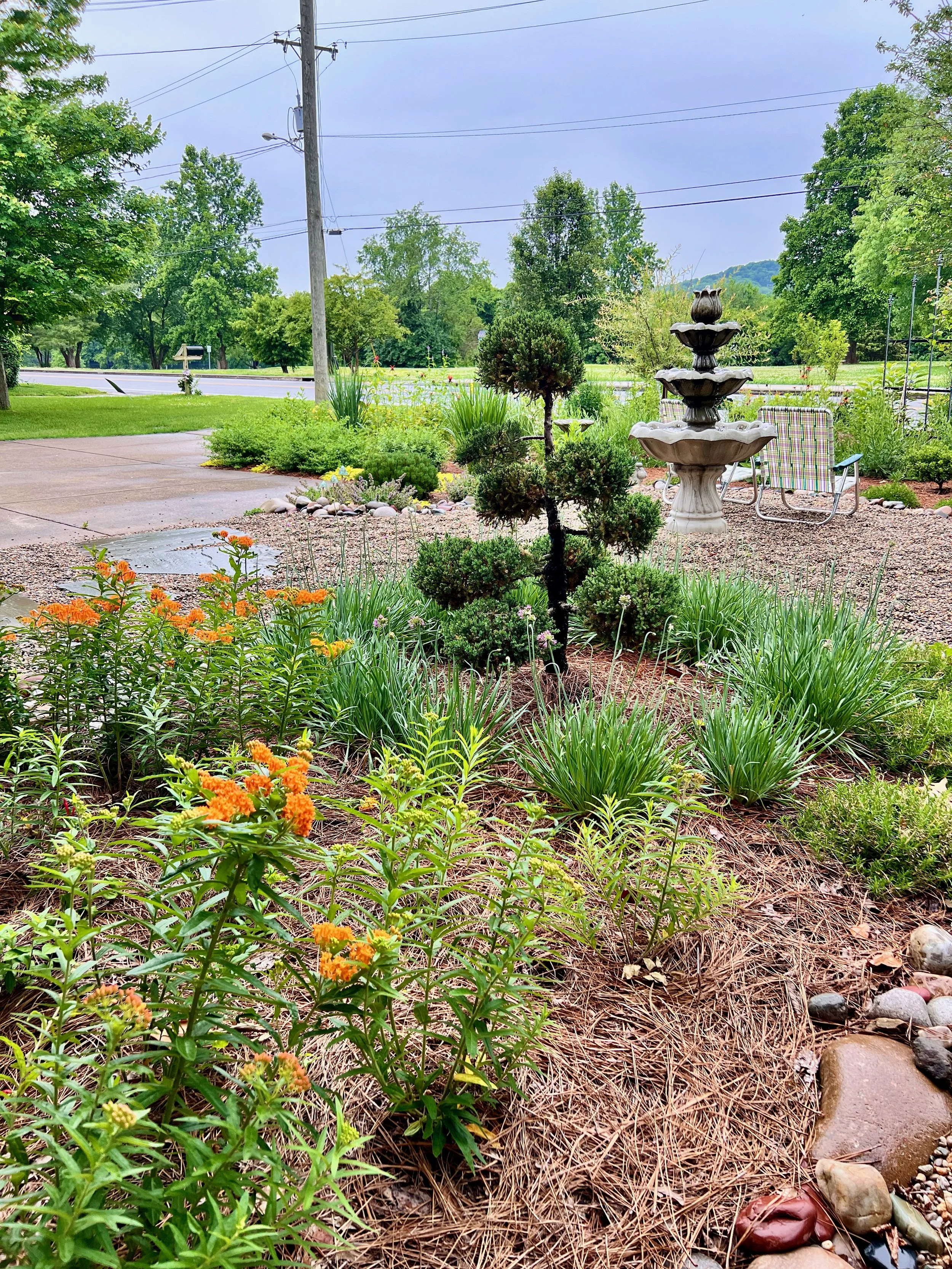
Asclepias tuberosa, Butterfly Weed, combined with a Juniper topiary pom pon, ornamental onions and creeping phlox in this Nashville front yard pollinator garden.
Butterfly Weed (Asclepias tuberosa)
Bloom: June through August. Bright orange flower clusters.
Wildlife value: Monarch butterfly host plant. Caterpillars feed on the foliage. Also draws great spangled fritillaries, swallowtails, and native bees of every size. This is a must-plant if you care about monarchs, because it's the specific milkweed species that's adapted to Tennessee's drier, well-drained slopes.
Height/Habit: 18 to 24 inches. Deep taproot, extremely drought-tolerant once established. Do NOT try to transplant it. Mark it in spring because it's very late to emerge and you will think it died and accidentally dig it up. It didn't die. It's just slow.
In Nashville clay: Needs decent drainage. Better on a slope or berm than in a flat wet clay bottom. This is the milkweed for sun and drainage. For wet clay, you want swamp milkweed (below).
Swamp Milkweed (Asclepias incarnata)
Bloom: June through August. Pink flower clusters.
Wildlife value: Also a monarch host plant. More tolerant of wet conditions than butterfly weed, which makes it the milkweed for Nashville's flat clay lots, rain gardens, and low spots where water sits. Same butterfly and pollinator value.
Height/Habit: 3 to 4 feet. Upright, multi-stemmed. Does not spread aggressively like common milkweed. Well-behaved in a garden setting.
In Nashville clay: Handles wet clay in the way Nashville clay handles water: grudgingly but effectively. This is the milkweed to put where drainage is poor.
Wild Bergamot (Monarda fistulosa)
Bloom: July through August. Lavender flowers with that distinctive shaggy look.
Wildlife value: Bumblebees, hummingbirds, hummingbird moths (which are spectacular to watch, they hover like hummingbirds and are often mistaken for them). Also draws long-tongued native bees. The dried seed heads feed birds in winter.
Height/Habit: 3 to 4 feet. Can get powdery mildew in Nashville's humid summers, which is mostly cosmetic but annoying. Good air circulation helps. 'Claire Grace' is a cultivar with better mildew resistance if this bothers you.
In Nashville clay: Native and adapted. Full sun, clay-tolerant, drought-tolerant once established.
Design note: This is the native alternative to ornamental bee balm (Monarda didyma), which is mildew-prone in Nashville. Wild bergamot handles our humidity better and serves the same pollinators.
Black-Eyed Susan (Rudbeckia hirta and R. fulgida 'Goldsturm')
Bloom: July through September. The gold standard (literally) of Nashville summer gardens.
Wildlife value: Bees, butterflies, soldier beetles. Leave the seed heads: goldfinches, juncos, and sparrows feed on them into winter. The plant also hosts silvery checkerspot butterfly larvae.
Height/Habit: 18 to 30 inches. 'Goldsturm' spreads to form dense colonies, excellent for massing. R. hirta is shorter-lived but self-sows freely.
In Nashville clay: Indestructible. The plant that makes you look like you know what you're doing even if you've never gardened before.
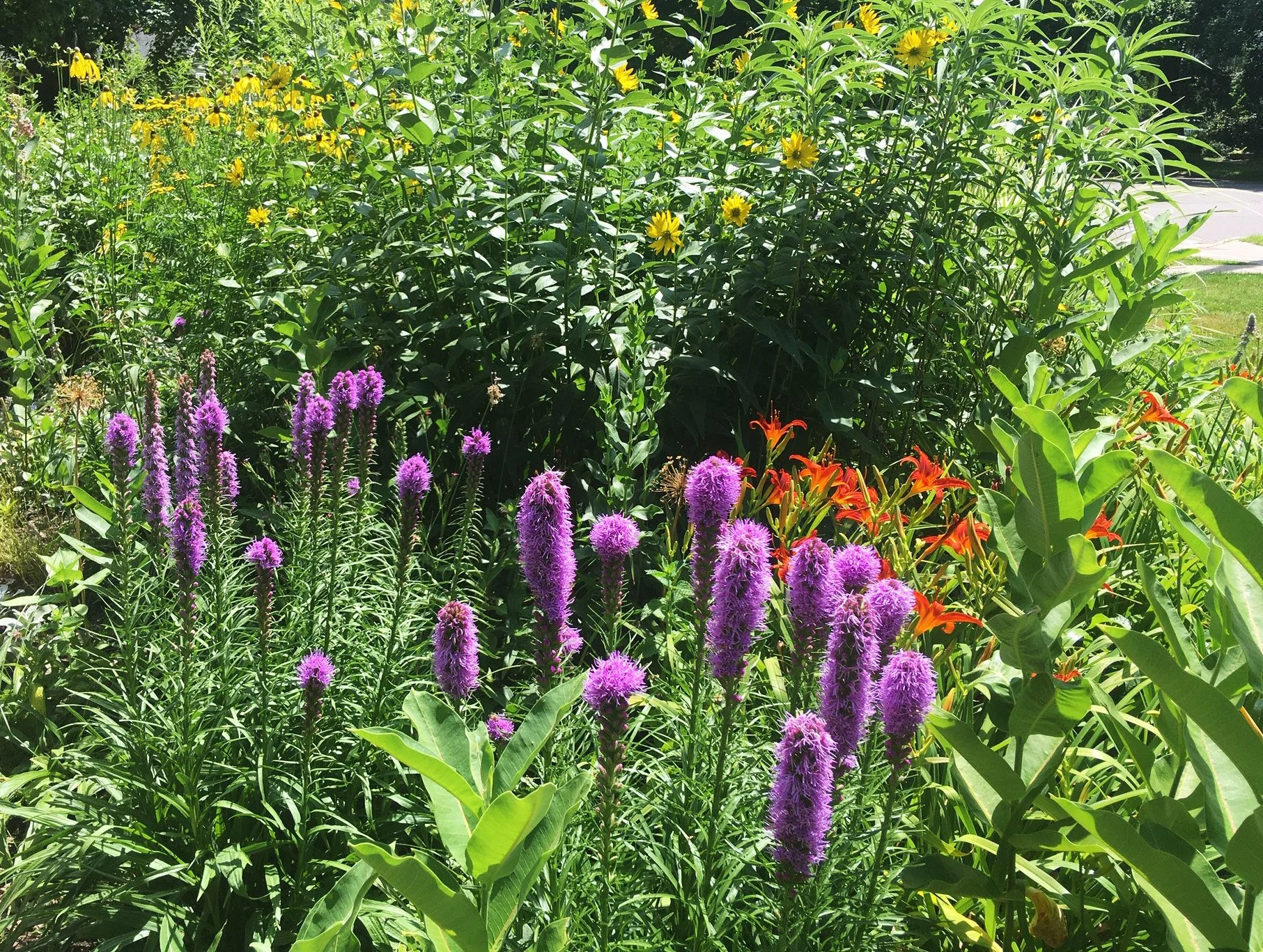
Liatris gives gorgeous vertical purple bloom interest.
Dense Blazing Star (Liatris spicata)
Bloom: July through August. Purple flower spikes that open from the top down, unusual and eye-catching.
Wildlife value: Monarchs and swallowtails in particular seek this out. Also a magnet for painted ladies and multiple native bee species. The corms are eaten by voles and chipmunks, which makes it part of the mammal food web too.
Height/Habit: 2 to 4 feet. Strong vertical line, architectural. Works as an accent in a border of mounding plants.
In Nashville clay: Handles clay if drainage is reasonable. Wants sun and doesn't like standing water.
Ironweed (Vernonia gigantea or V. noveboracensis)
Bloom: August through September. Deep purple flower clusters on tall, commanding stems.
Wildlife value: Late-season butterflies, including monarchs, swallowtails, and painted ladies, forage on it heavily when summer bloomers are fading. Also draws bees and beneficial wasps. Seeds feed birds.
Height/Habit: 4 to 7 feet. This is a tall plant. Use it at the back of a border or in a meadow where it has room. It's dramatic and can hold a composition by sheer scale.
In Nashville clay: Native, tough, and unbothered by our soil. Handles moist to average conditions.
Cardinal Flower (Lobelia cardinalis)
Bloom: July through September. Electric red spikes, the most vivid color in the native palette.
Wildlife value: The hummingbird plant. Tubular red flowers evolved specifically for ruby-throated hummingbird pollination. If you want hummingbirds to stop in your garden and stay, this is non-negotiable.
Height/Habit: 2 to 4 feet. Upright. Short-lived perennial, it may last 3 to 4 years and then need replacing, but it self-sows in moist conditions.
In Nashville clay: Needs consistent moisture. This is a streamside plant at heart. I use it in rain gardens, near downspout outlets, in low clay spots where water sits after rain. The very places most plants drown. Cardinal flower thrives there.
Fall Pollinator Plants for Tennessee: September through November
This is when most pollinator gardens fail. The summer show is over, the coneflowers are going to seed, and the garden goes brown and quiet right when fall-migrating monarchs, late-season bumblebees, and overwintering birds need it most. The fall garden is what separates a designed pollinator habitat from a summer flower bed that gives up. The fall season is also the best time to plant a new landscape or garden. I go into detail on that here.
Goldenrod (Solidago rugosa 'Fireworks')
Bloom: September through October. Cascading sprays of golden-yellow flowers.
Wildlife value: One of the most important late-season nectar sources for migrating monarchs and native bees building up winter reserves. According to Doug Tallamy's research, the genus Solidago supports over 100 species of moths and butterflies. Dozens of native bee species forage on goldenrod, including more than 40 pollen specialists that depend on it specifically. The flowers also support soldier beetles, ladybugs, beneficial wasps, and hoverflies. Seeds feed juncos, sparrows, and goldfinches through early winter.
And I'm going to say this again because I say it to every client: goldenrod does not cause allergies. Ragweed does. They bloom at the same time and goldenrod gets blamed because it's more visible. Goldenrod pollen is heavy and sticky. It travels by insect, not by wind. Ragweed pollen is light and airborne. You can bury your face in goldenrod and sneeze zero times. I refuse to leave it out of designs because of a myth.
Height/Habit: 3 to 4 feet. 'Fireworks' has an arching, cascading habit, like exploding fireworks, hence the name. It's the most architectural goldenrod cultivar and the one I use most.
In Nashville clay: Native. Handles everything.
Aromatic Aster (Symphyotrichum oblongifolium 'October Skies')
Bloom: September through November. Lavender-blue flowers that keep going until hard frost.
Wildlife value: Late-season bumblebee queens depend on this plant to build the fat reserves they need to survive winter underground. When you see a bumblebee in November on an aster, that bee is one of the only survivors from her colony, a future queen, feeding up for six months of hibernation. Asters are also monarch migration fuel. 'October Skies' is still blooming when most of the garden is done.
Height/Habit: 18 to 24 inches. Dense, mounding. Naturally compact, doesn't need staking or cutting back.
In Nashville clay: Thrives. Drought-tolerant. Handles lean clay. One of the easiest fall natives to grow.
Design note: Mass it at the front of a border where its late bloom can be appreciated. It pairs beautifully with the golds of goldenrod and the copper-bronze of little bluestem.
Blue Sage (Salvia azurea)
Bloom: September through October. True blue flowers on tall, airy stems.
Wildlife value: Late-season bumblebees, migrating monarchs, and skippers. One of the few sources of true blue color in the fall garden, which makes it visually distinct from the yellows and purples that dominate the autumn palette.
Height/Habit: 3 to 5 feet. Gets leggy and floppy if not supported by surrounding plants. I grow it through a mass of mountain mint or little bluestem that holds it upright.
In Nashville clay: Native and adapted. Prefers well-drained conditions and full sun. Put it on a slope or in a bed with decent drainage.
Wrinkleleaf Goldenrod (Solidago rugosa)
Bloom: September through October. Upright clusters of golden flowers, more vertical than 'Fireworks'.
Wildlife value: Same massive late-season pollinator and bird value as 'Fireworks'. I include the straight species alongside the cultivar because they have slightly different habits and bloom windows, which extends the goldenrod season.
In Nashville clay: The straight species is even tougher than the cultivar.
Native Grasses and Sedges for Tennessee Pollinator Gardens
Native grasses aren't pollinator plants in the way flowers are. They're wind-pollinated. But they're essential to the ecosystem in ways the flower-only guides ignore entirely.
Little Bluestem (Schizachyrium scoparium)
Bloom season interest: Green-blue foliage in summer turns copper and bronze in fall, then holds its pale gold color all winter.
Wildlife value: Provides nesting cover for ground-nesting bees and sparrows. The clumps shelter overwintering beneficial insects, toads, and small reptiles including five-lined skinks. Seeds feed juncos, sparrows, and field mice (which feed hawks and owls, and now you're building a food chain). Leave it standing through winter.
Height/Habit: 2 to 3 feet. Upright, tidy. The best-behaved native grass.
In Nashville clay: Handles clay, drought, heat, and lean soil. Better in sun.
Switchgrass (Panicum virgatum 'Shenandoah')
Wildlife value: The taller equivalent of little bluestem for habitat value. Dense stands provide nesting cover for birds and overwintering shelter for beneficial insects. Seeds feed songbirds.
Height/Habit: 3 to 4 feet. 'Shenandoah' has red-tipped foliage that deepens through summer.
Pennsylvania Sedge (Carex pensylvanica)
Wildlife value: This is the shade groundcover that completes the ecosystem. Spreads to form dense mats that host skipper butterfly larvae, shelter ground-nesting bees, and provide cover for toads, salamanders, and small reptiles. It's the living floor of the woodland food web.
Height/Habit: 6 to 8 inches. Fine-textured, semi-evergreen. Slowly spreading.
In Nashville clay: Handles shade and clay, the combination that defeats most plants. This is the native answer to the bare-dirt-under-trees problem.
Native Shrubs for Tennessee Pollinator Gardens
If your pollinator garden is only perennials and grasses, you're missing an entire layer of the ecosystem. Shrubs provide nesting sites for birds, overwinter cover, berry crops that sustain wildlife through winter, and the structural framework that holds the garden together in January when everything else is dormant.
Buttonbush (Cephalanthus occidentalis)
Bloom: June through July. Spherical white flower clusters that look like tiny pin cushions.
Wildlife value: Draws more insect diversity than almost any native shrub. Bees, butterflies, hummingbird moths, and beetles. The seeds feed waterfowl and shorebirds. The dense branching provides nesting habitat. It's also a wetland plant, so it handles the places in your garden where nothing else survives.
Height/Habit: 6 to 12 feet. Upright, multi-stemmed. Can be pruned to keep it smaller.
In Nashville clay: Loves wet clay. Wet spots, rain gardens, drainage swales. This is the shrub for the low spot.
American Beautyberry (Callicarpa americana)
Bloom: June through July (small, subtle flowers). Berries: September through November, electric magenta-purple.
Wildlife value: Over 40 species of songbirds eat the berries. Mockingbirds, brown thrashers, catbirds, robins, cedar waxwings. The berry clusters are so vivid they almost look artificial, and birds find them immediately. The small summer flowers draw native bees.
Height/Habit: 3 to 6 feet. Arching, informal. Use it where you want wild personality.
In Nashville clay: Native, tough, handles clay and part shade.
Virginia Sweetspire (Itea virginica 'Henry's Garnet')
Bloom: May through June. Fragrant white flower racemes.
Wildlife value: Multiple native bee species, particularly long-tongued bumblebees. The dense branching provides cover for nesting birds. Handles wet clay, a genuine rain garden shrub.
Height/Habit: 3 to 5 feet. Arching. Deep garnet-red fall color that holds late.
In Nashville clay: I covered this in the main plant guide. It tolerates wet clay better than almost any other flowering shrub.
Oakleaf Hydrangea (Hydrangea quercifolia 'Ruby Slippers')
Bloom: June through July. White cone-shaped flower clusters that age to rose-pink.
Wildlife value: Native bees and butterflies visit the flowers. The peeling bark provides overwintering habitat for insects. The dense form provides nesting cover. Four-season structure in the garden.
In Nashville clay: This is the hydrangea for Nashville. Full details in the plant guide.
Native Pollinator Plants for Shade in Tennessee
This is the question nobody answers in pollinator guides, and it's the reality of half the properties I work on.
Most pollinator plants want full sun. That's true. But if your yard is under a mature oak canopy, and in Belle Meade, Forest Hills, and the established neighborhoods of Franklin and Brentwood, many are, you're not out of the game. You just need the shade-adapted species.
Full shade to part shade (less than 4 hours of direct sun): Virginia bluebells, bloodroot, wild geranium, wild ginger (Asarum canadense, a shade groundcover that hosts pipevine swallowtail), Pennsylvania sedge, Christmas fern (shelter for overwintering insects), cardinal flower (in moist shade), great blue lobelia (Lobelia siphilitica, blue spikes in part shade, visited by bumblebees).
Part shade (4 to 6 hours of sun): Golden Alexanders, columbine, spiderwort, beardtongue, Virginia sweetspire, beautyberry, wild bergamot (will tolerate more shade than most guides suggest, though it blooms less).
A shaded native pollinator garden will have fewer flashy flowers than a sunny one. But it will have more structural interest. Ferns, sedges, mosses, shrub layers. And the habitat value for woodland species like box turtles, salamanders, and overwintering insects is actually higher in shade because the leaf litter and moisture levels they need are preserved under canopy.
Almost nobody is designing shade pollinator gardens intentionally, which means you have the opportunity to create something genuinely rare on your property.
How Long Does a Native Pollinator Garden Take to Establish?
Most pollinator garden content shows you a picture of a lush, buzzing border and skips the two years it looked like nothing. So.
Year one: The garden looks sparse. The plants are small. You'll see some pollinators, early adopters, especially bees, but nothing like what's coming. You'll wonder if you should have planted things closer together. You planted them correctly. Be patient.
Year two: The perennials are filling in. Bloom is stronger and longer. You'll start seeing butterfly species you haven't seen before. The mountain mint, if you planted it, is already becoming a scene. Ground-nesting bees may be establishing in the bare soil between plants.
Year three: This is when people stop me on the sidewalk. The garden is lush, layered, and buzzing. Literally buzzing. The food web is establishing. You're seeing predatory insects, birds you didn't plant for, toads under the stepping stones. The little bluestem has hit its stride and the fall garden is breathtaking.
Year five and beyond: The garden is self-sustaining in ways that would have seemed impossible in year one. It's self-seeding, self-mulching through leaf litter, and supporting a community of organisms that maintains its own pest control, pollination, and soil health. Your maintenance is minimal. A late-winter cutback and maybe some editing of aggressive spreaders. The clay under the garden has been transformed by the root systems into something more porous, more alive, more capable of supporting life than anything you could have achieved with amendments alone.
This is the same patience I write about when it comes to designing for large properties. The land knows things you don't yet. So does the garden. Give it time.
Before You Go Any Further: This Garden Might Not Be For You
I'd rather lose you here than have you build a pollinator garden and then undo everything it's trying to do.
A healthy pollinator ecosystem depends on mess. Real mess. The kind of mess that will make your neighbors wonder if you've given up on your yard if you don't have defined edges and clear design intent holding it together.
In November, when every other yard on your street is getting the full fall cleanup, your pollinator garden needs to be left alone. The leaf litter that your neighbor is paying someone to blow and bag? In your garden, that's the winter blanket for overwintering bumblebee queens sleeping underground, for the chrysalises of swallowtails tucked into the leaf layer, for the toads and box turtles that burrow under the leaves when temperatures drop. Bag those leaves and you're bagging next year's pollinators with them.
The ornamental grasses and perennials that look brown and dead in December? Don't cut them. The hollow stems of your coneflowers, your mountain mint, your bee balm are housing stem-nesting native bees that sealed themselves inside in fall and won't emerge until spring. The seed heads you think look messy are feeding goldfinches, juncos, and sparrows through the coldest months when there is nothing else. Those standing stems also catch snow and ice, which insulates the crowns beneath them.
I leave everything standing on my farm until late February. Everything. It looks like a lot of brown. It looks untidy by any conventional landscape standard. And underneath all of that brown, hundreds of organisms are surviving the winter because I didn't clean up after them.
And then, just when you've made it through the brown months and the garden is starting to green up, nesting season begins. March through June, the birds that your pollinator garden attracted will want to raise their families nearby. On my farm, there's a corner of the covered front porch where a bird nests every single year. Same corner. Same mud-and-twig construction tucked against the beam. March through June, without fail, that corner is an active nursery. My sofa is directly below it and will never be perfectly clean during those months. I've accepted this. I think of it as my labor and delivery unit. The bird chose my porch because my garden gave it a reason to be here, and the insects in my pollinator beds are feeding its nestlings. That's the system working exactly as it should, right above my head, on my furniture.
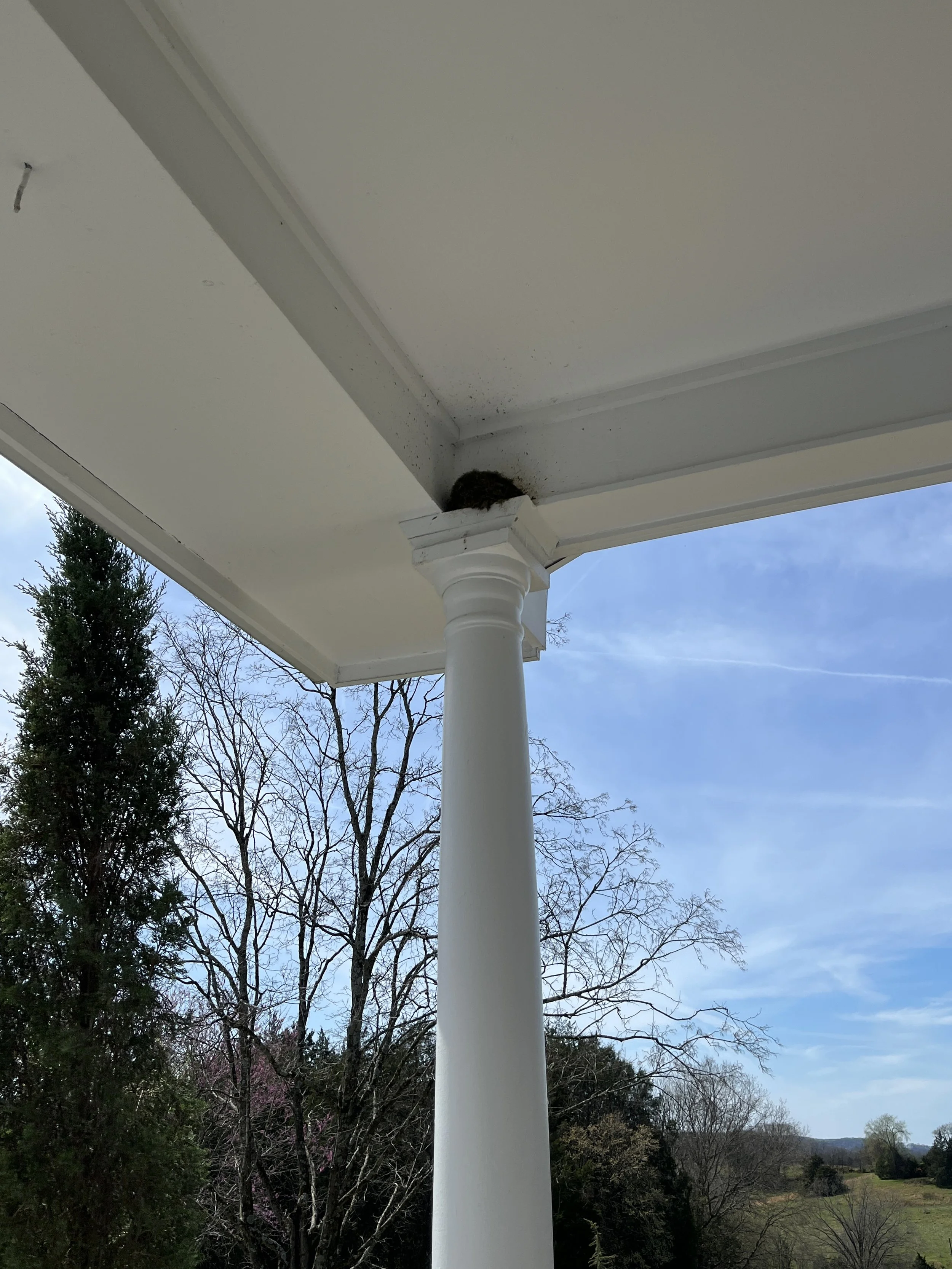
Same corner, same nest, same bird in late winter.
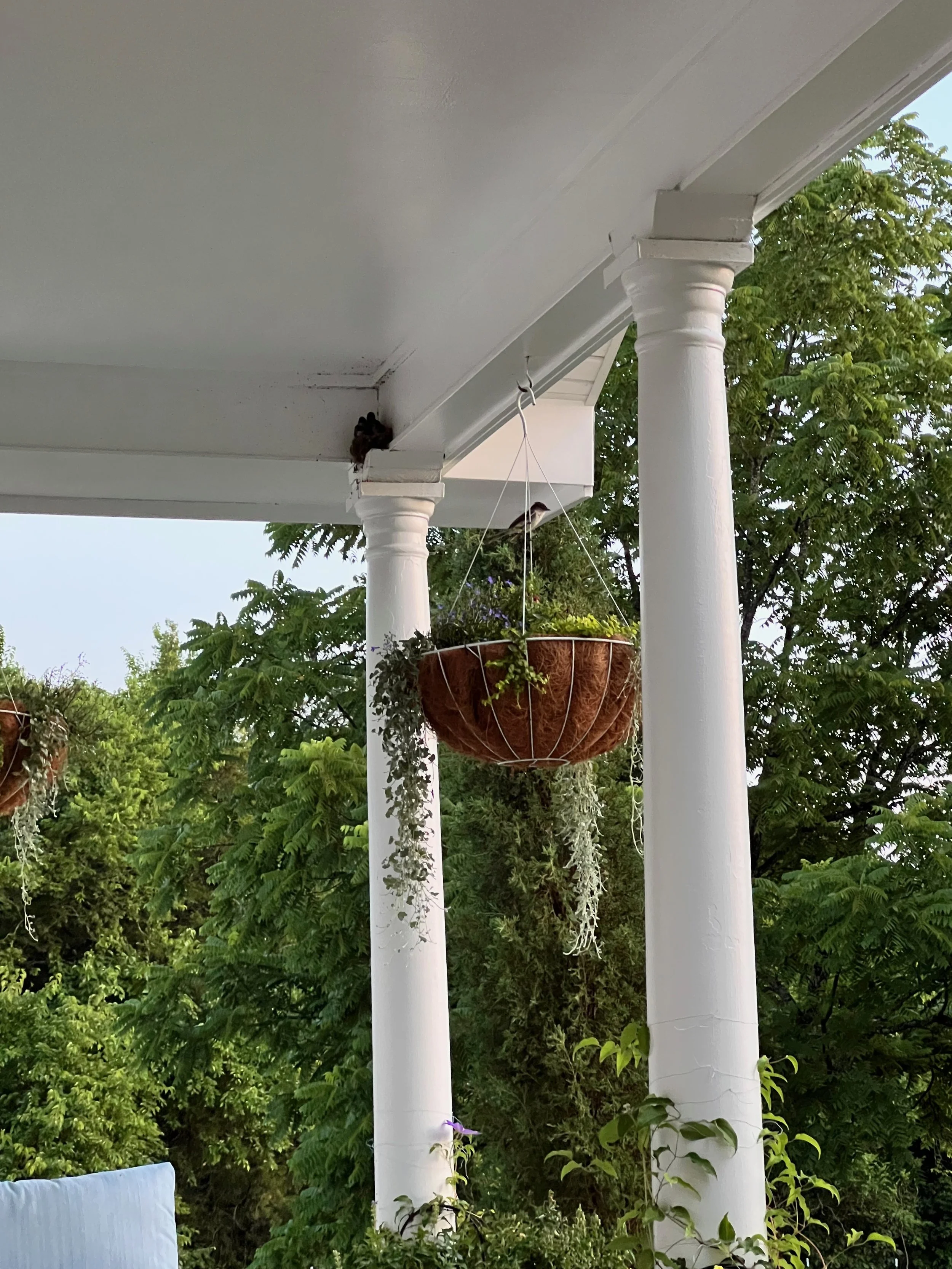
Same corner, same nest, different bird, new babies in late June. The sofa below it is never clean from March through June. I've made my peace.
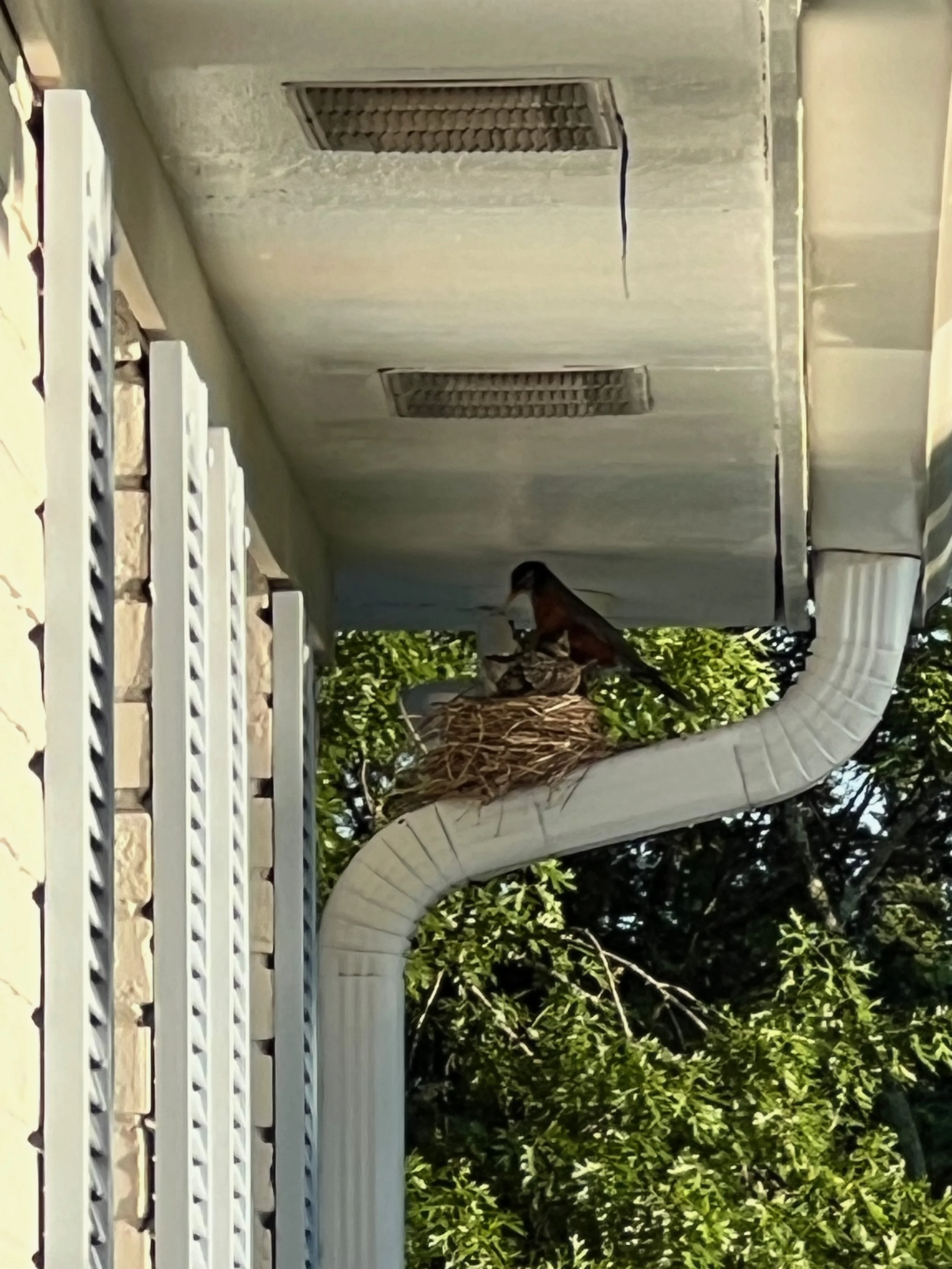
May 2026 Update: Now have two active nests on the porch. Lucky me.
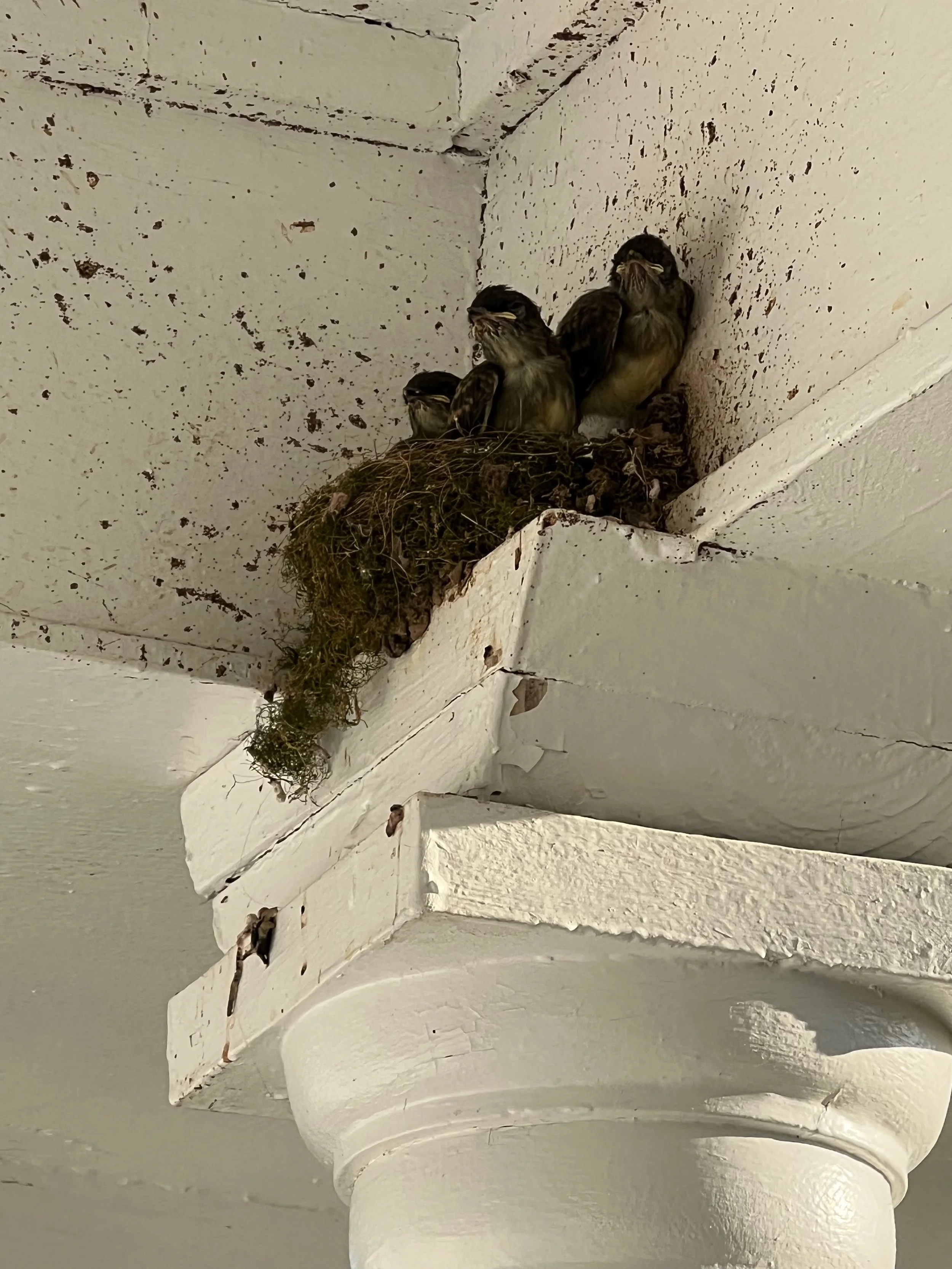
May 2026 Update: 9 babies total across two nests. Lord, bless my sofa cushions.
If you pay a lawn crew to come through in October and blow every leaf, cut every stem, and leave your beds looking like a magazine cover for winter, a native pollinator garden is not the right choice for you. I mean that with zero judgment. Some people want a clean, manicured landscape year-round and there is nothing wrong with that. I can design you a beautiful garden that looks pristine in every season. But it won't be this garden.
This garden asks you to tolerate winter brown, to leave the leaves, to resist the urge to tidy, and to trust that the mess is doing work you can't see. The ecosystem that gives you hummingbirds in July is built on the leaves you didn't rake in November. Those two things are the same system. You can't have one without the other.
If you're okay with that, keep reading.
What Tennessee Gardeners Ask Me About Pollinator Gardens
Can I grow a pollinator garden in Nashville clay?
You can grow a better pollinator garden in Nashville clay than in most other soils. Our native pollinator plants evolved in this clay. Coneflowers, mountain mint, black-eyed Susans, blazing star, goldenrod, little bluestem, these plants don't just tolerate Nashville clay. They're adapted to it. Their root systems are built for it. The main thing to avoid is planting species that need sharp drainage (like butterfly weed) in flat, low spots where clay holds water. Put those on a slope or berm and put wet-clay-tolerant species (swamp milkweed, cardinal flower, Virginia sweetspire) in the low spots. Read the site and match the plant to the conditions. My full Nashville plant guide goes deep on clay-specific recommendations.
Can I have a pollinator garden in shade?
Yes, though it will look different from a sunny one. Virginia bluebells, bloodroot, wild geranium, wild ginger, Pennsylvania sedge, great blue lobelia, and cardinal flower (in moist shade) all thrive under canopy. A shaded pollinator garden has more structural interest, ferns, sedges, mosses, shrub layers, and the habitat value for woodland creatures like box turtles and salamanders is actually higher in shade because the leaf litter and moisture they need are preserved under canopy. You won't get the same volume of blooms, but you'll get a different and equally valuable ecosystem.
Will a pollinator garden attract wasps?
Yes. Wasps are part of the ecosystem and they're doing important work. Paper wasps are predators, they hunt caterpillars and other soft-bodied insects to feed their larvae, providing natural pest control for your garden. Parasitic wasps (tiny, non-stinging) lay their eggs in pest insects and are among the most effective biological controls that exist. Thread-waisted wasps, potter wasps, and mud daubers are all solitary and almost never sting humans. The wasps you're worried about, the aggressive yellowjackets at your picnic, are ground-nesting scavengers that are attracted to food, not flowers. A pollinator garden does not increase yellowjacket populations. It increases the population of beneficial wasps that keep your actual garden pests in check.
Will a pollinator garden attract mosquitoes?
No. Mosquitoes breed in standing water: bird baths, clogged gutters, old tires, anything that holds stagnant water for more than a few days. A pollinator garden planted in the ground does not create mosquito habitat. In fact, a healthy pollinator garden may reduce mosquitoes over time because it attracts dragonflies, damselflies, and predatory insects that feed on mosquitoes and their larvae.
Do I need to use pesticides in a pollinator garden?
No, and you shouldn't. The entire premise of a pollinator garden is that it creates a self-regulating ecosystem. The beneficial insects in your garden, the parasitic wasps, the ladybugs, the lacewings, the predatory beetles, control pest populations naturally. If you spray insecticide, you kill those beneficial predators along with whatever pest you were targeting, and you break the system. Even organic pesticides like insecticidal soap and diatomaceous earth are not selective; they harm beneficial insects too. If you have a specific pest problem, address it with targeted physical removal or by planting more diverse species that attract the predators of that pest. If you're currently on a spray program for your landscape, a native pollinator garden is going to require a different philosophy.
What's the difference between a pollinator garden and a wildflower meadow?
Scale and intent. A pollinator garden is a designed planting bed or series of beds within a residential landscape, with defined edges, deliberate plant selection, and a composition that holds together visually. A wildflower meadow is a larger-scale conversion, typically a half-acre or more of lawn or pasture replaced with native grasses and wildflowers, managed by annual mowing rather than by bed-level maintenance. Both support pollinators. A pollinator garden fits within a typical Nashville residential lot. A meadow is more appropriate for acreage. I wrote about meadow conversion in detail here.
Where should I place a pollinator garden on a large or rural property?
If you're on five, ten, twenty acres in Middle Tennessee, you have options that suburban homeowners don't, and you also have challenges they don't. The best placement depends on how water moves across your property, where your sun exposure is strongest, and how the garden relates to where you actually spend time. On acreage, I like to design pollinator plantings in two zones: an intensive garden close to the house where you can watch the system work from your porch or kitchen window, and broader native plantings along fence lines, field edges, or drainage corridors where they serve as habitat connectors between your property and the surrounding landscape. Those edge plantings are where the real wildlife value compounds, because they link your habitat to whatever's adjacent and give animals like box turtles, ground-nesting birds, and beneficial snakes room to move through the property along corridors of cover. On a large property, the garden doesn't exist in isolation. It exists inside a watershed, a wind pattern, a wildlife migration path. Understanding what your land is already doing before you design anything is the single most important step.
How much sun does a pollinator garden need?
Most pollinator plants perform best with six or more hours of direct sun. But "most" isn't "all." If your yard gets four to six hours of sun, you can still grow spiderwort, beardtongue, golden Alexanders, columbine, Virginia sweetspire, and wild bergamot. If you have less than four hours, you shift to shade-adapted species: Virginia bluebells, bloodroot, wild geranium, Pennsylvania sedge, cardinal flower, and great blue lobelia. The important thing is to be honest about your light conditions and choose accordingly rather than cramming sun-lovers into shade and watching them decline.
When should I plant a pollinator garden in Tennessee?
Fall is best for shrubs and perennials. October through November. The soil is still warm, roots establish through our mild winter, and the plants are ready to take off in spring. Spring planting works too, mid-April through late May, after last frost. Avoid planting June through August. The heat stress on new plantings in a Nashville summer is severe. My spring playbook has the full timing guide.
How big does a pollinator garden need to be?
There's no minimum. Even a single 4x8 raised bed planted with a handful of well-chosen natives will draw pollinators. A 100-square-foot border with 15 species covering the full bloom season from March through October will support a genuinely diverse insect community. Bigger is better in terms of habitat value, but don't let a small yard stop you. Every native plant you put in the ground is doing work that a patch of lawn or a boxwood hedge never will.
When do I cut back a pollinator garden?
Late February. Not fall. Not December. Late February, right before new growth starts pushing. Leave everything standing through winter: the dead stems, the seed heads, the brown grasses, the leaf litter. All of that is housing overwintering bees, feeding birds, and insulating plant crowns. When you cut back in late February, cut perennials and grasses to 4 to 6 inches above the ground. Leave the cut stems on the ground or pile them at the edge of the garden for a few weeks to give any remaining stem-nesting insects time to emerge before you remove the debris.
Will my HOA allow a pollinator garden?
Maybe. Many HOAs still enforce conventional landscape standards that prioritize mowed lawn and trimmed shrubs. But the conversation is shifting. Tennessee does not currently have a statewide "right to garden" law that overrides HOA restrictions on native plantings, though some states do. Your best strategy is to design the pollinator garden with clear edges, defined borders, and intentional composition so it reads as a designed garden rather than an abandoned lot. A garden with crisp mowing edges, stone borders, and a visible design framework will pass most HOA reviews. A weedy tangle with a "pollinator garden" sign in it will not.
How do I keep a pollinator garden from looking messy?
I wrote a full companion post on exactly this question. The short answer: defined edges, massed plantings instead of one-of-everything scattered around, evergreen anchors that hold the composition together in winter, and bloom sequencing so there's always something happening. The difference between a pollinator garden that looks designed and one that looks neglected is composition, not plant selection. The plants are the same. The arrangement is everything.
Do native pollinator plants spread aggressively?
Some do, some don't, and the honest answer depends on the species. Mountain mint spreads by runners and can be assertive. Goldenrod (some species) can colonize if you let it. Black-eyed Susans self-sow freely. But little bluestem stays in tidy clumps. Coneflowers spread gently. Blazing star stays exactly where you planted it. The key is knowing which species are runners, which are self-sowers, and which are well-behaved, and designing with that knowledge. I give you that information for every plant on this list. The spreaders aren't problems if you give them room or put them where you want a mass. They're only problems if you plant them in a tight border and expect them to stay put.
What pollinators does coneflower attract?
More than almost any other native perennial. Bumblebees, honeybees, sweat bees, mining bees, soldier beetles, painted lady butterflies, fritillaries, swallowtails, and skippers all visit the flowers for nectar and pollen. Leave the seed heads standing in fall and winter and goldfinches, juncos, and sparrows feed on the seeds. The dried hollow stems provide overwintering habitat for stem-nesting native bees. One plant, three seasons of wildlife value.
Is milkweed the only plant monarchs need?
Milkweed is the only plant monarch caterpillars can eat. Without it, they cannot complete their life cycle, period. But adult monarchs need nectar from a wide range of flowers, and migrating monarchs in particular need late-season nectar sources to fuel their journey south. In Tennessee, goldenrod and fall asters are critical migration fuel. A garden with milkweed alone is a nursery with no cafeteria. You need the full bloom sequence.
Do I need to add a water source for pollinators?
It helps, but it doesn't have to be elaborate. A shallow dish with a few pebbles and enough water to barely cover them gives bees a place to land and drink without drowning. A bird bath works too. Change the water every few days so it doesn't become mosquito habitat. If your property already has a rain garden, a wet clay low spot, or a seasonal creek, that's already providing water for pollinators and dozens of other species.
Will a pollinator garden attract hummingbirds?
Plant coral honeysuckle, cardinal flower, and eastern columbine and you will have hummingbirds. Ruby-throated hummingbirds are the only breeding hummingbird in Tennessee, and they're drawn to red and orange tubular flowers. Coral honeysuckle blooms May through July with sporadic rebloom into fall. Cardinal flower blooms July through September. Columbine covers April through May. Between the three of them, you have hummingbird-attracting flowers for six months straight. Wild bergamot and bee balm also draw hummingbirds, though less exclusively. If you plant any combination of these natives, hummingbirds will find your garden. They are remarkably good at locating new food sources, and once they find yours, they'll return year after year.
Where to Start
If you're standing in your yard right now trying to figure out how to begin, start with one bed. Pick the sunniest spot if you have it, or the shadiest spot if that's what you've got, and plant for one full bloom sequence from spring through fall. Even a 100-square-foot bed with 15 well-chosen native species will draw pollinators within weeks and begin building habitat within a season.
My companion post on designing native pollinator gardens covers the composition principles: massed plantings, defined edges, evergreen anchors. The things that make a native garden look designed rather than abandoned. That post is the how-it-looks. This one is the what-goes-in-the-ground.
And if you want help designing a native pollinator habitat for your specific property, your clay, your light, your shade, your life, I'd love to hear from you. I'll walk your property, read your conditions, and help you build a living system that feeds, shelters, and sustains an entire community of creatures, from the first mining bee of March to the box turtle that might still be crossing your path thirty years from now.
Clare Horne is the founder of The Grass Girl, a fine garden design studio based outside Nashville, Tennessee. She designs residential gardens for clients in Wilson, Williamson, Davidson, Sumner, and Cheatham counties.