
What Your Land Knows That You Don't
You bought land. Maybe you've had it for a while now, maybe you just closed, but either way, you stand out on it sometimes and feel two things at once. The first is that you love it. That this is why you bought it, this feeling, this sky, this quiet. The second is that you have no idea what to do with most of it. The area around the house, sure. But the rest of the acreage, the slopes, the tree line, the back forty, whatever your version of "the rest" is, sits there, beautiful and untouched and waiting for something you can't quite name.
I know that feeling well. I live on a farm outside Nashville, and I've been here long enough that I can tell you things about my piece of ground that would sound strange to anyone who hasn't spent years with the same dirt under their feet. I know where every stream of water forms and runs after a heavy pour because I spent an entire spring filming it, walking the slopes in storms with my phone, cataloging the paths that water carved down the hill when nobody was selling anything or proving anything, just paying attention. I know where the sun disappears on the horizon in April and where it disappears in November. Those are two very different points, and I've planted my trees to frame both, a shifting view, a garden that changes its portrait of the sky every month of the year. I know that at a certain point on my front nine-acre slope, I have to stop planting cypress and pine specimens, because below that invisible line the moisture pooling and cold-air drainage will kill them inside of two seasons no matter how perfect they were installed or looked in the plan.
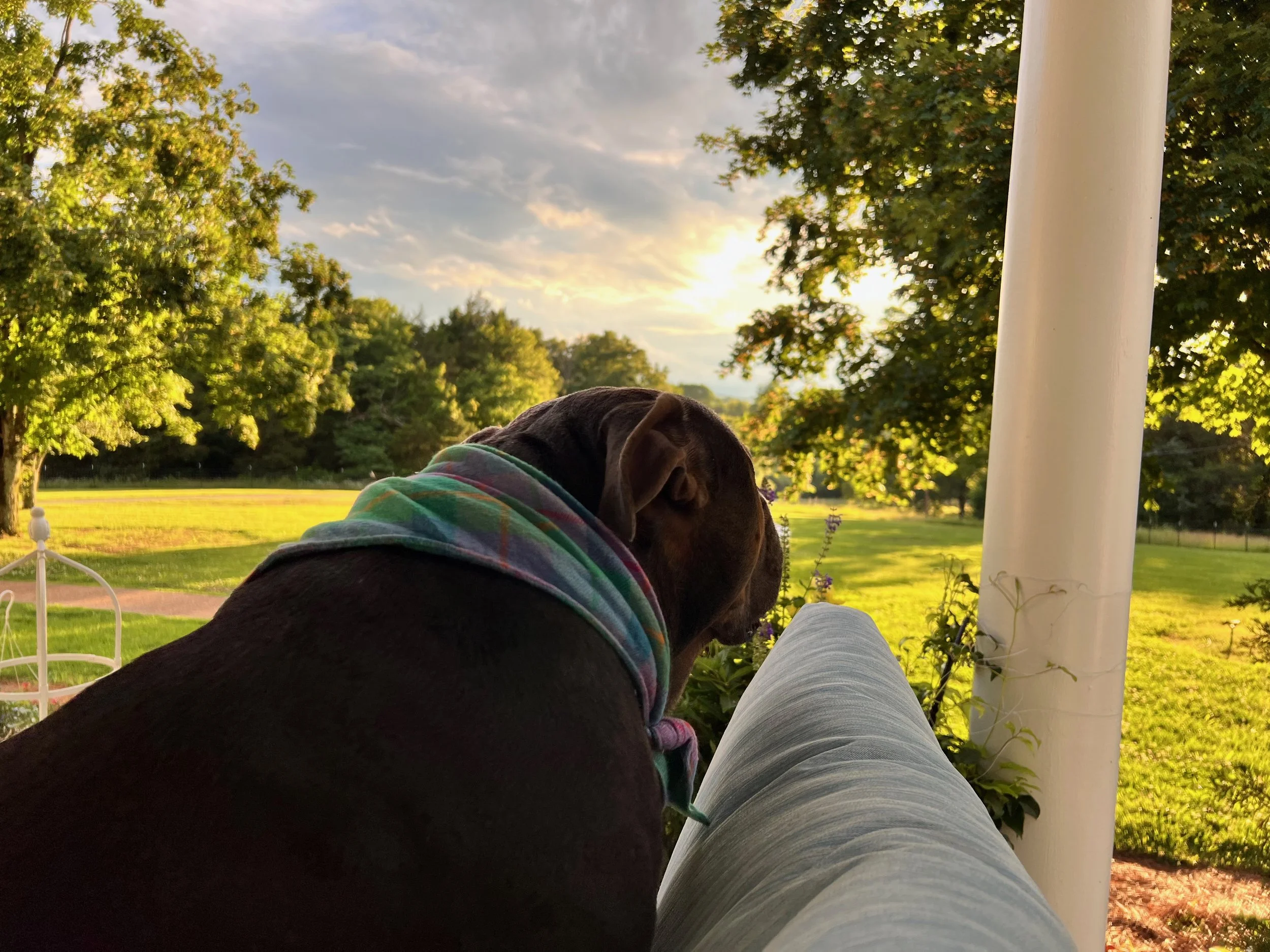
Watching the evening settle across the front acreage.
I learned all of this the same way. I watched. I waited. I let the land talk first.
I'm also a garden designer. I run a boutique fine garden design studio and work on properties ranging from city lots in Nashville to multi-acre estates across Middle Tennessee. My farm was my first acreage client and remains my most demanding one. It's where I developed the conviction that sits at the center of everything I do: that acreage is not a large yard. That it requires a completely different way of thinking, seeing, and, most importantly, a different relationship with time. And that almost everyone who works on large properties, from homeowners to the designers they hire, gets it wrong by moving too fast.
The Mistake Almost Everyone Makes Designing for Large Acreage
Frederick Law Olmsted, before he designed Central Park or the Biltmore Estate grounds or any of the hundreds of landscapes that made him the most important figure in American design history, was asked by George Vanderbilt to come look at a piece of land in the mountains of North Carolina. Olmsted walked it and told Vanderbilt the truth: the land was poor. The soil was depleted. The forests were wrecked from decades of bad farming. And rather than impose a grand English park on ground that couldn't support one, Olmsted recommended something radical: scientific forestry, land restoration, years of working with what the property actually was, not what Vanderbilt wished it could be. He wasn't decorating a property. He was reading it, painting a portrait of what the land already was before asking it to become something else. It was the first project of its kind in America, and it became one of Olmsted's greatest works precisely because he started by listening to what the land could not do.
That was 1889. And somehow, over a century later, the default approach to large-property design is still the opposite of what Olmsted understood. Walk the site once or twice. Take measurements. Produce a plan. Install by fall.
Here's what that looks like in practice. Someone buys ten or twenty or fifty acres. They close on the property. They're in love. They've been dreaming about this land for months. The rolling hills, the old trees, the way the light plays across a pasture in the evening. They want to do something with it and make it feel like theirs.
So they call a designer. The designer visits, takes measurements, shoots photos from the driveway, notes the slope and the views and the existing trees. Goes back to the office. Analyzes a survey. Produces a plan. Maybe it's a good plan, with solid plant choices, tasteful hardscape, everything looking right on paper.
But paper doesn't know where water actually moves during a hard spring rain. Paper doesn't know that the wind shifts direction between summer and winter storms. Paper has no idea that a family of deer bed down in that clearing at dusk, or that the sunset in April and the sunset in November drop behind completely different points on the horizon, or what the frost does in that low pocket by the creek, or why the previous owner's plantings failed in that one stubborn stretch along the fence line.
That plan made from two site visits and office hours knows the property's measurements. It does not know the property.
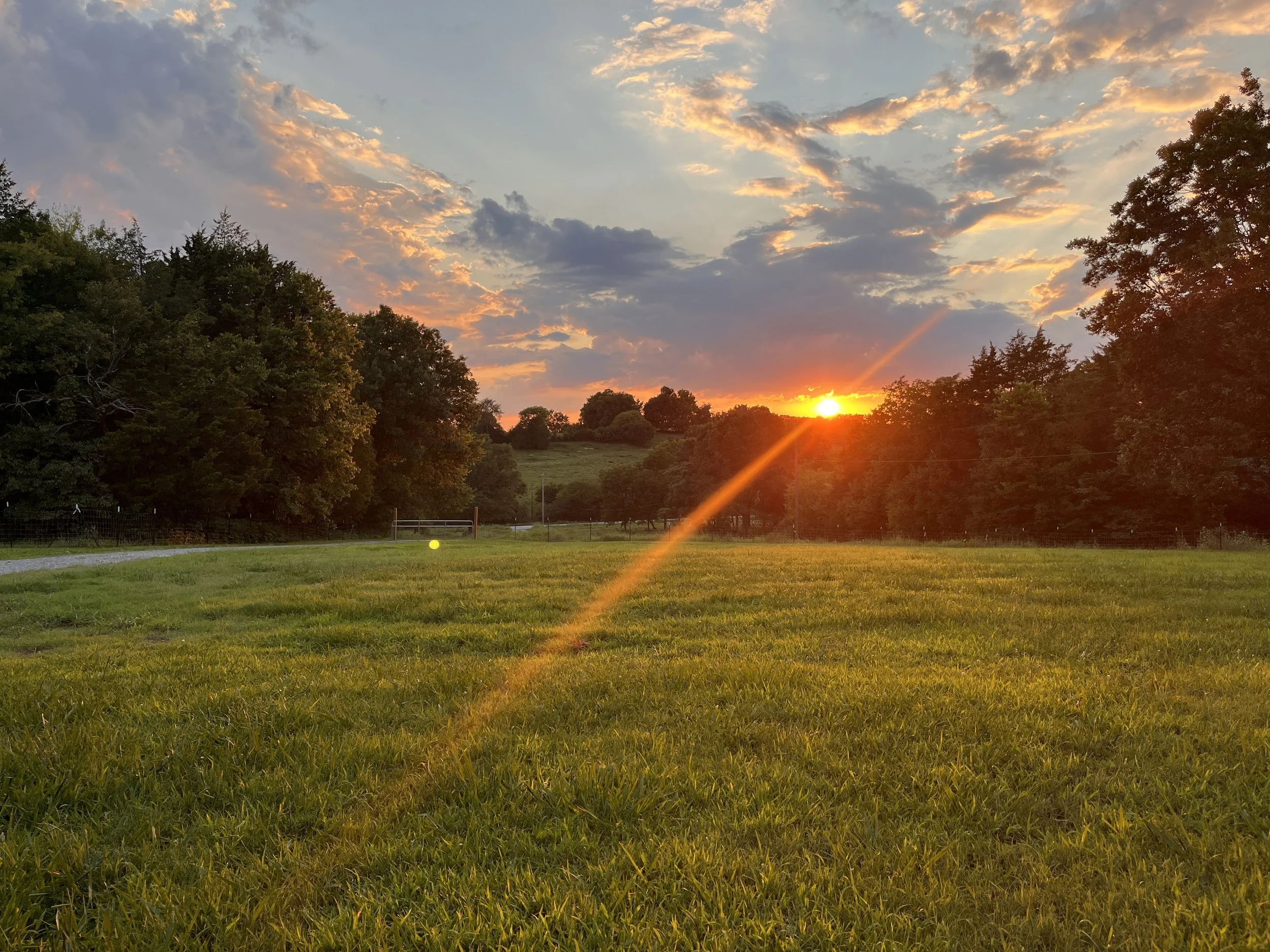
The sun dropping behind the western tree line on a June evening. In February, it sets nearly forty degrees south of the June point. Same land, different place entirely.
On a quarter-acre lot, the gap between measurement and knowledge might not cost you much. The variables are contained. You can make reasonable assumptions and correct course on-site as you go. But on ten acres, on twenty, on fifty, a property becomes a different organism entirely, with its wind patterns, its own microclimates, its own resident wildlife, its own relationship with every piece of land that borders it. If you don't spend real time learning what all of that is telling you, you will design against it. And on acreage, designing against the land is the most expensive mistake you can make. The land will win, maybe not immediately, but eventually.
How I Learned to Listen (And What My Farm Taught Me About Yours)
I want to tell you what it actually looks like to study a piece of land because this is the part of the process that's invisible to most people. It is the part no one photographs for Instagram or includes in a portfolio. It doesn't look like design. It looks like standing in the rain, or sitting on a porch in a thunderstorm, or walking the same slope for the hundredth time and noticing something that was missed the first ninety-nine.
I developed this way of working on my own farm before I ever applied it to a client's property, and I still think the best way to explain what I mean is to show you.
Water
I documented how water moved across my property through an entire spring; seasons of storms, filmed and cataloged. Where it gathered force on the upper slopes. Where it sheeted across hard clay. Where it carved new channels after a heavy pour and where it vanished into gravel seams I didn't know existed until I watched long enough to find them. When it came time to determine the exact curve my half-mile driveway needed to handle the grade without eroding, I had months of real evidence showing me precisely how water behaved on that slope, in what volumes, along what paths. I graded the driveway to follow the water's own logic. It will hold for decades — because I didn't fight what the hill was already doing. I just made room for it.
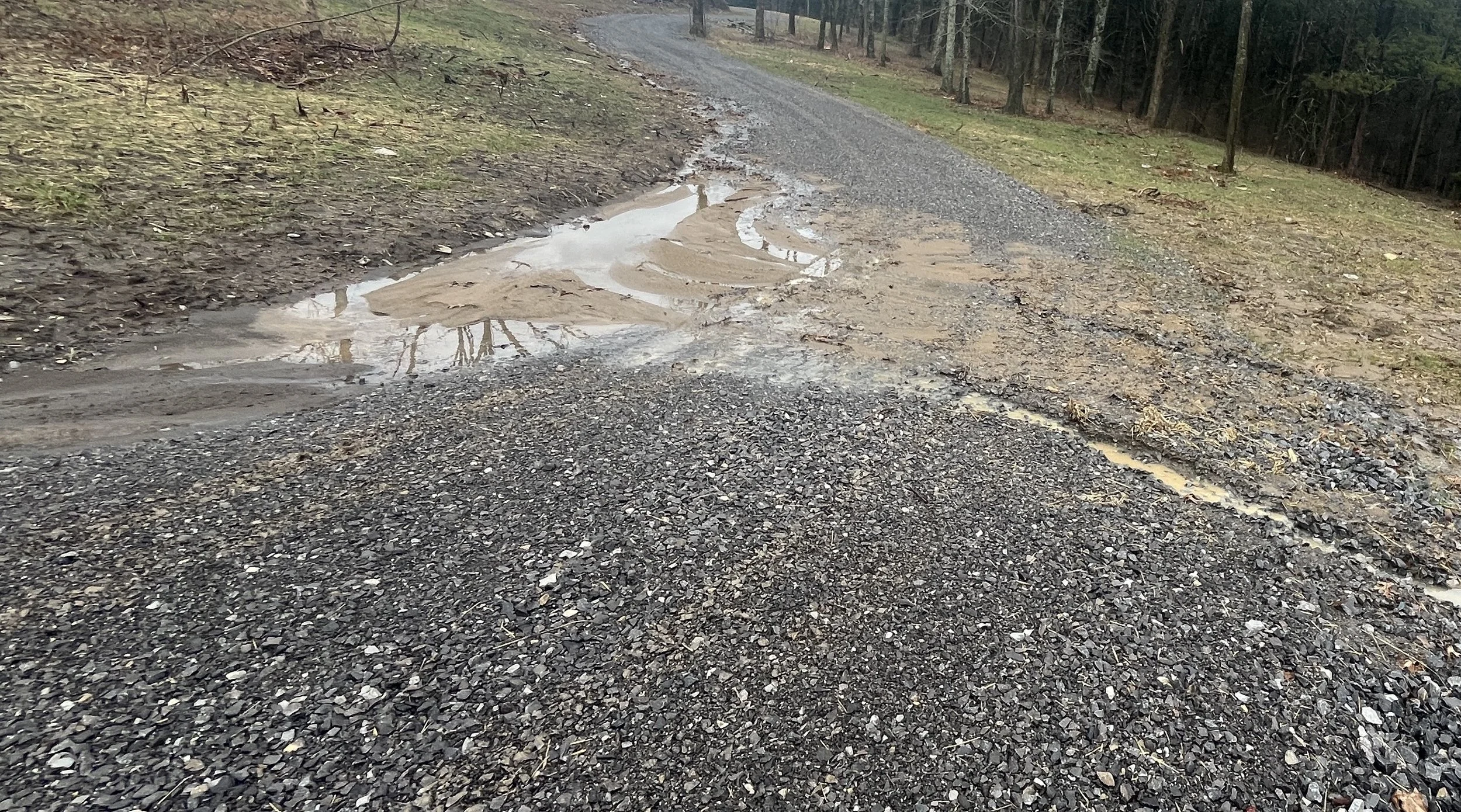
What water does to a gravel drive when it runs faster than the grade can handle. I filmed my slopes for an entire spring before I graded mine.
On a residential lot, drainage is a problem you solve with grading and a French drain. On acreage, water is a system — it moves from the top of your watershed to the bottom, and redirecting it in one place changes what happens everywhere downhill. You cannot fix the wet spot by the patio without understanding whether your fix will create a washout on the lower slope three years later. The only way to understand a system that complex is to watch it work, in real weather, over real time.
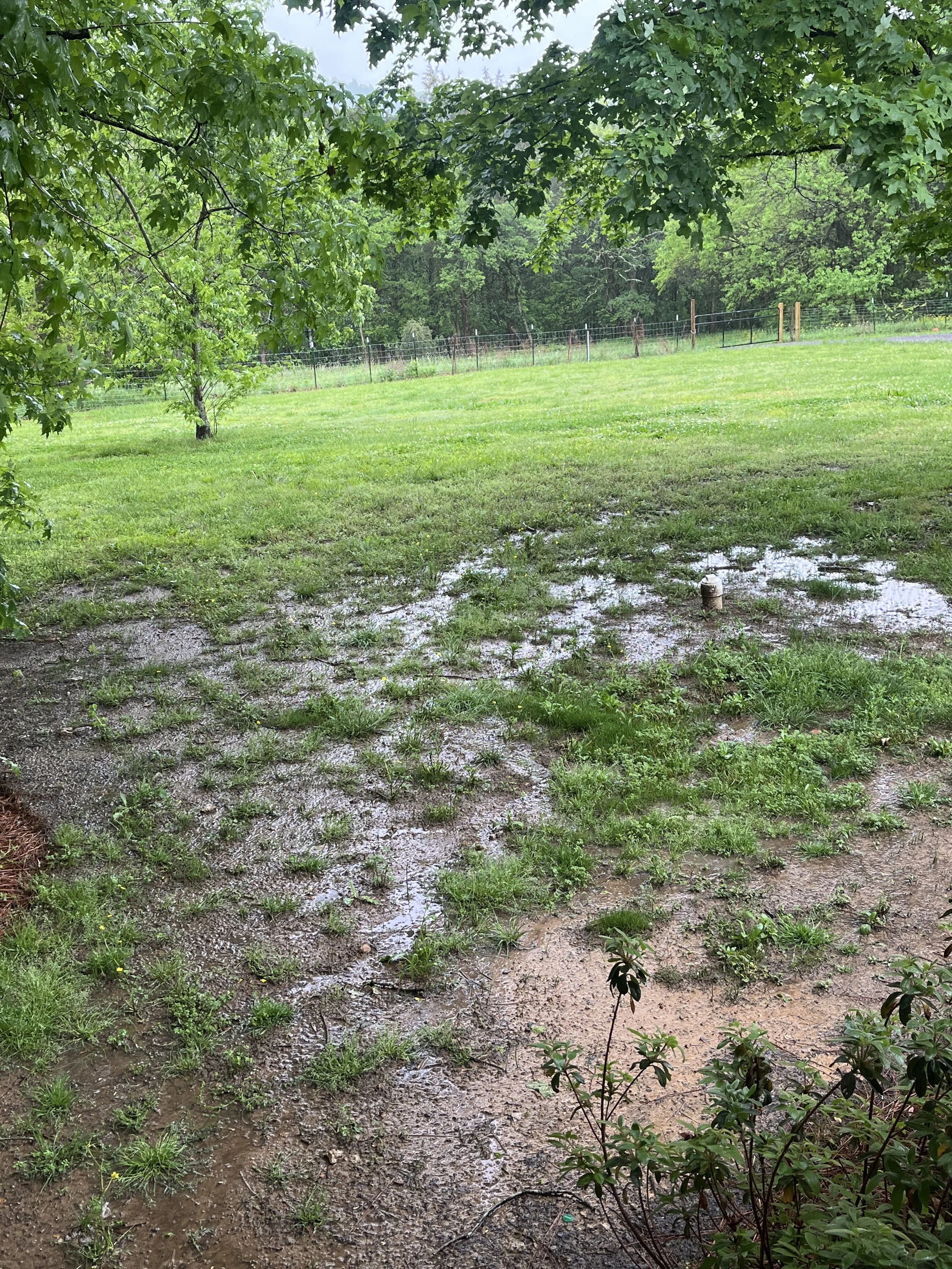
After a heavy spring rain — water pooling and sheeting across compacted clay. This is the kind of evidence no one site visit gives you.
Light
I know where the sun drops below the horizon in April and where it drops in November; remarkably different points, and the arc between them changes everything about what you can grow, where you can sit comfortably in the evening, and how a property feels as the seasons turn. I designed my tree placements to frame the view from my home for every month, a shifting composition that treats the sky as part of the garden. Because on acreage, a garden isn't just what's growing at your feet. It's the entire visible landscape, and that landscape is a different place in February than it is in June. If you've only visited your property twice before someone hands you a master plan, you're designing for a photograph of something that never holds still.
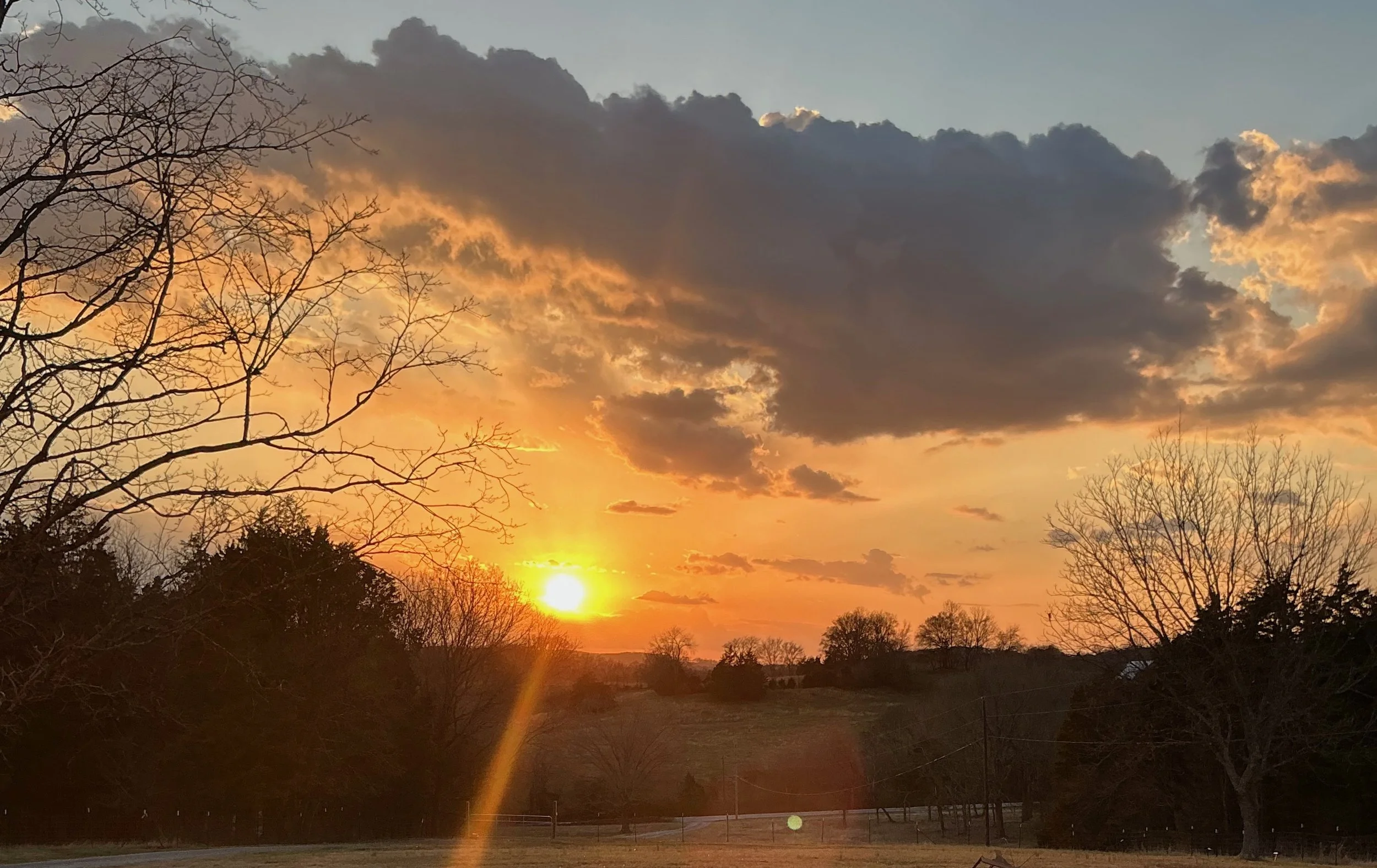
February. Bare trees, different horizon, different light entirely. I designed my tree placements to frame every version of this sky.
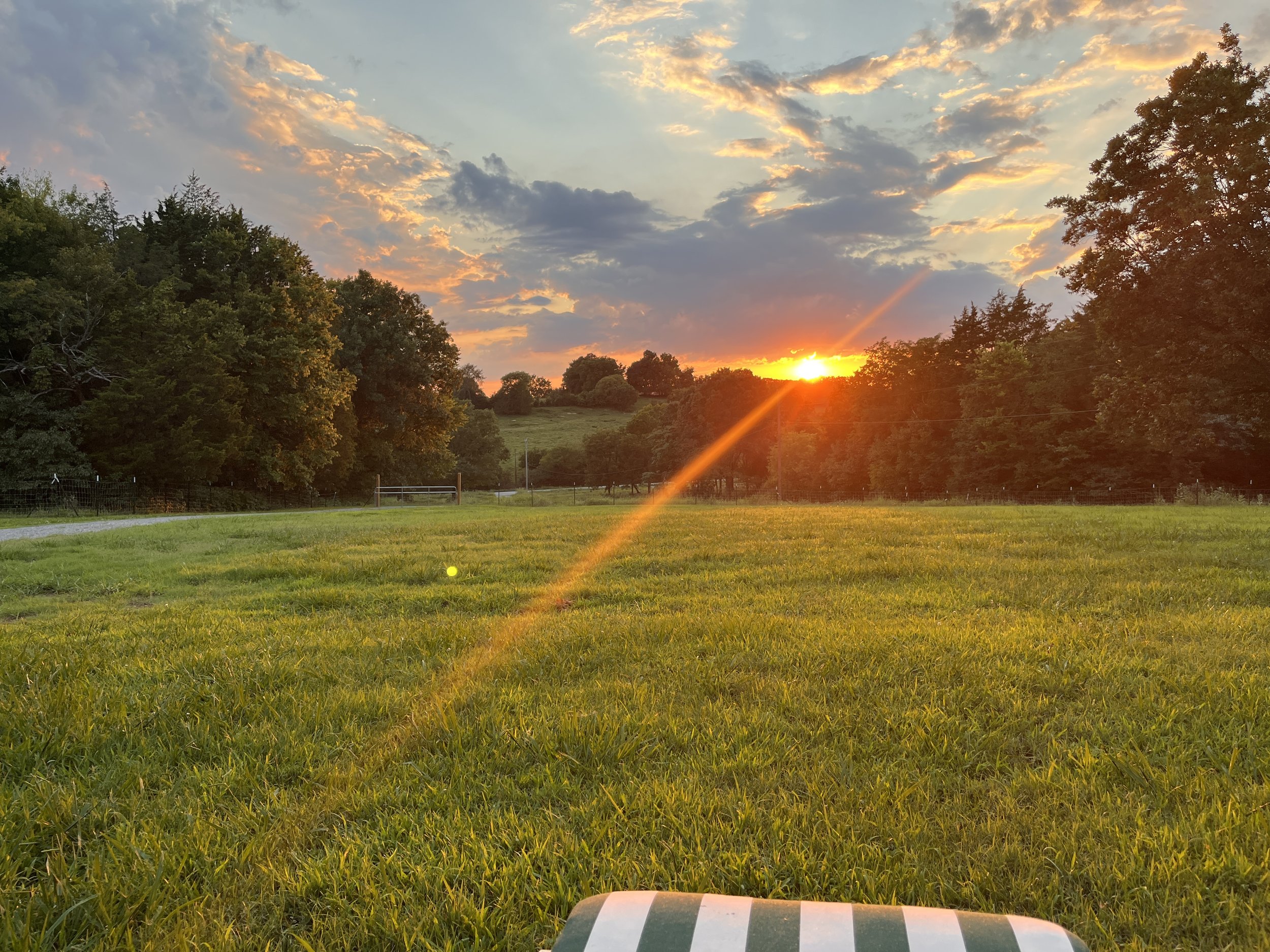
The same sunset documented in June.
Wind
I sat on my porch during violent thunderstorms for two full seasons. I needed to understand how wind moved across my land during the storms that do actual damage: the straight-line gusts that snap branches and flatten young trees, the corridors between ridges that funnel and accelerate airflow. Middle Tennessee gets severe weather, and on a large property, trees are both your greatest asset and your greatest liability when wind reaches sixty miles an hour. From that documentation, I know exactly where to place windbreak plantings and how to stagger them to absorb energy rather than redirect it. Those trees are structural. And I couldn't have placed a single one of them without all that time in the rain, watching.
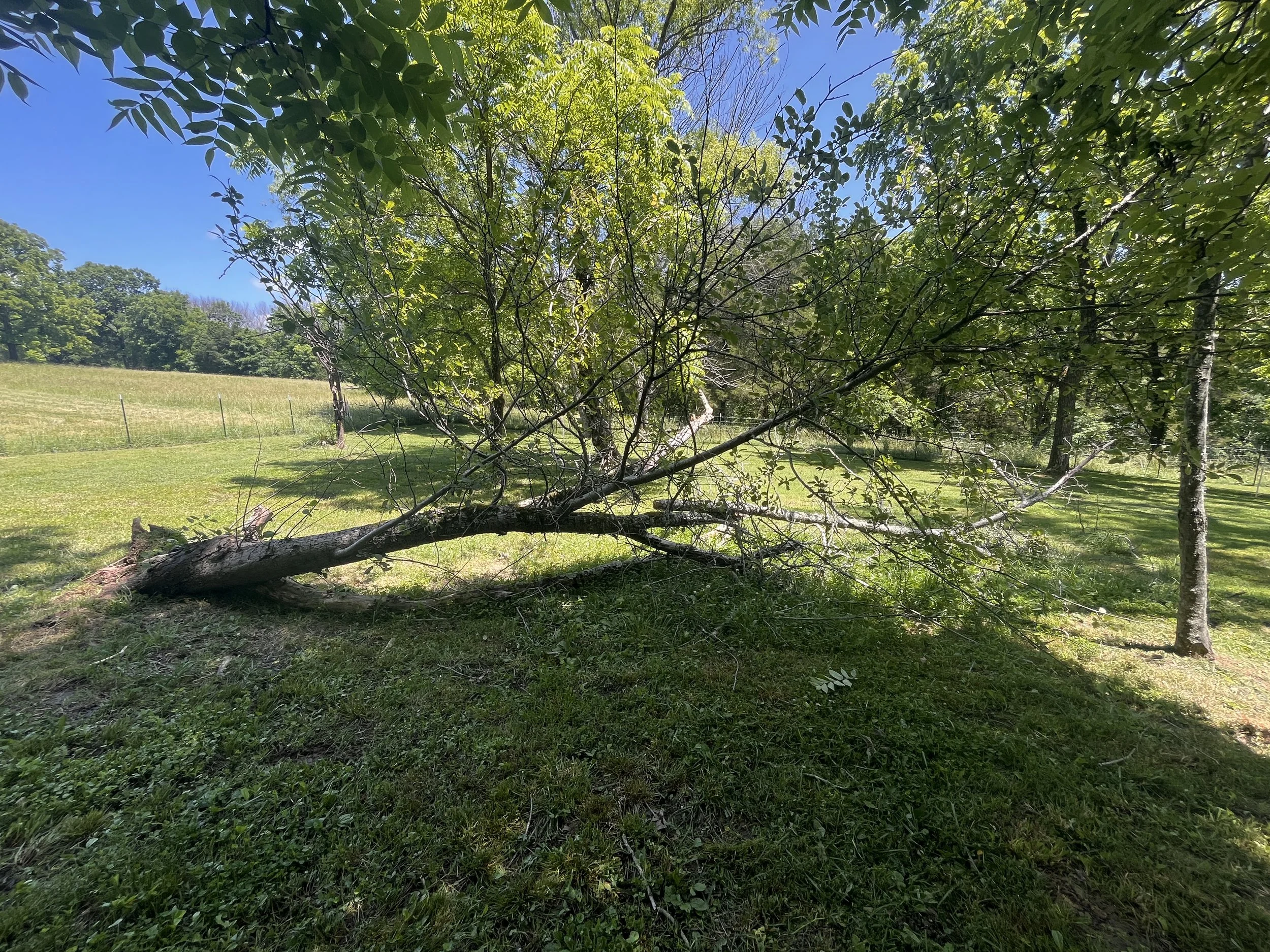
Straight-line wind damage on my farm. This is why windbreak placement isn't decorative — it's structural engineering.
Wildlife
I know where I can't put my edible garden. The soil is right there. The light is right. Everything about the spot works on paper. But a family of deer comes to that clearing and beds down at dusk, and they've been doing it longer than I've owned the deed. So that ground is spoken for. I put my kitchen garden somewhere else. The best design decision I've ever made on this property was recognizing a place where the answer was to do nothing at all.
Neighbors
This might be the most overlooked category of knowledge in all of landscape design, and on acreage it can make or break an entire master plan. Your property doesn't exist in a vacuum. It exists inside a community of human and animal neighbors who don't care about your survey pins.
On my farm, my neighbor's cows have a genuine talent for breaking through the fence at one particular spot. Doesn't matter how many times it gets mended; they find their way. So I don't plant anything there that could hurt them if they foraged on it, and I don't put in anything I'd mourn watching a heifer stomp at dawn. On client properties, the same principle governs decisions that are far more significant. If your neighbors shoot on their back acreage (and in Middle Tennessee, plenty do), I need to know that before I site your reading garden, the outdoor dining space where you imagined hosting friends on summer evenings. If there's a stretch of woods where copperheads are active, your children's treehouse plans need to relocate entirely. If the adjacent property runs cattle and the prevailing wind carries what cattle produce, that changes where every outdoor living space on your land wants to be.
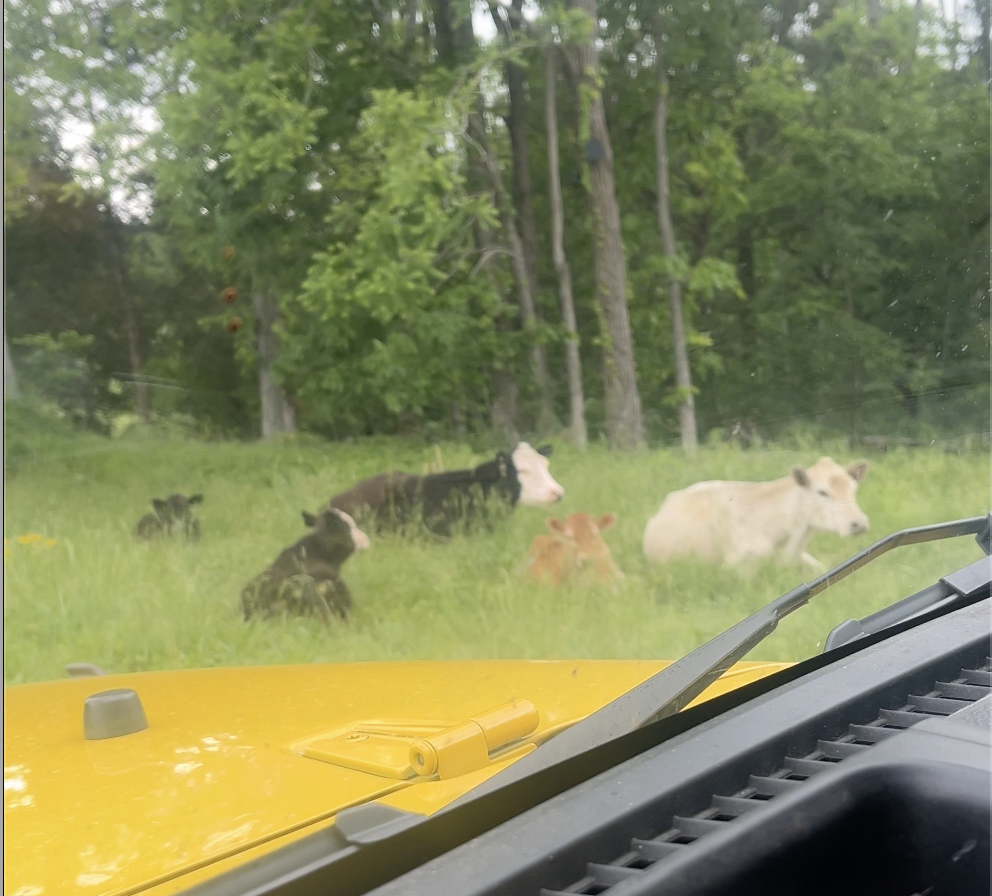
My neighbor's cows, on my side of the fence again. Some design constraints don't show up on a site survey.
None of this shows up on a site plan. You learn it from time, from walking the edges, from conversations with the people who've lived next door for decades. A designer who doesn't know what's on the other side of your fence line is designing with half the information, and on a large property, the half you're missing is often the half that matters most.
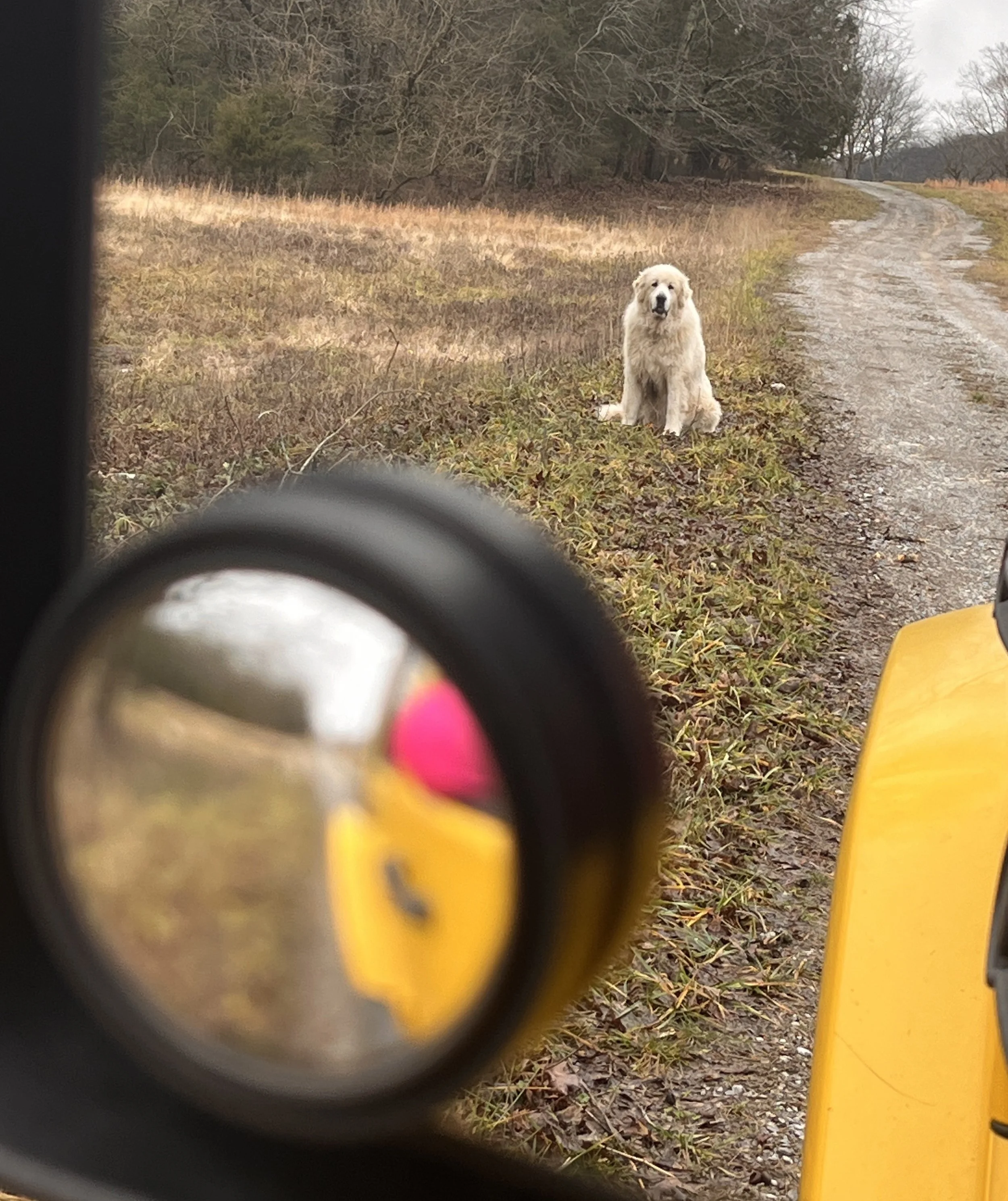
The neighbor's dog. A regular visitor who is 100% immune to fencing. Also not on the survey.
The Clay Beneath the Charm of Tennessee Land
I grew up in Wilson County, Tennessee. I live on a farm with deep family history (that story is here), and I've spent my adult life with my hands in Middle Tennessee clay, which is its own kind of education, and one you cannot get from a textbook or a weekend soil workshop.
People move to this part of the world and fall in love with the rolling green hills, the limestone outcroppings, the old cedars, the way a creek sounds. They should. It's among the most beautiful landscape in the American South. But underneath all that beauty is some of the most obstinate soil you'll ever try to grow anything in. Heavy clay that holds water the way some people hold grudges — indefinitely and without good reason. Limestone shelves sitting six inches below the surface in places you'd never suspect. Seasonal water tables that turn a gentle slope into a spring-fed bog every February and bake it back to hardpan by July.
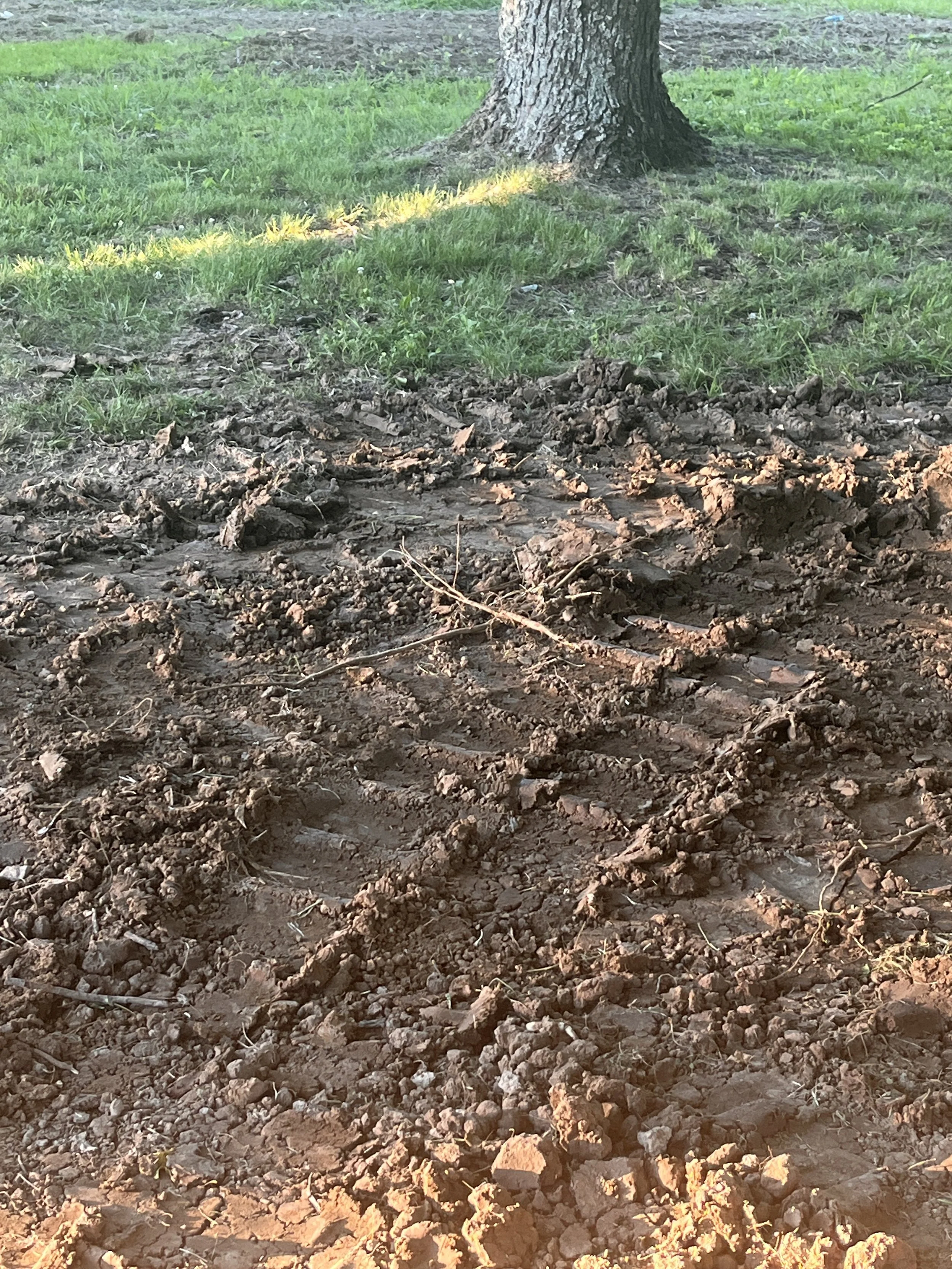
Middle Tennessee clay. It holds water the way some people hold grudges — indefinitely and without good reason.
If you haven't worked in this soil over years, failed in it, watched your best ideas die in it and figured out why, you will make mistakes that no amount of money fixes after the fact. You'll plant a beautiful specimen tree in what looks like a perfect spot and watch it drown in its own root ball because the clay sealed around it like a bathtub. You'll grade a driveway based on surface topography and discover that the real water runs along a limestone shelf three feet down, following a path that has absolutely nothing to do with what the grade looks like from above.
Every region has its own version of this. The Hudson Valley has rocky glacial till and deep frost pockets that can kill a seemingly established tree in its fifth winter. Sonoma has complex clay-over-sandstone geology and fire ecology that has to inform every planting decision you make. The Sea Islands have salt spray and hurricane surge and soil that changes character entirely within fifty feet of the waterline. No land anywhere is as simple as it looks from the road on a beautiful day or afternoon site-visit.
A soil report gives you chemistry. Time gives you behavior. And behavior, not chemistry, is what you're designing for.
What I'm Really Asking of You
If you've read this far, I think I already know something about you. You bought land, or you're about to, and you bought it for reasons that had very little to do with square footage or investment return. You bought it because of how you felt the first time you stood on it. Maybe it was the hills south of Franklin, or one of the quiet roads in Wilson County where the farms have been farms for a hundred and fifty years, and you fell in love with it before the real estate agent finished her sentence. Something about the land itself called to you: the quiet, the space, the feeling that this ground was operating on a clock much older and much slower than the one you'd been living by.
I know that feeling, because it's the reason I live where I live.
Here's the tension, though. Most people who buy acreage are very good at getting things done. They're used to having a vision, assembling the right team, and executing. And every one of those instincts, which serve them beautifully in the rest of their lives, will work against them when it comes to land. Speed, applied to acreage, produces properties that look like magazine spreads and feel somehow empty. I think of it as the "resort pool" problem, where you spend heavily on the immediate backyard, the pool, the outdoor kitchen, and then you look out across the rest of your property and feel nothing. The connection between the designed living space and the larger land was never made, so the garden feels like a stage set and the acreage feels like someone else's field. Everything polished. Nothing breathing.
Part of the reason that happens is that most design processes skip the most important question. They ask what you want: a pool, an orchard, a cutting garden, a lush place to entertain. They don't ask why you want it. They don't ask what you left behind to get here, or what you're reaching for, or what this land is actually supposed to do in your life. And those questions matter, because a garden that answers them is a fundamentally different thing than a garden that just checks off a wish list of features.
I think about my clients the same way I think about land, as something to be read, carefully, before I propose anything. How do you actually live? Not how do you want your property to look, but how do you move through a morning? Where do you go when you need to think? Do you want to be pulled outside or do you want the outside to come to you? Are your kids the kind who disappear into woods or the kind who want a flat field and a goal post? When you imagine yourself on this property five years from now, ten years from now, what does the feeling look like, not the features, the feeling?
A great garden on acreage answers the land and the person at the same time. It's land portraiture; the ground's intelligence and the life being lived on it, read and designed together. And you can't paint a portrait of someone you met twice over an iPad and a tape measure.
So here's what I ask of the people I work with, and I won't pretend it's easy: wait.
I know you want to start. I know you can already see what this property could become. But your land has been here for a very long time, longer than any of us, and it knows things you don't know yet. Things that will take a full year of seasons, storms, light, and silence to reveal. Give me that time. Let me learn your property the way I learned mine: by being there in January and July and every month between, by watching what the water does and where the wind comes from and who else lives on this ground and what your neighbors are up to on the other side of the tree line.
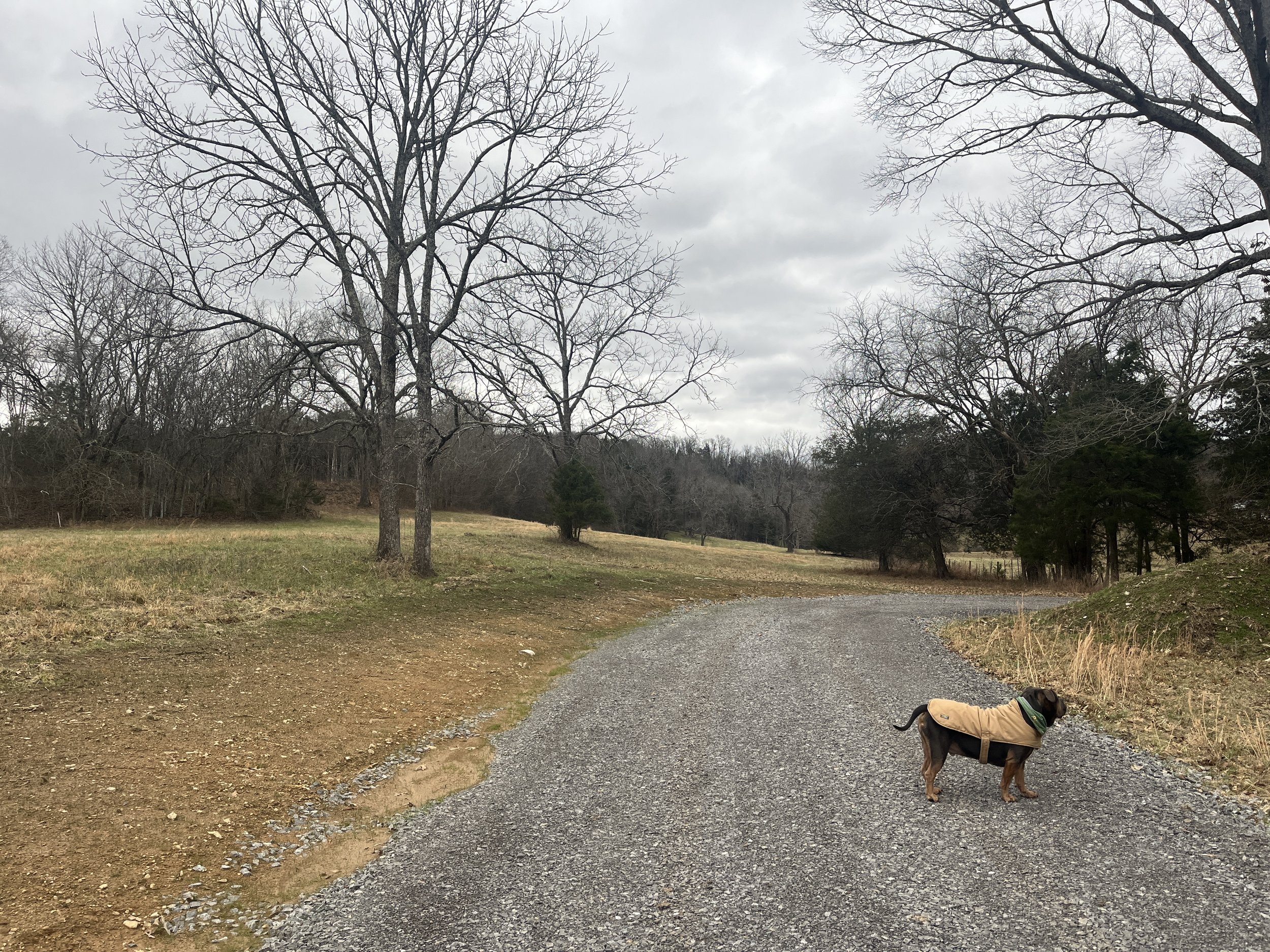
January on the farm. Still out here. Still learning.
Then I'll show you what the land has been trying to say. And we'll design something together that couldn't exist on any other piece of ground on earth because it will have grown directly from the intelligence of yours.
I work in phases, because the land keeps teaching. A tree I plant in year one changes the light for what I plant in year three. Each phase informs the next, and the property gets smarter and more beautiful as it grows. The years between planting and maturity aren't a gap to endure, they're part of the design, and a great plan accounts for how a property will look and feel during every stage of its becoming. An estate garden isn't a product you receive. It's a living thing that deepens with time, and working with someone who understands that is the difference between a property you show off and a property you fall in love with a little more every year.
Your Land Is Already Working
Right now, wherever your property is, your land is doing something. Water is moving through it along paths it carved long before your name was on the deed. Wind is crossing it from angles that shift with the season. The sun is painting different rooms across its surface every hour of the day. Animals are living on it in patterns you haven't discovered yet. Your neighbors are doing things on their side of the fence that will shape what's possible on yours.
All of that is information. All of that is design material as real and as essential as any plant you'll ever choose or any stone you'll ever set. And all of it is available to you, if you're willing to do the one thing this industry almost never asks: slow down. Watch. Let your land speak before you answer.
I know that's not what most people want to hear. They want a master site plan in weeks and shovels in the ground by fall. There are plenty of firms happy to provide that.
But if you want something else, a property that feels like it was always supposed to look this way, where the design and the land seem to have arrived at the same conclusion on their own, that's land portraiture. And it takes time. And you need someone willing to take it.
That's what I do. And my own farm, with its obstinate clay, its storm-carved slopes, its deer who sleep in the clearing I'll never plant, and its neighbor's cows who keep finding their way through a fence I'll never stop mending, is where I learned how.
I'd love to hear about your land. What drew you to it, what you've noticed so far, what you're dreaming about for it. That's where every good project starts, just a conversation between two people who care about the same piece of ground.
Learn more about how to plan and design for large property acreage here.