
Nashville Pool Landscaping in Zone 7a: Designing the Garden Around the Water
Your Pool Is a Water Feature, Start Treating It Like One.
Most pool builds in Nashville end with concrete, sod, and a row of boxwood. That's not a landscape. That's a missed opportunity to create the most important room in your house.
I need to say something that might sound obvious but apparently isn't, based on how most Nashville pool builds end up: a pool is a water feature.
It is the single largest, most dramatic water feature you will ever install on your property. Larger than any fountain. More visually dominant than any pond. More expensive than most of the other elements in your landscape combined. It is a body of water sitting in the middle of your yard, reflecting the sky.
And yet, in neighborhood after neighborhood across Williamson County, Davidson County, Wilson County, I watch homeowners spend $80,000, $100,000, $150,000+ on a pool build, and then surround it with a concrete deck, a strip of sod, and maybe a row of dwarf hollies or boxwood if the pool company threw in a "landscaping package." The pool itself is gorgeous. The space around it is dead.
I don't mean the plants are dead, although in Nashville clay they often will be within a year. I mean the space has no life in it. No texture. No fragrance. No movement. No sound other than the pool pump. No reason to look up from the water and feel something. It is a rectangle of water in a rectangle of concrete in a rectangle of grass, and it could be anywhere. It could be a hotel in any city. There is nothing about the space that says this is yours. This is where your life happens.
That's what I want to talk about. Not "softening hardscapes" or "enhancing your outdoor experience." I want to talk about what a pool becomes when you design the garden around it as if the pool were what it actually is; the centerpiece water feature of the most expensive room in your home.
What the Pool Builder Leaves Behind
Let's start with what you're actually working with after the pool crew packs up. Because this is the starting point for most of my pool-related consultations, and it's almost always the same story.
The pool builder excavated a massive hole in your yard. Heavy equipment, excavators, concrete trucks, plumbing trucks, drove across your property for weeks or months. The soil around the pool is now compacted to the density of a parking lot. Whatever topsoil existed has been scraped away, mixed with subsoil, or buried under backfill. The grading around the pool deck is designed for one purpose, making sure water drains away from the pool, and that purpose doesn't always align with what plants need.
You're left with a beautiful pool surrounded by bare, compacted, often poorly draining ground with little to no organic matter in the soil. The concrete or stone deck radiates heat. The areas closest to the pool get chlorinated splash water. And the pool builder's landscaping recommendation, if they offer one at all, is usually "put some bushes around it."
This is not a criticism of pool builders. They build excellent pools. But a pool builder is not a garden designer any more than a framing carpenter is an interior designer. The pool is the structure. The garden around it is the composition. And the composition is what determines whether your backyard feels like a room you want to spend your life in, or a chlorinated slab you visit when it's hot enough.
A Pool Is Where Your Life Happens
Here's what I've seen happen, every single time, when a pool garden is designed with intention.
The family that built the pool for the kids? They start eating dinner outside because the patio finally feels like a space worth setting a table in. The plantings created a sense of enclosure, not a wall; a feeling of being held by the space rather than exposed in it. The kids swim, sure. But the parents stay outside after the kids go in, because the garden smells like sweet olive and the light is doing something to the ornamental grasses that makes the whole space glow at dusk.
The couple that built the pool because they wanted a place to unwind? They stop going inside at sunset. They sit by the water with a glass of wine and listen to the rustling of the grasses and the birds settling into the trees for the night. The pool isn't just a thing they use. It's a thing they sit near. It changes the pace of their evening. It changes the pace of their thinking.
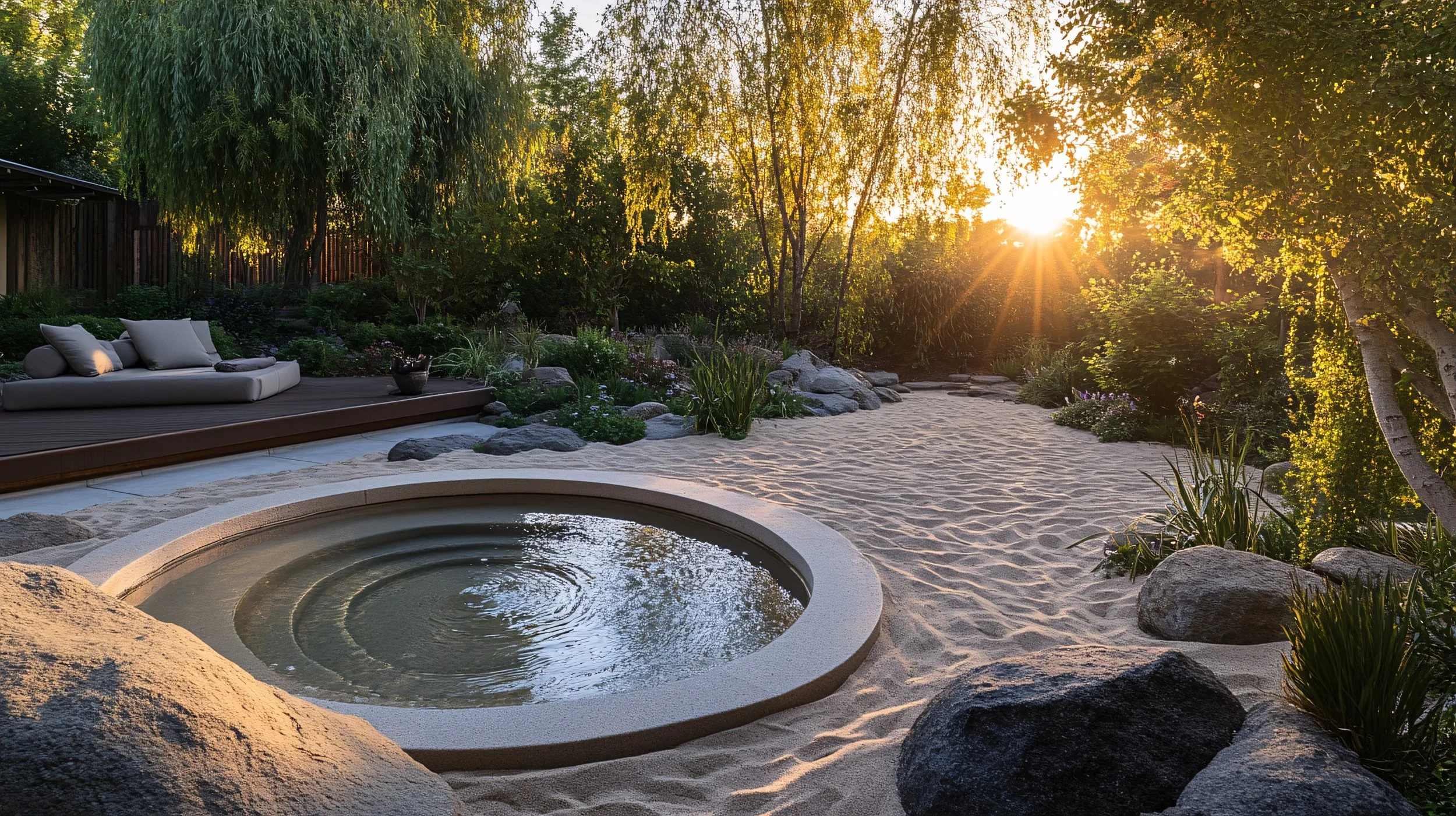
Even the smallest adult pools have a much greater impact on the life happening in and around them when they are designed with thoughtful care.
The retired homeowner who built the pool for the grandchildren? The grandchildren remember the butterfly that landed on the coneflower next to the pool. They remember catching a frog near the rain garden at the edge of the property. They remember the smell of the garden, the feel of the warm stone under their feet, the way the whole backyard felt like a world. Not just a pool. A place.
This is what I mean when I say a pool is a water feature. A water feature is not utilitarian. It is experiential. It creates atmosphere. It interacts with light, sound, fragrance, movement, and the living things around it. Your pool already does this with light, watch it at golden hour and tell me it doesn't. But if the only things surrounding that water are concrete and turf grass, you've given it nothing to interact with. You've put a jewel in a cardboard box.
A pool surrounded by a garden is a fundamentally different experience from a pool surrounded by a deck. It is the difference between swimming in a living space and swimming in a construction project.
The Real Challenges of Planting Around a Nashville Pool
Before I talk about what to plant, I need to talk about why planting around a Nashville pool is harder than most homeowners, and most landscapers, realize. Because the conditions within 15 feet of a pool are not the same as the conditions in the rest of your yard, and if you ignore these differences, your plants will fail.
Reflected heat. A concrete or stone pool deck absorbs solar radiation all day and radiates it back. The air temperature on and immediately adjacent to a pool deck can be 10–15 degrees hotter than the ambient temperature. Plants sitting in beds right against the deck are living in a microclimate that's closer to Zone 8 or even 9 in summer. This means they need to be heat-tolerant beyond what Nashville's Zone 7a designation suggests. Delicate woodland plants and cool-season perennials will cook.
Chlorine and salt splash. Every splash, every kid doing a cannonball, every time someone gets out of the pool and drips across the deck, that's chlorinated or salt water hitting the soil and foliage of nearby plants. Most plants can handle occasional splash. But beds immediately adjacent to the pool, within three to five feet of the water line, get chronic exposure. Over time, chlorine and salt accumulate in the soil and burn sensitive foliage. You need plants that tolerate this, and you need to plan for periodic deep watering of those beds to flush the salts through the soil.
Compacted soil and backfill. As I described above, the ground around a new pool build is typically devastated. Before you plant anything, you need to address the soil. This means breaking up compaction in the planting areas, incorporating 3–4 inches of quality compost into the top 8–10 inches, and verifying that water actually drains through the amended beds rather than pooling. If the pool builder graded the surrounding area to drain toward a specific point, make sure your planting beds work with that drainage pattern, not against it.
The leaf and debris calculation. This is the one everyone's heard about, and it's real, but it's more nuanced than "don't plant trees near a pool." The actual rule is: don't plant trees or shrubs that produce heavy seasonal leaf drop, messy fruit, or sticky sap directly over or immediately adjacent to the pool. But you absolutely can, and should, plant trees and large shrubs near your pool for shade, screening, and canopy. You just need to choose the right ones and position them thoughtfully. More on this below.
What to Plant and Where: A Nashville Pool Garden, Zone by Zone
I think about pool landscaping in three concentric zones, each with different conditions and different design roles.
Zone 1: The Splash Zone (0–5 feet from the pool edge)
This is the hardest zone. Chronic splash exposure, maximum reflected heat, foot traffic, and the need for plants that don't shed debris into the water. It's also the most visually important zone, these are the plants your eye sees first when you're in the pool looking out.
What works here:
Ornamental grasses are the heroes of this zone. They handle heat, they tolerate occasional salt splash, they don't drop leaves into the pool, and they move in the wind, which is the single most important design quality for a pool garden, because movement transforms a static space into a living one.
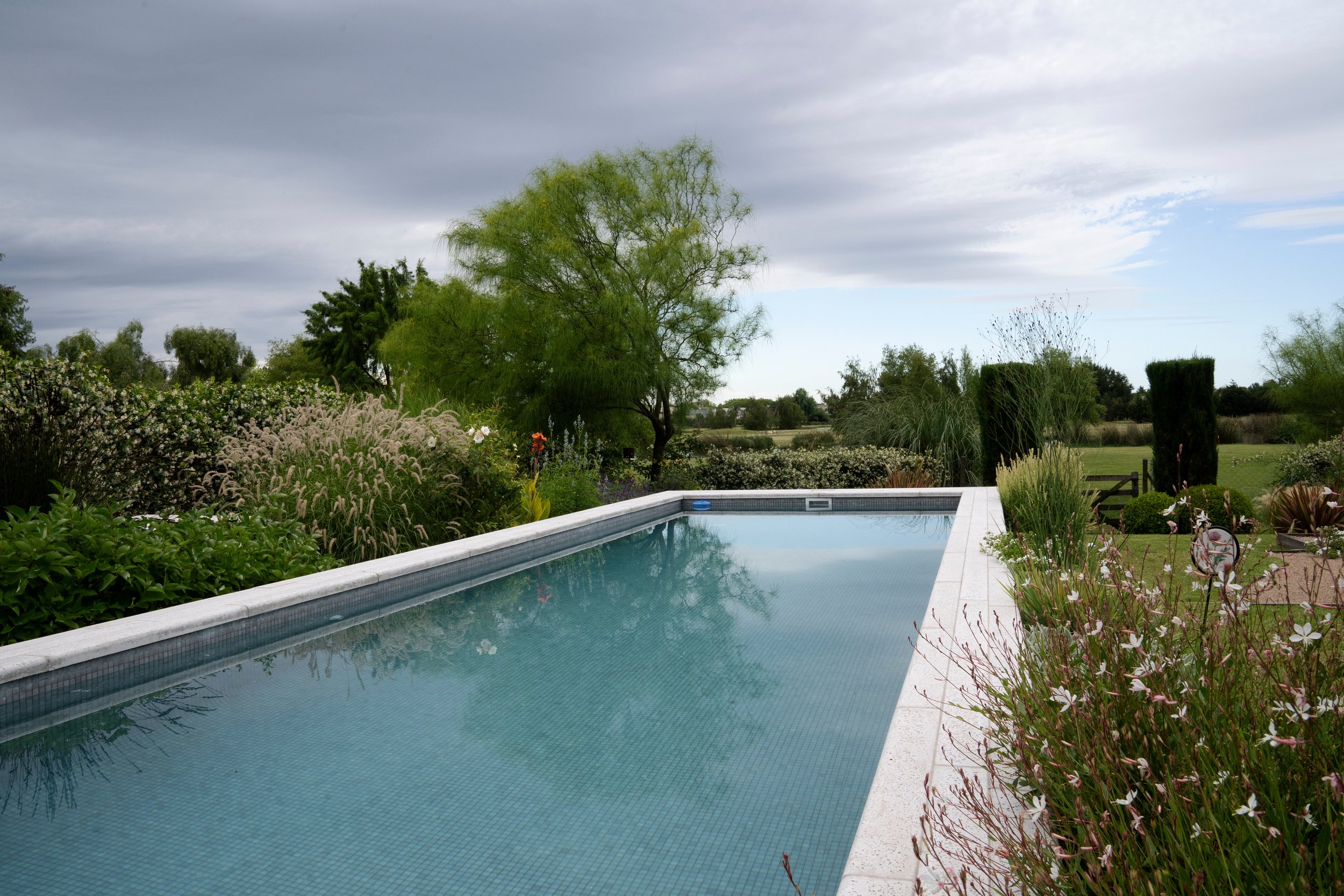
Ornamental grasses provide even the most geometrical of pools with softness, movement, and texture.
Muhlenbergia capillaris (Pink Muhly Grass) — those pink cloud seed heads in October, hovering above the water? Unforgettable. Full sun, heat-loving, drought-tolerant once established, and it thrives in Nashville clay. Plant it where the afternoon light catches the seed heads from across the pool.
Panicum virgatum 'Northwind' (Switchgrass) — Stiff, upright, columnar. Doesn't flop. Gold fall color. Stands through winter. This is the structural grass; it gives vertical line and architectural presence next to the horizontal plane of the water.
Nassella tenuissima (Mexican Feather Grass) — Fine, flowing, perpetually in motion. It catches every breath of wind. Planted near the pool where you can see it from the water, it adds a softness that concrete and stone can't provide on their own. It does self-seed, so be aware, but in contained beds near a pool deck, it's manageable and stunning.
For non-grass options in this zone: Agave 'Blue Glow' or 'Whale's Tongue' in a large container on the deck (dramatic, sculptural, zero debris), Yucca 'Color Guard' (variegated, architectural, heat-proof), and Lantana as a seasonal color punch that handles the heat radiating off the deck.
What doesn't work here: Boxwood (gets scorched by reflected heat and doesn't like splash), most ferns (too delicate for this microclimate), anything that drops petals or berries into the water.
Zone 2: The Garden Frame (5–15 feet from the pool)
This is where the real garden happens. The reflected heat is less intense, splash exposure is minimal, and you have room for the layered, textured planting that transforms the space from "pool with some plants" to "garden with a pool in it."
Screening and structure:
This is the zone where you solve privacy. And privacy around a Nashville pool is not optional, your neighbors are close, especially in the newer subdivisions where lot sizes are shrinking even as pool builds are booming.
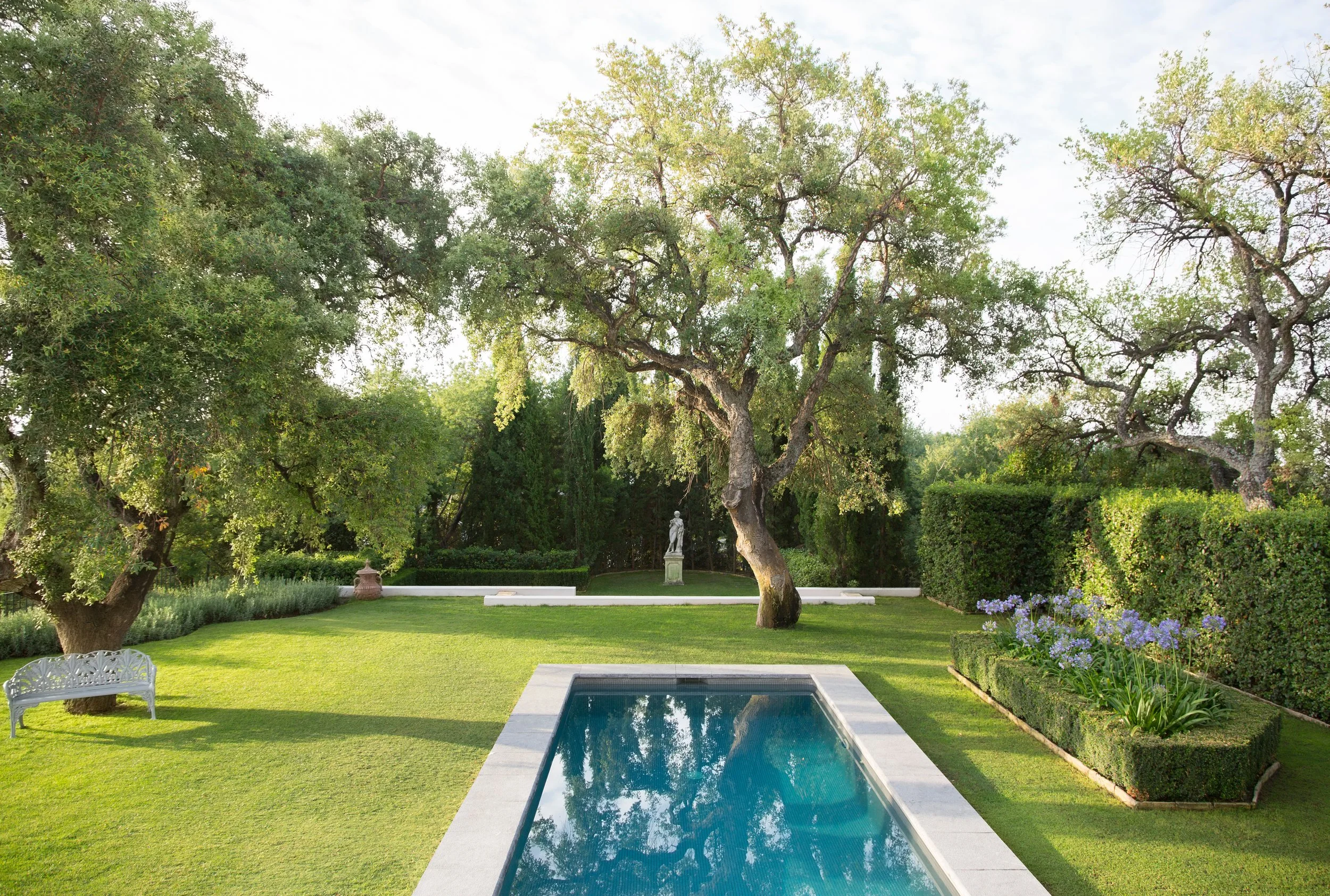
Privacy hedges and thoughtful tree placement create a private layered retreat around the pool’s perimeter.
Thuja 'Green Giant' (Green Giant Arborvitae) — Fast-growing evergreen screen. Plant 5–6 feet apart for a solid wall within 2–3 years. Position it far enough from the pool that it's not dropping needles directly into the water. This is your workhorse privacy solution.
Juniperus virginiana 'Taylor' (Taylor Juniper) — Columnar native. Narrow footprint for tight spaces. Handles heat, clay, drought. Excellent where you need a vertical screen but don't have room for the width of an arborvitae.
Ilex vomitoria 'Will Fleming' (Will Fleming Yaupon Holly) — Another tight columnar option. Native. Evergreen. Extremely tough. Tolerates the reflected heat near a pool better than most evergreen screens because Yaupon is naturally a full-sun, heat-adapted species.
Mid-layer planting — the texture and fragrance layer:
Calamintha nepeta (Lesser Calamint) — Clouds of tiny white flowers from June through frost. Fragrant when brushed against. Pollinators love it. Drought-tolerant. Low, mounding habit. This is the plant that makes people stop and ask "what is that?" because the entire plant hums with bees and smells like mint on a warm evening.
Salvia 'Amistad' — Deep purple spikes from May through hard frost. Heat-loving. Hummingbird magnet. Stunning against the blue of a pool.
Vitex agnus-castus (Chaste Tree) — Trained as a small multi-trunk tree, this gives you lavender-blue flower spikes all summer, silvery-green foliage, and a Mediterranean feel that works beautifully against pool stone and water. It handles the heat zone near a pool like nothing else. Prune hard in late winter and it comes back vigorous every year.
Osmanthus fragrans (Sweet Olive / Tea Olive) — In a sheltered spot (south-facing, near a wall or the house), Sweet Olive can survive Nashville winters and reward you with the most intoxicating fragrance of any plant you'll ever grow. The tiny flowers are invisible, and you smell it before you see it. Imagine sitting by the pool on an October evening and catching that scent on the air. That's what a pool garden is for.
Rosa 'Drift' series (Drift Roses) — Low, spreading, continuous bloom from May through frost. Disease-resistant. Handles heat. Zero maintenance beyond an annual cutback. These fill the mid-ground between the pool deck and the taller screening plants with reliable, no-drama color.
The groundcover layer:
Nepeta 'Junior Walker' (Catmint) — Lavender-blue spikes, gray-green foliage, fragrant, blooms for months, drought-tolerant, deer-resistant. Spills beautifully over the edges of raised beds or stone walls near the pool. This is the plant that ties everything together at ground level.
Thymus 'Elfin' or 'Coccineus' (Creeping Thyme) — In the cracks between pavers or flagstone near the pool, creeping thyme handles foot traffic, releases fragrance when stepped on, and stays flat. It needs decent drainage, so it works best in stone joints or raised beds rather than raw clay.
Zone 3: The Canopy and Backdrop (15+ feet from the pool)
This is where your shade trees and large specimen plants live. Far enough from the pool to minimize debris in the water, but close enough to create the canopy and enclosure that make the pool area feel like a room rather than an exposed rectangle.
Trees for a Nashville pool garden:
Lagerstroemia 'Natchez' or 'Muskogee' (Crepe Myrtle) — The classic Nashville pool tree. Summer bloom, gorgeous bark, minimal leaf litter compared to deciduous shade trees, and the multi-trunk form creates a canopy that filters light rather than blocking it entirely. Position so the canopy reaches over the seating area but not directly over the water.
Cercis canadensis (Eastern Redbud) — Small, native, spring-blooming. Heart-shaped leaves provide dappled shade. The canopy is open enough that debris is minimal. Beautiful structure in winter.
Quercus shumardii (Shumard Oak) — If you want real shade for the long term and have the space (20+ feet from the pool edge), Shumard Oak handles Nashville clay, grows relatively fast for an oak, and develops a magnificent canopy. Yes, oaks drop leaves. That's what a pool cover and a good leaf blower are for. Don't let leaf anxiety prevent you from having a shade tree; a pool with no shade in a Nashville July is a pool nobody uses between noon and 5pm.
Magnolia grandiflora 'Bracken's Brown Beauty' — Evergreen. Large, glossy leaves. Fragrant white flowers in late spring. The cultivar 'Bracken's Brown Beauty' is the one that handles Zone 7a reliably. Plant it as a specimen tree at the back of the pool garden where its year-round presence anchors the composition.
A Design Philosophy, Not a Plant List
I've given you specific plants because specifics matter and because most pool landscaping advice is uselessly vague. But I want to be clear about something: a list of plants is not a design. A design is a composition; a deliberate arrangement of form, texture, color, fragrance, movement, and seasonal change that creates a feeling.
The feeling I'm designing for in a pool garden is this: you're somewhere. Not just "outside." Not just "by the pool." You're in a place that has its own atmosphere, its own scent, its own light, its own sounds. The water reflects the sky and the trees. The grasses move. The Calamint hums with bees. The Sweet Olive reaches you on the evening air. The stone is warm under your feet. The space holds you.
That's what separates a garden designed as a composition from a landscaping package stapled onto a pool bid.
Your pool cost more than most people's kitchens. The garden around it is what turns that investment into a place your family actually lives in, not just a place they swim. It's where the birthday parties happen. Where the Saturday mornings are. Where your teenager brings a book and sits in the shade and doesn't look at a screen for two hours and you pretend not to notice because you don't want to break the spell.
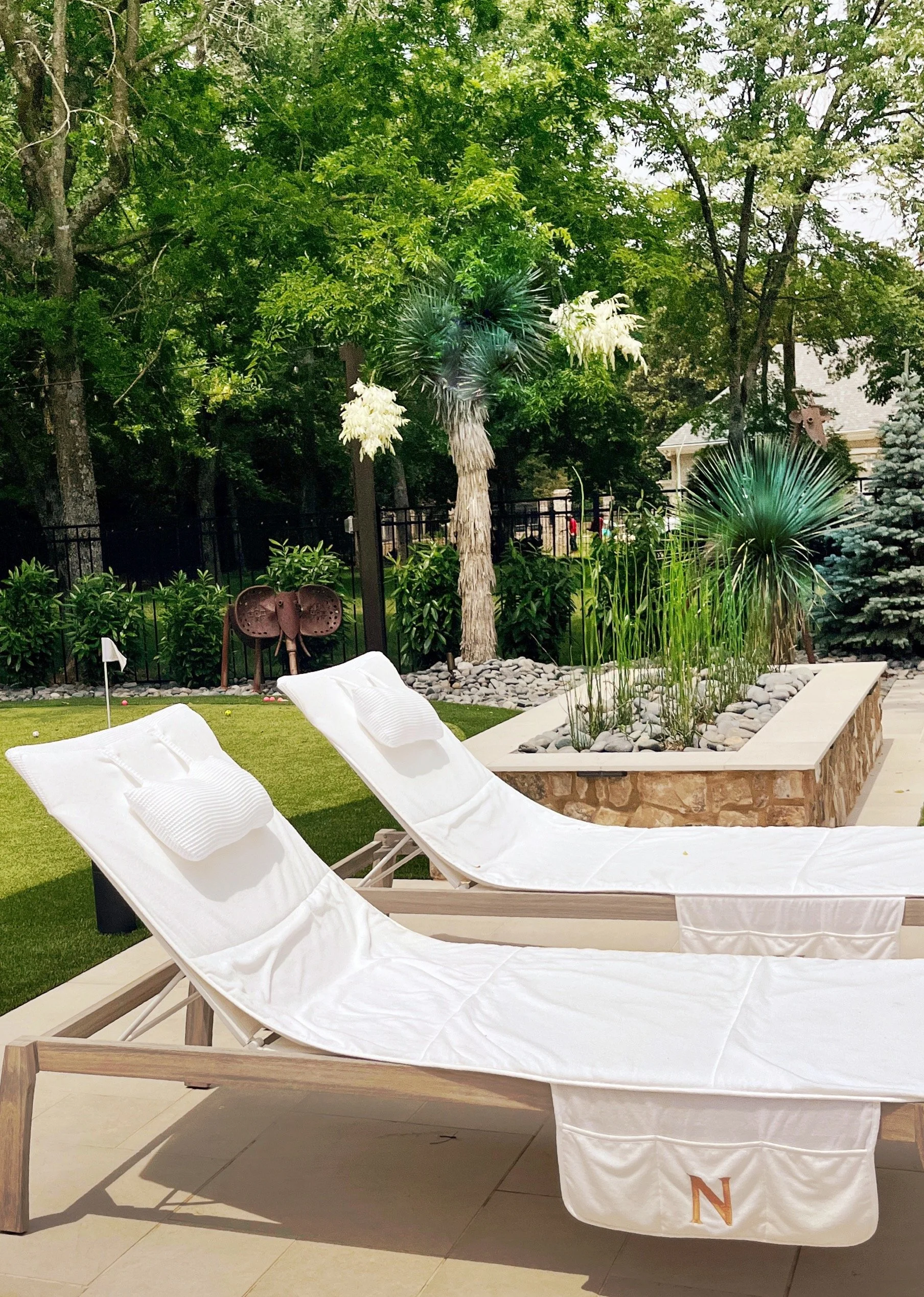
A pool surrounded by life, by fragrance and movement and texture and sound, is a completely different thing from a pool surrounded by concrete. One is a feature. The other is a place. The difference is the garden.
The Practical Stuff: Before You Plant
A few things to handle before you buy a single plant:
Fix the soil first. I've said this in every blog post on this site and I'll say it again: Nashville clay that's been driven over by pool construction equipment is not soil you can plant into. Break up compaction. Add compost. Verify drainage. If you skip this step, nothing else matters. The details on Nashville soil prep are in my spring playbook.
Think about irrigation. Beds near a pool deck dry out faster than beds in the rest of your yard because of the reflected heat and because the deck itself prevents rainwater from reaching the adjacent soil. A simple drip irrigation zone for the pool garden beds is worth the investment; it keeps plants alive through Nashville's brutal summers without you having to drag a hose around the pool deck.
Plan for lighting. A pool garden at night, well-lit, is one of the most beautiful things you can create in a residential landscape. Uplighting on specimen trees, path lighting along walkways, and subtle wash lighting on textured plantings transforms the space after dark. This is worth planning during the design phase, not retrofitting after the plants are in.
Consider the whole property. The pool garden doesn't exist in isolation; it connects to the rest of your landscape. The transition from the pool area to the broader yard, the front garden, and the approach from the house should feel intentional. If the pool garden is lush and layered and then you step around the corner into bare builder-grade sod, the spell breaks. A design consultation looks at the whole property as a single composition, not just the area around the pool.
Your Pool Deserves a Garden
You already made the big investment. The pool is in. The water is blue. The deck is finished.
Now give it something to be part of.
Not a row of generic shrubs from the pool company's subcontractor. Not a strip of sod that turns brown by July. Not a landscape that looks like it was designed by someone who's never sat beside that pool at dusk and wondered what the space could feel like if it were alive.
Give it grasses that catch the wind. Give it fragrance that reaches you while you're floating. Give it trees that filter the light into something golden. Give it a garden that makes your family want to be outside, not just in the water, but near it, around it, in the living space it was always meant to anchor.
A pool is a water feature. The most magnificent water feature most people will ever own. Design it like one.
What Pool Owners Ask Me
What's the biggest mistake people make landscaping around a new pool?
Treating it as an afterthought. The pool builder finishes, the deck goes in, and then someone calls a landscaper who sticks a row of boxwood along the fence and spreads mulch. That's not design. That's filling space. The area around your pool is the most used, most visible, and most expensive outdoor space on your property, and the conditions within 15 feet of a pool are completely different from the rest of your yard. Reflected heat off the deck, chlorine splash on foliage, compacted soil from the pool build, drainage patterns altered by construction. If you don't design for those specific conditions, your plants will fail and your space will feel like a concrete slab with some struggling shrubs around it.
Won't trees near a pool just mean leaves in the water all the time?
This is the question that stops people from planting trees, and the result is pools baking in full Nashville sun with no shade and no canopy, which means nobody uses the pool between noon and 5pm in July. You need trees near your pool. You just need the right trees in the right position. Crepe Myrtle 'Natchez' or 'Muskogee' as a multi-trunk gives you a high canopy that filters light over the seating area without hanging directly over the water. Eastern Redbud is small, open-canopied, and drops minimal debris. Shumard Oak, if you have the space and place it 20+ feet from the pool edge, gives you real shade for the long term. Yes, oaks drop leaves. That's what a pool cover and a leaf blower are for. Don't let leaf anxiety prevent you from having a shade tree. A pool with no shade in a Nashville August is a pool nobody uses.
How do I get privacy around my pool without it feeling like a prison?
Layer. Don't build a wall. The instinct is to line the fence with a single row of identical evergreens and call it done. That creates privacy but it also creates a claustrophobic enclosure that feels defensive rather than inviting. A layered border, tall evergreen screening in the back, flowering shrubs and grasses in the middle, low perennials at the front edge, gives you complete screening that also gives you a garden. From inside the pool area, you're not looking at a green wall. You're looking at Oakleaf Hydrangea blooming, catmint spilling, Switchgrass catching the breeze, and a few well-placed crepe myrtles providing canopy. The neighbor is gone. But you forgot about the neighbor because you're inside something beautiful.
The soil around my pool is terrible. What happened?
The pool builder happened. Heavy equipment, excavators, concrete trucks, plumbing trucks, drove across the area around your pool for weeks or months during construction. Whatever topsoil existed was scraped away or mixed with subsoil and backfill. The ground is compacted to the density of a parking lot. And the grading was designed to move water away from the pool, not to support plant life. You're planting into devastated ground. Before a single plant goes in, you need to break up compaction in the planting areas, incorporate 3–4 inches of compost into the top 8–10 inches, and verify that water actually drains rather than pooling. Skip this step and nothing else matters; the most beautiful plant selection in the world won't survive in compacted backfill with no organic matter.
Will chlorine or salt water kill my plants?
Chronic splash exposure will stress sensitive plants over time. The beds immediately adjacent to the pool, within three to five feet of the water line, get hit with chlorinated or salt water every time someone swims, does a cannonball, or drips across the deck. Most plants handle occasional splash. But over a full summer of daily use, salt and chlorine accumulate in the soil and burn delicate foliage. The solution is twofold: choose tough, splash-tolerant plants for the beds closest to the water (ornamental grasses, Yaupon Holly, Lantana, Drift Roses), and deep-water those beds periodically to flush salts through the soil. Plants 5+ feet from the pool edge rarely experience enough splash to matter.
How hot does it actually get on the pool deck?
Hot enough to change your plant choices. A concrete or stone pool deck absorbs solar radiation all day and radiates it back. Air temperature on and immediately adjacent to the deck can be 10–15 degrees hotter than the ambient temperature. You're essentially gardening in Zone 8 or 9 conditions during summer. Delicate woodland plants and cool-season perennials will cook next to the deck. You need heat-lovers; things that thrive in full sun and reflected warmth. Yaupon Holly handles reflected heat better than almost any evergreen. Vitex blooms all summer in it. Grasses are unfazed by it. Boxwood, on the other hand, often scorches next to a pool deck and sulks through Nashville summers. If your pool landscaper is recommending boxwood as the foundation around your pool, they're not thinking about the microclimate.
Should I add a water feature if I already have a pool?
Yes, but not for the visual. For the sound. Your pool is a body of still water. It's beautiful but it's silent. A small fountain, a bubbling stone, or a pondless waterfall near the seating area adds a layer of sound that still water can't provide. Moving water masks road noise, neighbor noise, and the mechanical hum of the pool pump. It gives the space a voice. And at night, water catching light from your landscape lighting becomes one of the most beautiful elements in the entire garden. The water feature doesn't compete with the pool; it completes it. Your pool is already the biggest water feature on your property. A smaller moving-water element gives it a soundtrack.
What about lighting around the pool?
Plan it during the design phase, not after the plants are in. Nightscaping around a pool transforms the space after dark, and Nashville families use their pools in the evening as much as during the day. Uplight specimen trees so the canopy glows above the pool. Use path lighting along walkways so people can move safely. Wash light across textured plantings, grasses, bark, stone, o the garden is visible at night, not just a dark void beyond the deck. And light the water feature if you have one; moving water lit from below or behind at night is one of the most beautiful things you can create in a residential landscape. The goal isn't to flood the space with brightness. It's to reveal it selectively. The pool deck catches moonlight on its own. The garden needs help after dark, and the right lighting makes the pool area as compelling at 9pm as it is at noon.
Do I need irrigation for the pool garden?
Yes. The beds adjacent to a pool deck dry out faster than beds in the rest of your yard. The deck itself prevents rainwater from reaching the adjacent soil; rain hits the concrete and runs to the drain instead of soaking into the planting beds. And the reflected heat accelerates evaporation. A simple drip irrigation zone for the pool garden beds is one of the smartest investments you can make. It keeps plants alive through Nashville's brutal summers without requiring you to drag a hose around the pool deck, which nobody does consistently enough to keep plants healthy. Set it up during installation. A properly zoned drip system costs far less than replacing dead plants every other year.
My pool is already in and the landscaping around it is bad. Can it be fixed?
Always. I get this call regularly: the pool is gorgeous, the deck is beautiful, and everything planted around it is either dead, dying, or a row of generic hollies that look like they belong at a gas station. The fix starts with understanding the conditions: the heat, the splash, the compacted soil, the drainage, and then designing specifically for them. It's not about ripping everything out. Sometimes it's about removing what's failing, amending the soil in the planting areas, and replacing with species chosen for the microclimate around a pool instead of the microclimate of a regular garden bed. The pool didn't change. The conditions didn't change. The plant choices do. And the right choices, in the right soil, with the right design thinking, turn the space from a struggling afterthought into the best room on your property.
Is my pool a water feature?
Yes. It's the single largest, most dramatic, most expensive water feature you will ever install on your property. Larger than any fountain. More visually dominant than any pond. It reflects the sky. It interacts with light. It changes throughout the day. And if the only things surrounding it are concrete and turf grass, you've put a jewel in a cardboard box. A pool surrounded by a living garden, fragrance, movement, texture, sound, canopy, is a completely different experience from a pool surrounded by a deck. One is a feature. The other is a place. The difference is the garden.
If your pool deserves better than what the pool company left behind, I'd love to help you design what should have been there from the start.