
Privacy Is a Garden, Not a Wall: A Designer's Guide to Screening in Nashville
Everyone wants privacy. Almost nobody thinks about it correctly. Here's how to stop blocking views and start creating rooms.
Privacy is the number-one request I hear from clients. It comes up in nearly every consultation I do, and I understand why. Lots are getting smaller. Houses are getting larger. New construction in Williamson and Wilson Counties is packing homes closer together than the established neighborhoods ever imagined. Your neighbor's second-story bonus room looks directly into your backyard. The house behind you cleared their trees, and now you can see their entire property from your patio. The road that felt distant when you bought the house feels like it's in your living room since the buffer trees came down.
So people start searching for "privacy screens" and "privacy fences" and "how to block my neighbor's view." And what they find, on every landscaping website, in every listicle, is the same advice: plant a row of Green Giant Arborvitae. Problem solved.
I want to offer you a completely different way to think about this.
The Problem with the Privacy Row
A single row of Green Giant Arborvitae planted five feet apart on your property line will, in fact, block your neighbor's view within a few years. It will also give you a flat green wall that looks like a highway sound barrier. It has no depth, no texture, no seasonal interest, no ecological value, and no beauty. It does one thing: blocks sight lines, and it does it in the most monotonous way possible.
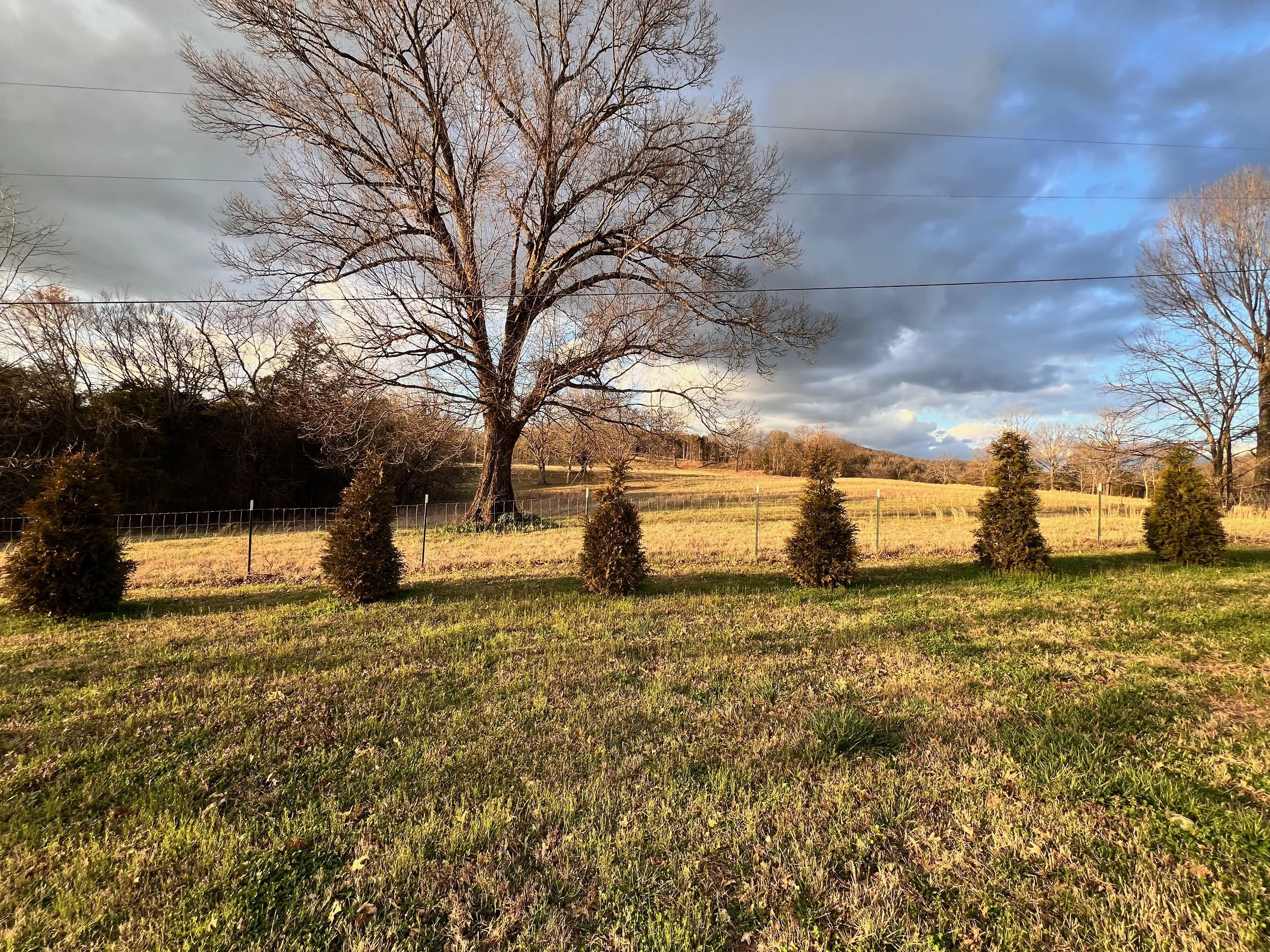
Row of Green Giants planted at 10’ from center.
It also has practical problems that most Nashville homeowners don't discover until year five or six. Green Giants grow 3–5 feet per year. They want to be 40–60 feet tall and 12–15 feet wide at maturity. If you planted them five feet apart on a standard Nashville lot, they're going to crowd each other. The lower branches will shade out and die, leaving you with bare trunks topped by a canopy, exactly the opposite of the dense, ground-to-sky screen you wanted. And if one dies, from bagworms, from root rot in poorly draining clay, from ice storm damage, you have a gap in your wall that's visible from space.
I'm not against arborvitae. I use them. But a single row of identical plants is not a design. It's a reflex. And there's something so much better available to you if you think about privacy differently.
Reframing Privacy: You're Not Building a Wall. You're Creating a Room.
Here's the shift I want you to make. Stop thinking about what you're blocking. Start thinking about what you're creating.
When I design for privacy, I'm not drawing a line on the property boundary and filling it with the tallest evergreen I can find. I'm creating enclosure, the feeling of being held by a space. A garden room has a floor (your lawn, your patio, your groundcover), a ceiling (the tree canopy, a pergola, the sky), and walls (the planted borders that define the space). The "walls" are where privacy happens. But they're not flat. They're not uniform. They're layered, textured, varied in height and density, and they're doing a dozen things besides blocking a sight line, they're blooming, they're providing habitat, they're creating fragrance, they're giving you something beautiful to look at from inside the room they're making.
A well-designed privacy planting doesn't feel like you're hiding. It feels like you're somewhere. Like you stepped into a space that's yours: enclosed, intimate, and alive. The neighbor isn't gone. They're just irrelevant, because you're inside something better than a blocked view. You're inside a garden.
That's what I design for. Here's how it works.

A living green privacy screen made up of tiered evergreens to add depth, height, and color interest.
The Layered Screen: How a Designer Thinks About Privacy
The most effective and most beautiful privacy planting in Nashville isn't a row. It's a border, a layered composition with depth, usually 6–12 feet from front to back, with three distinct layers working together.
The back layer (the tall screen) — This is your primary sight-line blocker. Evergreen trees or large shrubs that provide year-round density from roughly 8 feet to whatever height you need. This layer faces the thing you want to screen and does the structural work.
The mid layer (the texture and interest) — Smaller evergreen and deciduous shrubs, ornamental trees, and tall perennials that fill the space in front of the back layer. This is where seasonal bloom, fall color, fragrance, and wildlife value live. This layer faces you; it's what you look at from inside your garden room.
The front layer (the edge) — Low perennials, groundcovers, and small grasses that finish the composition at the border's edge. This layer ties the privacy planting into the rest of the garden and gives the whole thing a polished, intentional look.
When you layer like this, you get something no single row can give you: privacy that's also beautiful from your side. The back layer does the work. The mid and front layers give you a garden. And the depth of the planting creates a density that a single row never achieves, because you're screening with 10 feet of layered vegetation, not 3 feet of a single tree's canopy.
Now let me get specific. Nashville-specific. Cultivar-specific.
The Back Layer: Year-Round Structure and Screening
These are the plants that do the heavy lifting. They need to be evergreen (or semi-evergreen), dense, tall enough to block the relevant sight lines, and, critically, tolerant of Nashville's alkaline clay, humidity, and temperature extremes.
Thuja 'Green Giant' (Green Giant Arborvitae) — Yes, I'm including it. It's fast, it's dense, it's reliable. The key is how you use it. Don't plant a single row at 5-foot spacing and call it done. Plant it as the back layer of a deeper border, at 8–10 foot spacing, and layer in front of it. At wider spacing, each tree develops its full pyramidal form instead of being squeezed into a column. You get a screen that's more natural, more resilient (one loss doesn't leave a visible gap), and infinitely more interesting because it has plants in front of it.
Juniperus virginiana 'Taylor' (Taylor Juniper) — A columnar native that tops out at 20–25 feet tall but stays only 3–4 feet wide. This is your solution for tight spaces where you need vertical screening but don't have room for the width of an arborvitae. Dense, dark green, handles clay, drought, heat, and every other thing Nashville throws at it. Native to Middle Tennessee. Plant at 3–4 foot spacing for a tight column screen, or stagger with other species for a more varied composition.
Ilex × attenuata 'Nellie R. Stevens' (Nellie Stevens Holly) — Dense pyramidal evergreen reaching 15–25 feet. Glossy dark green leaves, red berries in winter if a male pollinator is nearby. Faster-growing than most hollies. Handles clay and partial shade. One of the best alternatives to arborvitae for Nashville screening; it gives you density without the monoculture feel, and the berries feed birds all winter.
Ilex vomitoria 'Will Fleming' (Will Fleming Yaupon Holly) — Tight columnar form, native, extremely tough. For spots where you need a narrow evergreen column that handles full sun, reflected heat, clay, drought, and neglect. Tops out around 15 feet. Think of it as the native version of an Italian Cypress: vertical, elegant, and bulletproof in Nashville conditions.
Cryptomeria japonica 'Yoshino' (Yoshino Japanese Cedar) — A beautiful alternative to arborvitae that more Nashville designers should be using. Pyramidal form, soft feathery foliage that stays green through winter (with slight bronze tinting in cold), and a graceful, less rigid character than Thuja. Grows 30–40 feet tall. Handles our clay if drainage is reasonable. Gives you an evergreen screen with genuine beauty; it doesn't look like a utility planting.
Magnolia grandiflora 'Bracken's Brown Beauty' — If you have the space and want a screen with presence, a row of Southern Magnolias is unmatched. Evergreen, fragrant white flowers in late spring, glossy leaves with brown felted undersides, and a canopy that grows dense enough to provide complete year-round screening. 'Bracken's Brown Beauty' is the cultivar for Zone 7a; more cold-hardy and compact than the species. This is a statement screen. It says something different than a row of arborvitae.
× Cuprocyparis leylandii (Leyland Cypress) — I include this with a strong caveat. Leyland Cypress grows extremely fast (3–4 feet per year) and provides screening quickly, which is why it's overplanted in Nashville. But it's susceptible to Seiridium canker and Botryosphaeria canker, both of which are common in our humidity, and a dead Leyland in a row is a highly visible problem. If you use it, plant it as part of a mixed screen, not a monoculture. If one fails, the mixed planting absorbs the loss.
The Mid Layer: Where the Garden Happens
This is the layer most landscapers don't think about. It's the layer that transforms a screen into a garden. These plants go in front of your tall evergreens and face your garden room. They're what you see when you look toward the privacy border from your patio or your kitchen window.

A formal hedge back layer provides height, privacy, and year-round greenery, while the mid-layer creates the garden space you want to live in.
Hydrangea quercifolia 'Ruby Slippers' (Oakleaf Hydrangea) — Native, four-season interest: white flower panicles in summer aging to pink, spectacular burgundy-red fall color, exfoliating bark in winter. Reaches 4–5 feet. Handles shade from the tall evergreens behind it. One of the most valuable shrubs in Nashville design and criminally underused in privacy plantings.
Calycanthus floridus (Carolina Allspice / Sweetshrub) — Native shrub with fragrant, dark red-brown flowers in late spring. The fragrance is the point: it's sweet, fruity, and carries on the air. A privacy border that smells good from inside the garden room is a fundamentally different experience from one that's just green.
Fothergilla major 'Mt. Airy' — Bottlebrush-like white fragrant flowers in spring before the leaves emerge, then blue-green summer foliage, then blazing orange-red-yellow fall color. 5–6 feet tall. An underused native shrub that gives three seasons of strong interest. Plant it in groups of three in the mid layer for impact.
Itea virginica 'Henry's Garnet' (Virginia Sweetspire) — Fragrant white flower racemes in late spring, deep burgundy fall color, arching habit that softens the rigid forms of the evergreens behind it. Native. Handles wet clay AND drought; one of the few shrubs equally comfortable in both extremes. 3–5 feet tall.
Viburnum × pragense (Prague Viburnum) — Semi-evergreen to evergreen in Nashville, meaning it holds its dark glossy leaves through most winters. White flower clusters in spring, excellent as a mid-layer screen element because of its density and winter presence. Reaches 8–10 feet. This is the mid-layer plant that adds winter screening beyond what deciduous shrubs can offer.
Distylium 'Vintage Jade' — My go-to boxwood replacement. Evergreen, dense, mounding, handles shade, clay, humidity, and deer. In the mid layer of a privacy border, it provides reliable year-round green at the 3–4 foot height range. Not exciting. Completely dependable. Every border needs plants like this holding the structure together.
Ornamental Grasses in the Mid Layer
Grasses deserve their own mention because they do something no shrub can; they move. In a privacy planting, movement transforms a static wall into a living border. The rustling sound adds another layer of screening: auditory privacy, masking conversation and street noise the way a water feature does.
Panicum virgatum 'Northwind' (Switchgrass) — 5–6 feet of stiff, upright, blue-green foliage that turns gold in fall and stands through winter. My most-used structural grass. In a privacy border, it fills the mid-height zone with year-round presence and movement. Native.
Calamagrostis × acutiflora 'Karl Foerster' (Feather Reed Grass) — Narrow, upright, 4–5 feet. Wheat-colored seed heads from June through winter. Useful where you want grass height in a narrow space. Technically not native, but non-invasive and well-adapted to Nashville.
The Front Layer: The Finished Edge
These plants tie the privacy border into the rest of your landscape. They face outward toward the garden and give the whole composition a polished, intentional look.
Nepeta 'Walker's Low' or 'Junior Walker' (Catmint) — Lavender-blue spikes, gray-green aromatic foliage, blooms for months, drought-tolerant, deer-resistant. Spills beautifully along a border edge. The fragrance when you brush against it is one of the small pleasures of a well-planted garden.
Calamintha nepeta (Lesser Calamint) — Clouds of tiny white flowers from June through frost. The entire plant hums with pollinators. Low, mounding, fragrant, and tough. One of the best front-layer plants for Nashville.
Geranium 'Rozanne' — Long-blooming (May through frost) perennial geranium with violet-blue flowers. Scrambles through other plants and knits the front edge together. One of the longest-blooming perennials available.
Liriope muscari 'Big Blue' (Lilyturf) — Evergreen, grass-like, purple flower spikes in late summer, dense enough to suppress weeds at the border edge. It's common in Nashville, almost too common, but it's common because it works. In a layered privacy border with interesting plants above it, Liriope at the front is a reliable foundation that lets the rest of the composition shine.
Beyond Plants: The Design Elements That Complete Enclosure
Plants are the primary tool, but a designed privacy garden can incorporate other elements that deepen the sense of enclosure and room-making.
Water features. I've written about this in the pool post, moving water provides auditory privacy that plants alone can't. A fountain, a pondless waterfall, even a simple bubbling urn placed between your seating area and the noise source replaces traffic, conversation, and mechanical sounds with the sound of water. Your brain stops registering the noise you wanted to escape.

The fountain in this garden space helps to drown out surrounding noise.
Structures with vines. A pergola, arbor, or trellis covered with a climbing plant gives you overhead enclosure — the ceiling of your garden room. The best climbers for Nashville structures: Climbing Hydrangea (Hydrangea anomala petiolaris) for shade, slow to start, magnificent once established, with white lacecap flowers and exfoliating bark; Crossvine (Bignonia capreolata) 'Tangerine Beauty' for sun, native, semi-evergreen, orange trumpet flowers in spring that hummingbirds fight over; and Clematis, dozens of varieties for every situation, from the massive spring-blooming Clematis montana to the late-season Clematis terniflora (Sweet Autumn Clematis, which smells incredible in September but self-seeds aggressively, be warned).

Build your own vine support to customize your space or buy pre-made arbors and trellis online!
Grade changes and raised beds. Every foot of elevation you add to a planting bed is a foot of height you don't need from the plants. A raised stone wall at 2–3 feet planted with 5-foot shrubs gives you 7–8 feet of screening with plants that stay manageable. This is especially useful in tight spaces where you can't accommodate large trees.
Sculpture, art, and focal points. A large pot, a stone sculpture, a piece of weathered steel — these are the elements that make a privacy garden feel intentional rather than reactive. They say "this space was designed" rather than "we needed to block the neighbor." Antique malls and estate sales in Nashville are full of pieces with character. Place them where the sight line enters your garden room; they become what the eye finds instead of the thing you were trying to hide.
Use Container Gardens for Portable Privacy. Container gardens are a great way to add privacy to a specific area of your yard. You can use pots to create a barrier around your patio or to block an unsightly view.

Mobile containers allow you to move planters exactly where you want privacy or increased shade.
The Nashville Privacy Challenge: What Your Contractor Doesn’t Know
Here's the truth about privacy screening in Nashville that generic listicles don't address.
New construction lots have almost no room for depth. The newer subdivisions in Spring Hill, Nolensville, and southern Williamson County have setbacks so tight that a 10-foot deep layered border isn't possible on many properties. You have to get creative: columnar plants like Taylor Juniper and Will Fleming Yaupon that screen in 3–4 feet of width. Vertical screening on structures. Container plantings on elevated decks. The design challenge is harder on small lots, and the solution is more specific to the site, not less.

Ornamental grasses installed within raised planters help to increase privacy on this Nashville rooftop.
Second-story sight lines require different thinking. A 6-foot fence doesn't help when the neighbor's bonus room window is 20 feet up. You need canopy: tall trees that provide overhead screening. This is where Magnolias, large Cryptomeria, or strategically placed deciduous trees with dense summer canopies come in. The screen doesn't need to be solid, it needs to be sufficient. Filtered privacy is often enough, and a tree canopy that breaks the direct sight line while allowing dappled light through is more pleasant than a solid evergreen wall.
Clay drainage affects your plant choices. If the area where you need screening is also where water collects, common along fence lines and property edges where grading often directs runoff, our "drought-tolerant" screening plants may drown. Read the drainage before you choose the plants. Virginia Sweetspire handles wet feet. Most conifers don't. The soil and drainage story applies here too.
Privacy Is a Feeling, Not a Feature
I want to leave you with this. The goal of privacy screening isn't to build a wall between you and the world. It's to create a space where the world outside stops mattering, because the space inside the garden is so complete, so layered, so alive and fragrant and textured and yours that you forget there's anything on the other side.
That's a garden room. A room made of living things that changes with the light and the seasons and holds you while you're in it.
If your current "privacy screen" is a bare fence or a struggling row of Leylands or a property line that makes you feel exposed every time you step outside, there's a better version of that space waiting. One that gives you privacy AND a garden. Let me know if you'd like to find it.