
How Much Does Landscaping Cost in Nashville?
A designer’s honest breakdown of what projects actually cost and what’s really driving the price.
I’m going to be straight with you: there’s no single answer to this question. I know that’s not what you want to hear when you’re trying to figure out a budget. But the reason every landscaping website gives you a range instead of a number is because it genuinely depends on your property, your soil, your access, and what you’re actually trying to create.
What I can do is tell you what I’m seeing on real projects in Nashville, Williamson County, Wilson County, and the surrounding areas right now in 2026. Not national averages. Not what a website in California thinks Tennessee costs. What things actually cost when you’re standing on red clay in Middle Tennessee trying to build something beautiful.

The Short Answer
A general rule of thumb in the industry is to budget about 10% of your home’s value for landscaping. If you have a $500,000 home, a $50,000 landscape budget is appropriate. If your home is $800,000, you’re looking at $80,000.
On average, I see residential landscape projects in the Nashville area range from $40,000 to $60,000. Some are less. Many are more. It depends entirely on how much property you’re working with and how much of that property you want to transform.
But that number by itself doesn’t tell you much. So let me break down where the money actually goes.
What Actually Drives the Cost (It’s Probably Not What You Think)
Most people assume the plants and materials are the expensive part. They’re not. Labor is 60–80% of your total project cost. The stone, the plants, the mulch — those are a fraction of what you’re paying. What costs money is the skilled crew who knows how to install everything correctly so it’s still beautiful in five years.
Here’s what affects your price more than almost anything else:
Site Access
If a crew can drive a skid steer into your backyard, that’s one price. If everything has to be hand-carried through a gate, around the house, and down a slope in a wheel-barrow? That’s 30–50% more labor time. I’ve seen access issues alone add thousands to a project. This is one of the first things I assess on a site visit, and it’s something most homeowners don’t think to ask about.
Nashville’s Soil
If you’ve ever stuck a shovel in your yard and hit something that feels like a brick wall 18 inches down, you’ve met our clay. Nashville sits in Zone 7a, and our soil ranges from dense red clay in Williamson County to silty loam along the Cumberland River basin. In much of southern Davidson, Sumner, and Wilson Counties, the clay swells when it’s wet and cracks when it’s dry. This means drainage has to be designed, not guessed at. It means soil amendments aren’t optional. It means your crew may need specialized equipment for grading. All of this affects the price.
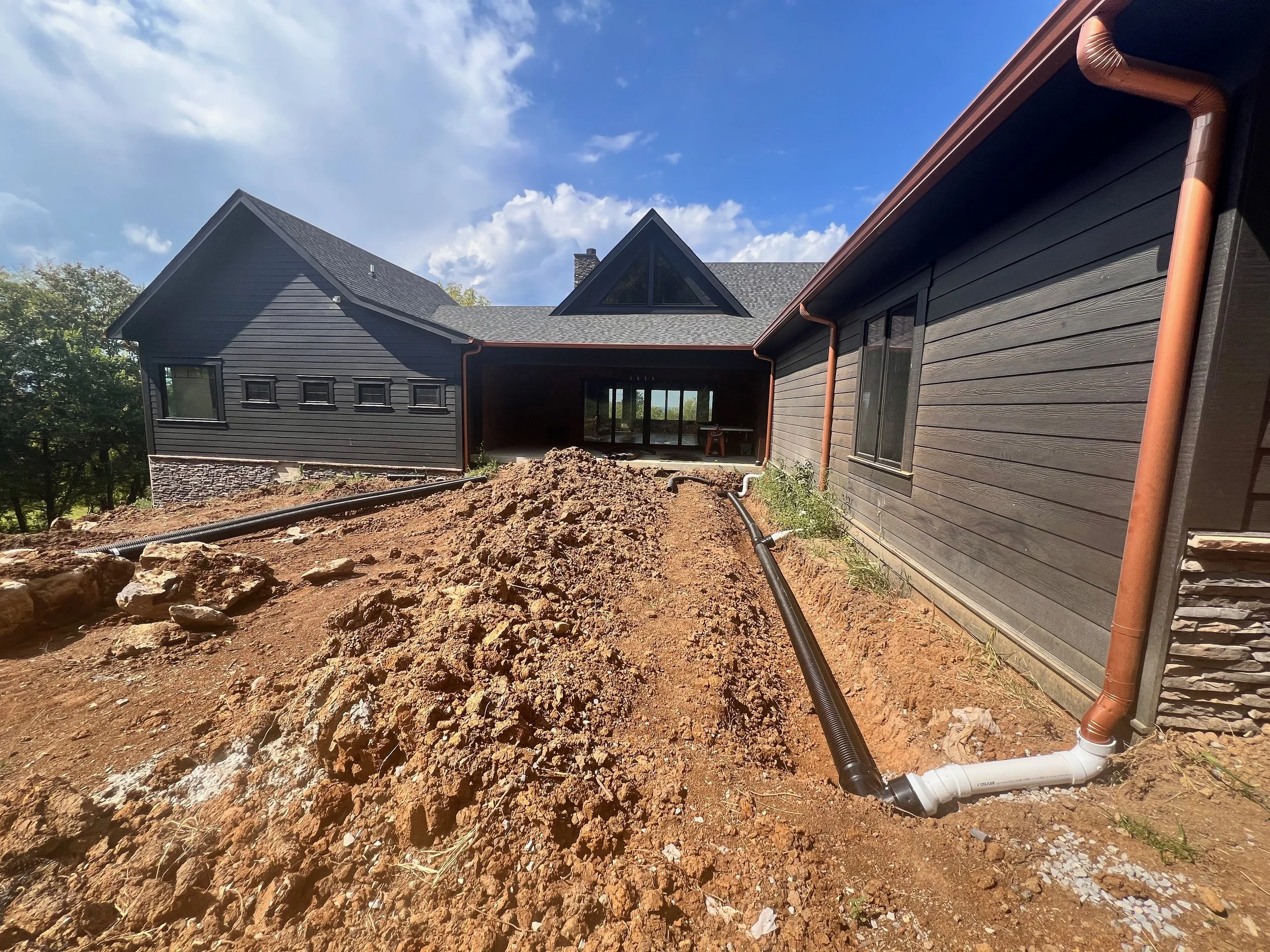
This is what Nashville’s clay soil looks like during a new build — and why drainage planning can’t wait until after the house is finished. That red clay doesn’t forgive. If water isn’t directed intentionally from the start, you’re solving expensive problems for years.
Slope and Grading
Nashville is not flat. If your property has any significant grade changes, you’re likely looking at retaining walls, terracing, or re-grading, and those are some of the most labor-intensive features in any landscape project. A flat lot in a Brentwood subdivision and a sloped lot in Sumner County are going to produce very different bids for otherwise similar projects.
What You’re Actually Building
There’s a significant difference between refreshing existing beds with new plantings and designing an entirely new outdoor living space from scratch. A foundation planting refresh is a very different project than a full backyard with a patio, fire pit, retaining walls, lighting, irrigation, and garden beds. Both are valid investments. They’re just different scales.
What Specific Features Cost in Nashville (2025 Pricing)
These are the ranges I’m seeing on real projects in 2025. About 75% of the time, a given feature will fall somewhere in these ranges. But remember: every property is different. The size of your lot, the materials you choose, and the overall scope of your project will shift these numbers. This is a starting point for your thinking, not a final quote.
Front Yard
Foundation Plantings: $12,000 – $18,000+
Foundation planting is the plants that go around your house: close to the walls, under the windows, beside the doors. It’s the backbone of your garden design and your property’s curb appeal. Foundation plants usually focus on year-round evergreen structure from trees and shrubs, with layers of texture and seasonal interest woven in.
Enhanced Front Yard Planting: $15,000 – $20,000+
This builds on your foundation plantings, adding varied heights, tiers, textures, and color through the addition of ornamental trees, layered shrubs, grasses, and perennials. If foundation planting is the bones, enhanced planting is the personality.
Walkways and Pathways: $6,500 – $9,500+
Material choice makes the biggest difference here, a simple gravel path is a different animal than a hand-laid natural stone walkway. Labor and site access affect the price significantly as well.
Irrigation and Drainage: $8,000 – $15,000+
This covers everything from timed drip irrigation lines to full underground French drain systems. The price depends heavily on your property size and how many irrigation stations are needed. In Nashville’s clay soil, proper drainage isn’t a luxury, it’s a necessity.
![[Nashville back yard Japanese garden with gravel patio, circular wood decking, topiary pom trees, and water feature.] - Meditation Garden Design by The Grass Girl](https://images.squarespace-cdn.com/content/v1/5d4b8776c9fed300018d8f4a/1771025248738-ELPFU9ESOJDU9WZ4V9FU/Nashville-Japanese-Meditation-Garden-The-Grass-Girl.jpeg)
Japanese gravel garden with custom circular decking
Backyard
Patio: $10,000 – $25,000+
Landscape Lighting: $275 – $425+ per light fixture
Wood-Burning Fire Pit: $3,500 – $9,000+
Gas Fire Pit: $9,000 – $15,000+
Retaining Wall: $12,000 – $25,000+
Privacy Screening: $15,000 – $20,000+
Fencing: $10,000 – $20,000+
Sloped Terracing: $15,000 – $40,000+
Natural Rock Water Feature: $7,000+
Custom Garden Moon Gate, Bridge, Arbor, or Trellis: $3,000 – $8,000+
Note on backyard pricing: The “+” on every one of these ranges is doing a lot of work. A 200-square-foot paver patio is a different conversation than an 800-square-foot natural stone patio with integrated seating. If you’re building several of these features together as part of one project, the overall scope affects pricing — sometimes in your favor, because your crew is already mobilized on site.
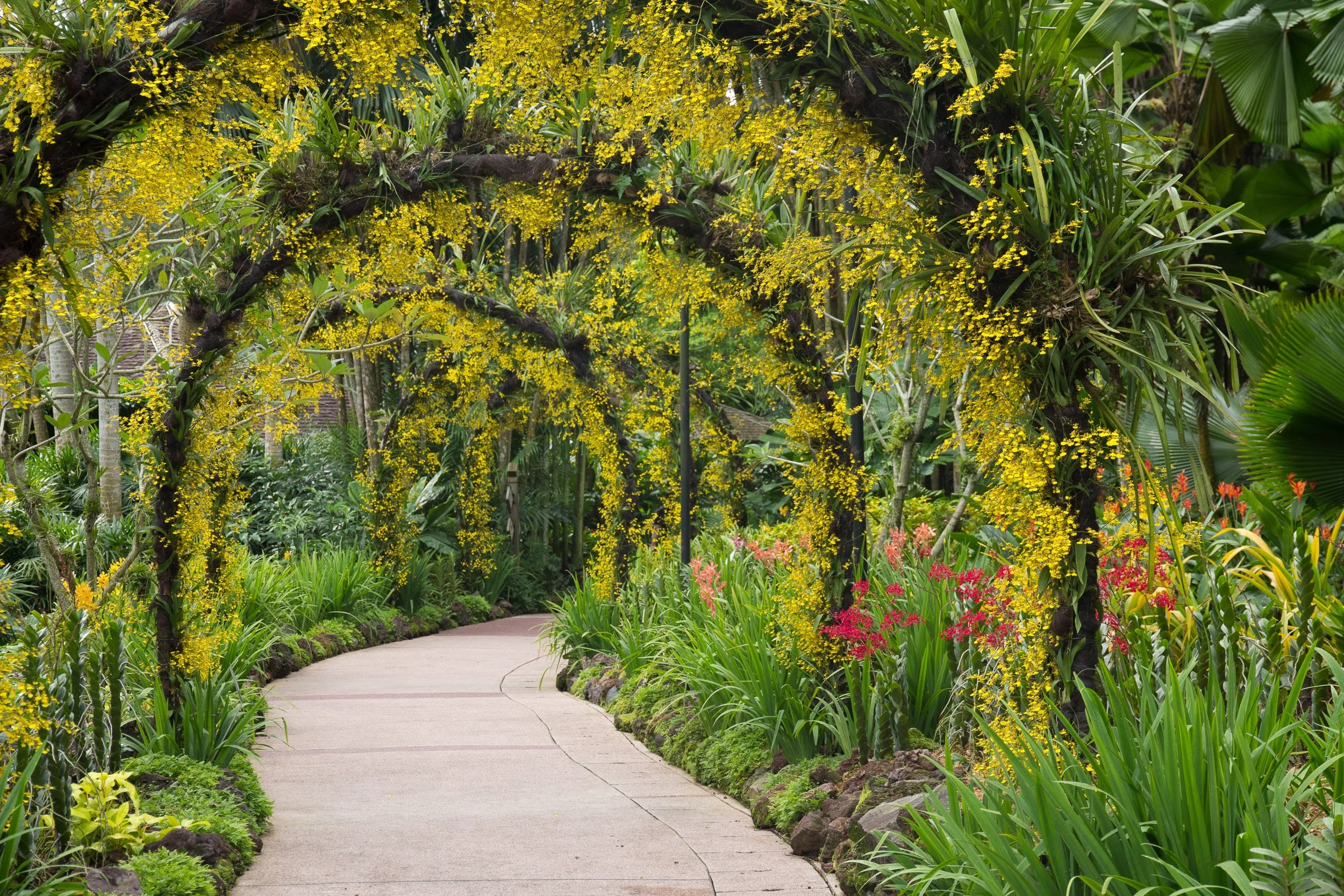
Custom Arbors
The Question Behind the Price: Are You Designing, or Are You Just Installing?
Here’s something most cost guides won’t tell you: the biggest factor in whether your landscape investment holds its value isn’t the materials. It’s whether someone actually designed it.
There’s a meaningful difference between hiring a crew to install a patio and plants, and hiring a designer who studies your property, how the light moves, where water flows, what you’ll see from your kitchen window, how the space will feel in January versus July, and then creates a plan that accounts for all of it before a single shovel goes in the ground.
I’m a garden designer with a fine art background. I approach outdoor spaces the way I approach composition in any other medium: every element has a reason, every plant has a role, every material is chosen for how it ages, how it catches light, and how it fits the larger vision. That perspective, the planning, the coordination with your contractor the on-site oversight during installation, is what keeps a $50,000 investment from looking like a $50,000 mistake five years later. (If you’re not sure whether you need a designer or a landscaper, I wrote a whole post about that distinction.)
How to Be Smart About Your Landscape Budget
Phase Your Project
You don’t have to do everything at once. In fact, I often recommend phasing. Get the infrastructure right first, drainage, grading, irrigation, because those are the things that cost dramatically more to retrofit later. Then build out your hardscape. Then your plantings. A good design accounts for phases from the start, so each phase feels complete rather than half-finished.
Don’t Skip the Infrastructure
I understand the temptation to put most of your budget toward the things you can see: the pretty patio, the lush plantings. But drainage, soil prep, and proper grading are the bones of your landscape. If the bones are wrong, everything on top of them fails. I’ve seen homeowners spend $20,000 on plantings only to watch half of them drown because no one addressed where the water was going. Spend the money on infrastructure. Your garden will thank you for it.
Get a Design Before You Get a Quote
Calling three companies and asking for a bid without a design is like asking three contractors to build your house without blueprints. You’ll get three wildly different numbers because everyone is imagining a different project. A design gives you a clear scope, which gives you apples-to-apples comparisons, which gives you actual control over your budget.
Think About the Calendar
In Nashville, fall is actually the best time to plant trees and shrubs: the roots establish during our mild winters, and the plants are ready to take off in spring. Designers are also typically less booked in late fall and winter, which means you may get faster turnaround on your design. Starting your design conversation in February or March means you’re positioned to install when the timing is actually right for the plants.
A Note on “Cheap” Landscaping
I want to be honest about something: you can absolutely find someone who will do your landscaping for less than the ranges I’ve listed above. There are crews who will install a patio and foundation plantings for half of what I’ve quoted here.
The question isn’t whether you can find cheaper. The question is what you’re getting. Are they pulling permits? Are they accounting for drainage? Do they know which plants actually thrive in Nashville’s clay? Are they going to be around next year when the retaining wall starts leaning or the plantings die because no one amended the soil?
The most expensive landscaping project is the one you have to do twice. I’ve walked onto more properties than I can count where the homeowner’s first call was to me because their first installation didn’t survive, and now they’re paying to tear it out and replace it. That’s not an investment. That’s paying double.