
When Should You Hire a Landscape Designer During a Nashville New Build?
The answer is earlier than you think. A Middle Tennessee garden designer on how to bring landscape design into a Nashville new build without wasting money or time.
I want to tell you about a project that still keeps me up at night.
A couple in Williamson County reached out to me about their new construction home. They’d spent over a year designing the interior with their architect; every cabinet pull, every tile, every light fixture chosen with care. They’d poured their hearts into it. The house was beautiful.
By the time they called me, the builder had already finished grading the lot. The heavy equipment had compacted the soil into something resembling concrete. The topsoil, what little there had been, was scraped away and mixed with construction debris. The natural drainage pattern of the property had been completely rerouted. And the builder had placed the driveway in a spot that effectively cut off the best area for a garden from the rest of the yard.
We made it work. We always make it work. But it cost them significantly more than it would have if they’d brought me in six months earlier, and there were compromises we had to make that I still think about. A mature tree that could have been saved. A natural low spot that would have been a gorgeous rain garden, now buried under fill dirt. A sight line from the kitchen window that could have framed something extraordinary.
I tell you this story not to scare you, but because I see it happen over and over again in Nashville. People pour enormous energy and resources into building their dream home, and then treat the landscape as an afterthought, something to figure out after the certificate of occupancy is in hand.
The landscape is not an afterthought. It’s the first thing you see when you pull into your driveway, and it’s the last thing you see when you look out your window at night. It’s where your children will play, where you’ll have your morning coffee, where you’ll grow things and watch them change with the seasons. It deserves the same intentionality as every room inside your house.
So let’s talk about when to actually bring a landscape designer into your new build process, step by step, and why the answer is much earlier than most people expect.
The Ideal Timeline: When a Landscape Designer Should Enter the Conversation
Phase 1: During Architectural Design (Before You Break Ground)
This is the dream scenario, and it’s more achievable than you think.
If you’re working with an architect on a custom home in Nashville, whether it’s a new build on acreage in Wilson County, a lot in one of Williamson County’s planned communities, or an infill project in Davidson County, the ideal time to engage a landscape designer is while the house plans are still being developed.
I know that sounds early. You might be thinking, “We haven’t even finalized the floor plan yet. Why would we be talking about gardens?”
Here’s why: the position of your house on the lot determines everything about your landscape. It determines where the sun hits in the morning and where shade falls in the afternoon. It determines your drainage patterns, your views, your privacy, and the relationship between your indoor living spaces and the outdoors. A landscape designer can look at a site plan and see things that even excellent architects sometimes miss, not because architects aren’t brilliant (they are), but because they’re focused on the building. I’m focused on everything around it.
At this phase, I’m not designing garden beds or picking plants. I’m asking questions like:
Where does the natural water flow on this property, and how will grading affect it? Which existing trees can we save, and are they worth saving? Where should the driveway go so it doesn’t compromise the best garden space? What will the view from the primary bedroom window look like? Where is south-facing exposure, and how can we use it? If you want a pool or outdoor kitchen in the future, where should the utility rough-ins or sleeves go now so you’re not jackhammering through a patio later?
This kind of early input doesn’t cost much; it’s usually a single site visit and a brief consultation. But the decisions it influences can save tens of thousands of dollars down the road.
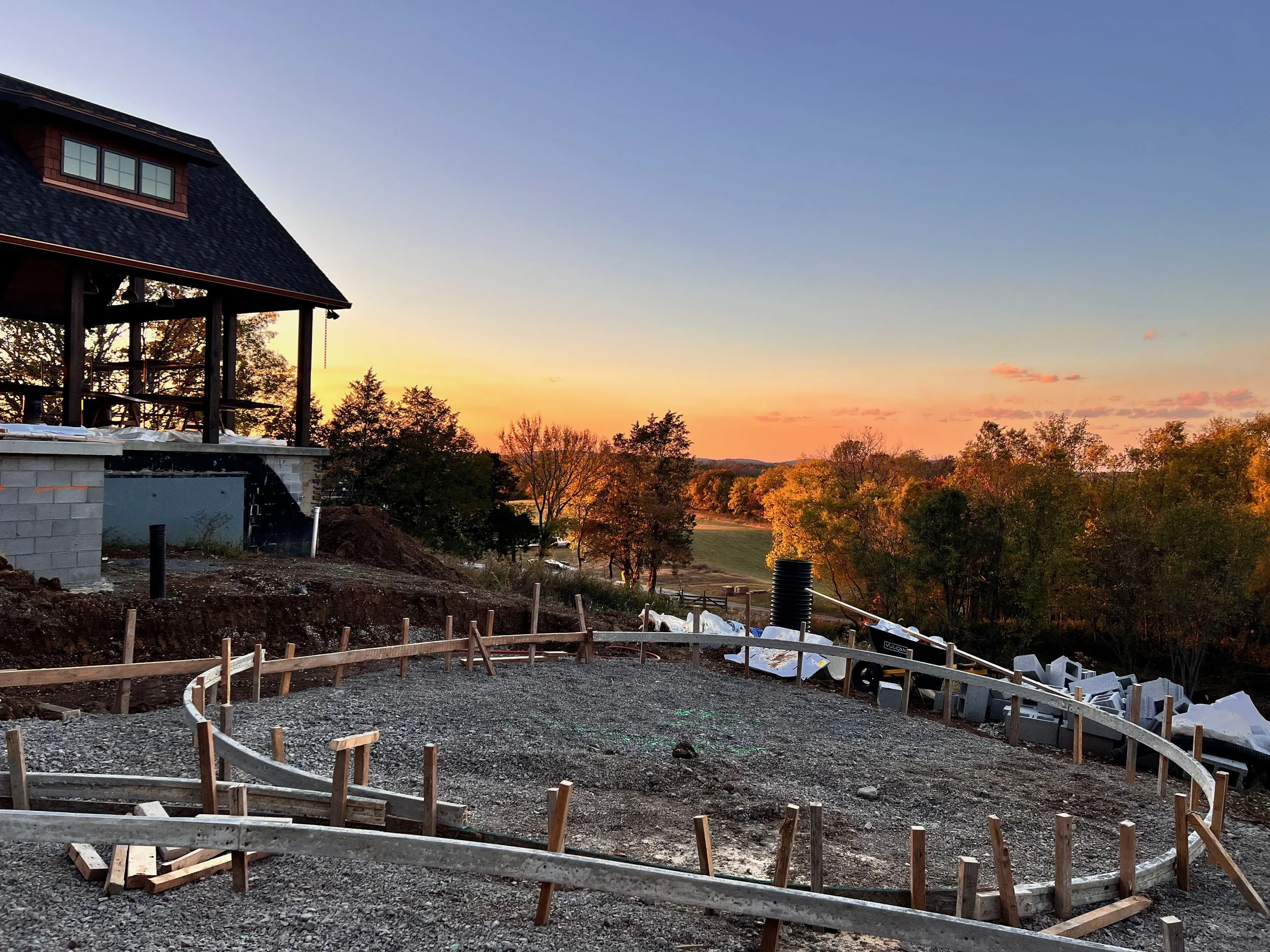
This is what six months of studying a property looks like before a single stone is placed. We had the time to walk this land across seasons — watching how the light shifted, where the best views opened up, when the family would actually be outside using each space. Every curve of this hardscape was positioned to frame a specific sight line at a specific time of day. You can't get this from a two-week turnaround. You get this from patience, presence, and knowing the land.
Phase 2: During Construction (While the Builder Is on Site)
If you’re past the architectural phase but your home is currently under construction, you are still in an excellent position. This is actually when most of my new-build clients come to me, and there’s a lot we can accomplish.
While the builder’s crew and heavy equipment are on site, there’s a window of opportunity that closes the moment they leave. This is when we can:
Coordinate with the builder on final grading so the landscape plan is considered before the lot gets its final shape. Run conduit for landscape lighting, irrigation lines, and gas lines for a future outdoor kitchen or fire feature, while the trenches are already open. Protect existing trees that are worth keeping by establishing tree protection zones before heavy equipment damages root systems. Identify where the builder is stockpiling topsoil (if they’re stockpiling it at all — more on that in a minute). Plan for proper drainage infrastructure so you don’t end up with a swamp in your backyard every time it rains.
Nashville’s clay soil makes this coordination especially critical. If you’ve ever tried to dig in Middle Tennessee clay after it’s been compacted by construction equipment, you know it’s like trying to plant in a parking lot. When I can work with the builder during construction, we can ensure that areas designated for planting get properly amended soil, not the compressed, nutrient-stripped substrate that heavy machinery leaves behind.
Phase 3: After Construction (But Before You “Just Plant Some Stuff”)
If your home is already built and you’re staring at a yard of bare dirt or builder-grade sod and three sad boxwoods, don’t worry. It’s not too late. It’s just different.
At this stage, we’re working with what exists rather than influencing what gets built. That means we may need to address drainage issues that weren’t planned for, amend heavily compacted soil, work around utility placements that weren’t optimized for the landscape, and potentially remove builder-installed plants that were chosen for speed and cost rather than design or longevity.
This is still absolutely worth doing. I’d rather design a thoughtful landscape plan for a finished home than see a homeowner make a series of disconnected impulse purchases at the nursery that end up costing just as much but looking like they were chosen by committee.
A landscape without a plan is just a collection of individual decisions. A landscape with a plan is a composition, and the difference becomes more obvious with every passing season.
The Grading Problem
This is the big one. In Middle Tennessee, our native soil is predominantly clay: heavy, red, stubborn clay that swells when it’s wet and cracks when it’s dry. When a builder grades your lot for the house foundation, they’re solving for one thing: getting water away from the building. That’s important, obviously. But the way they achieve it often creates problems for your future landscape.
I’ve walked properties where the builder graded the entire backyard to slope in a single direction, creating a natural funnel that deposits all stormwater into one corner of the lot. That corner is now permanently soggy and useless. A five-minute conversation with a landscape designer before grading could have distributed that water flow across the property, or directed it into a beautiful rain garden that would have become a design feature.
On Nashville’s rolling terrain, grading decisions are not cosmetic. They’re structural. They determine whether your yard is usable, whether your plants survive, and whether you’ll be spending money on French drains and retaining walls after the fact.
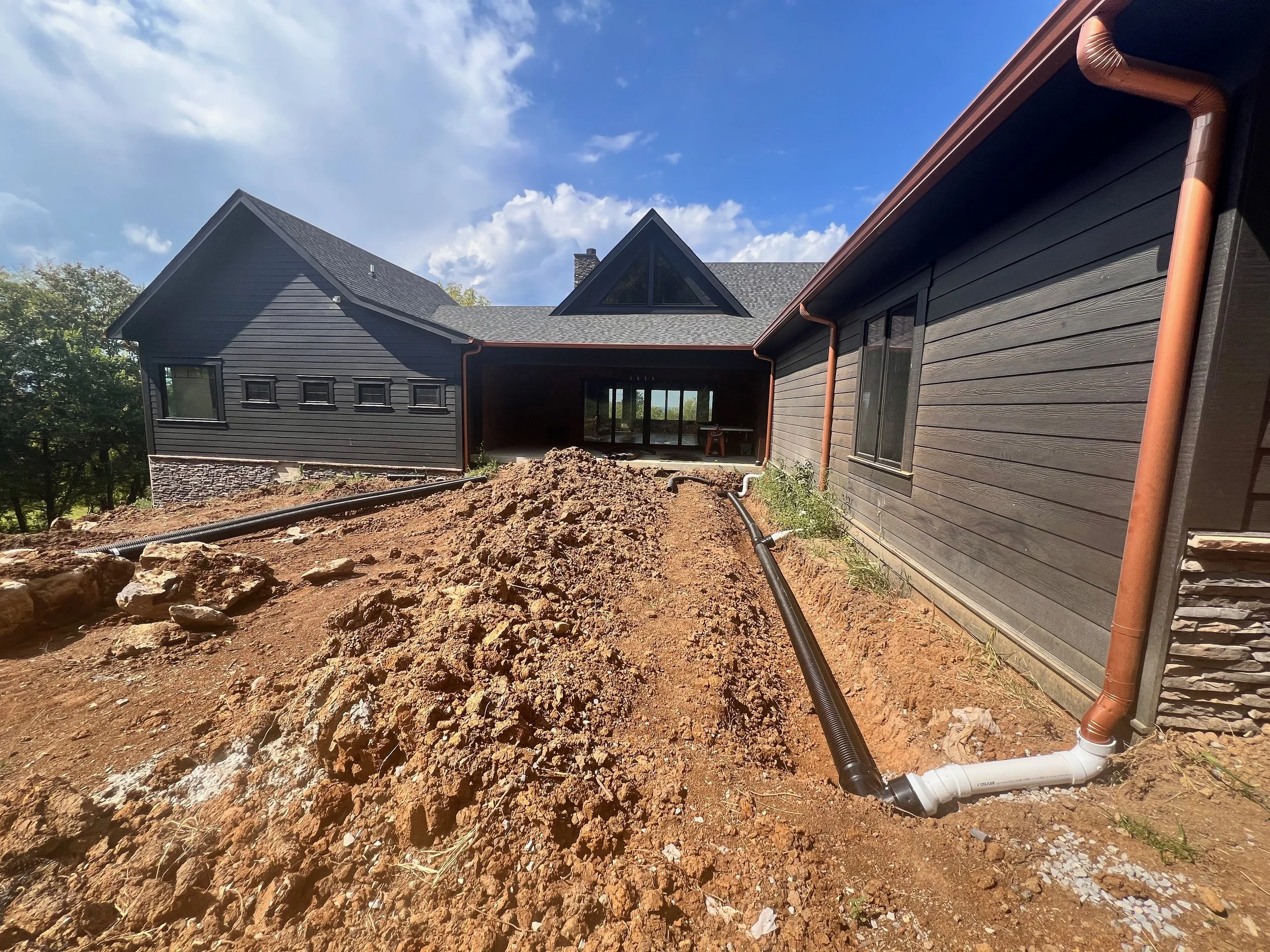
This is what Nashville's clay soil looks like during a new build — and why drainage planning can't wait until after the house is finished. We coordinated drainage infrastructure alongside the builder while the ground was already open, routing it with the full landscape plan in mind. That red clay you're looking at? It doesn't forgive. If water isn't directed intentionally from the start, you're solving expensive problems for years to come.
The Lost Topsoil Problem
Here’s something most homeowners don’t know: during construction, builders excavate and move massive amounts of earth. The thin layer of topsoil that sat on top of your property, the only layer where plants can actually thrive, often gets buried under feet of compacted clay subsoil, or worse, hauled off the site entirely.
If no one is watching out for this during construction, you end up with a property where the “soil” is essentially red clay fill with zero organic matter. I’ve tested soil on brand-new properties in Williamson County that had virtually no nutrients and a pH so off-balance that even the toughest native plants would struggle. Amending this soil after the fact is doable, but it’s expensive and labor-intensive. Had someone flagged the topsoil for preservation during the build, the cost and effort would have been a fraction.
The Infrastructure Problem
Running electrical conduit for landscape lighting costs almost nothing when the builder already has trenches open or sleeves installed for the house’s utilities. Running that same conduit after the house is finished? That means trenching through your brand-new yard, potentially cutting through freshly poured concrete or newly installed patios.
The same is true for irrigation lines, gas lines for outdoor fire features and kitchens, and drainage infrastructure. I had a client in Davidson County who wanted an outdoor kitchen with a natural gas grill. The gas line would have been a simple branch off the main during construction. After the fact, it required permits, excavation, and routing that doubled the cost.
I always tell clients: think of infrastructure like the bones inside the walls of your house. The drywall is already up, we can still do it, but it’s going to be more complicated and more expensive.
The Tree Problem
Mature trees are irreplaceable. A 30-year-old oak cannot be bought at a nursery. It takes 30 years to grow a 30-year-old tree. That’s it. There is no shortcut.
Construction equipment damages trees in ways that aren’t always immediately visible. Heavy machinery compacts the soil around root zones, cutting off oxygen and water. Grading can sever major roots. Stacking materials against trunks can damage bark. I’ve seen beautiful, mature hardwoods on Nashville properties that looked fine during construction but declined and died within two to three years afterward because their root systems were fatally compromised.
A landscape designer can walk a construction site and identify which trees are worth protecting, recommend tree protection fencing and root zone buffers, and coordinate with the builder to keep equipment out of critical areas. This takes almost no effort during construction. After the trees are damaged, there’s nothing to be done.
What Makes Nashville New Builds Different: The Things a Local Designer Knows
I want to spend some time here because this is where a boutique, Nashville-based designer adds value that a national landscaping app or out-of-state firm simply can’t.
Our Soil Is Not Like Other Soil
Nashville sits in USDA Zone 7a, and our soil is predominantly clay-based with underlying limestone bedrock. In some parts of Williamson County, you’ll hit rock eighteen inches down. In parts of Wilson County, you’ll find decent loam in the upper layers but heavy clay beneath. In Davidson County, it varies dramatically by neighborhood: silty loam near the Cumberland River, heavy clay in the southern suburbs, and shallow bedrock to the west.
I know this because I’ve had my hands in this dirt for years. I know what grows in it and what doesn’t. I know that you cannot plant a Southern Magnolia in four inches of topsoil over compacted clay and expect it to thrive, even though the nursery tag says it’s hardy in our zone. Zone hardiness tells you about temperature tolerance. It tells you nothing about soil structure, drainage, or the specific micro-conditions on your property.
When I design for a new build, I’m thinking about soil amendment strategies for every planting area, appropriate root zone depths for every tree and shrub species in the plan, drainage patterns that work with our clay soil rather than fighting it, and plants that don’t just survive in Nashville, they thrive here and get more beautiful over time.
Our Seasons Affect Timing More Than You’d Think
Nashville’s growing season typically runs from late April through October, but the real planting windows are more specific than that. Fall (October through late November/early December) is actually the best time to plant trees and shrubs in Middle Tennessee; the soil is still warm, the roots establish before winter dormancy, and the plant has a full spring ahead to settle in before summer heat.
If you’re building a new home and hoping to have a finished landscape by a certain date, we need to plan backward from those planting windows. If you want trees in the ground by October, we need a finished design by late summer at the latest. If you want spring color in your beds, we need to be thinking about bulbs in the fall. The Nashville growing calendar doesn’t bend to our schedules; we have to bend to it.
This is February right now, and if you’re reading this while your new home is under construction, this is exactly the right moment to reach out. We can develop a full landscape plan through the late winter and early spring months so that we’re ready to begin installation the moment conditions are right.
What It Actually Looks Like to Work with a Landscape Designer on a New Build
I want to demystify this because I think one of the reasons people wait too long is that they’re not sure what hiring a landscape designer even involves. So here’s how it works with me, specifically.
Step 1: The Conversation
We start with a conversation. You tell me about your property, your build timeline, your family, how you want to live in your outdoor space. This isn’t a formal process with clipboards and checklists. I want to understand what matters to you. Do you want a place where your kids can run barefoot? A cutting garden you can harvest from in the summer? A private courtyard where you can sit with a glass of wine and hear nothing but birds? An elegant front entry that makes you feel something every time you walk through the door? Or an outdoor bed hidden within a sun-dappled garden sanctuary? Anything is possible.
I ask the questions most landscaping companies don’t ask, because I’m not designing a “yard.” I’m designing a space that holds your life.
Step 2: The Site Visit and Analysis
I come to your property. If the home is still under construction, even better. I can see the raw land, the drainage patterns, the sun exposure, the existing trees, and what the builder is doing with the grading. I take photos. I study the light. I look at what the neighbors have done (and what’s working and what isn’t). I look at the architecture of your house and start thinking about how the landscape will relate to it.
I also bring my fine art eye to this, and I don’t say that lightly. My background trained me to see composition, to think about how the eye moves through a space, to consider negative space and focal points and seasonal rhythm. These aren’t things you’ll read about in a generic landscaping guide. They’re the difference between a landscape that functions and a landscape that moves you.
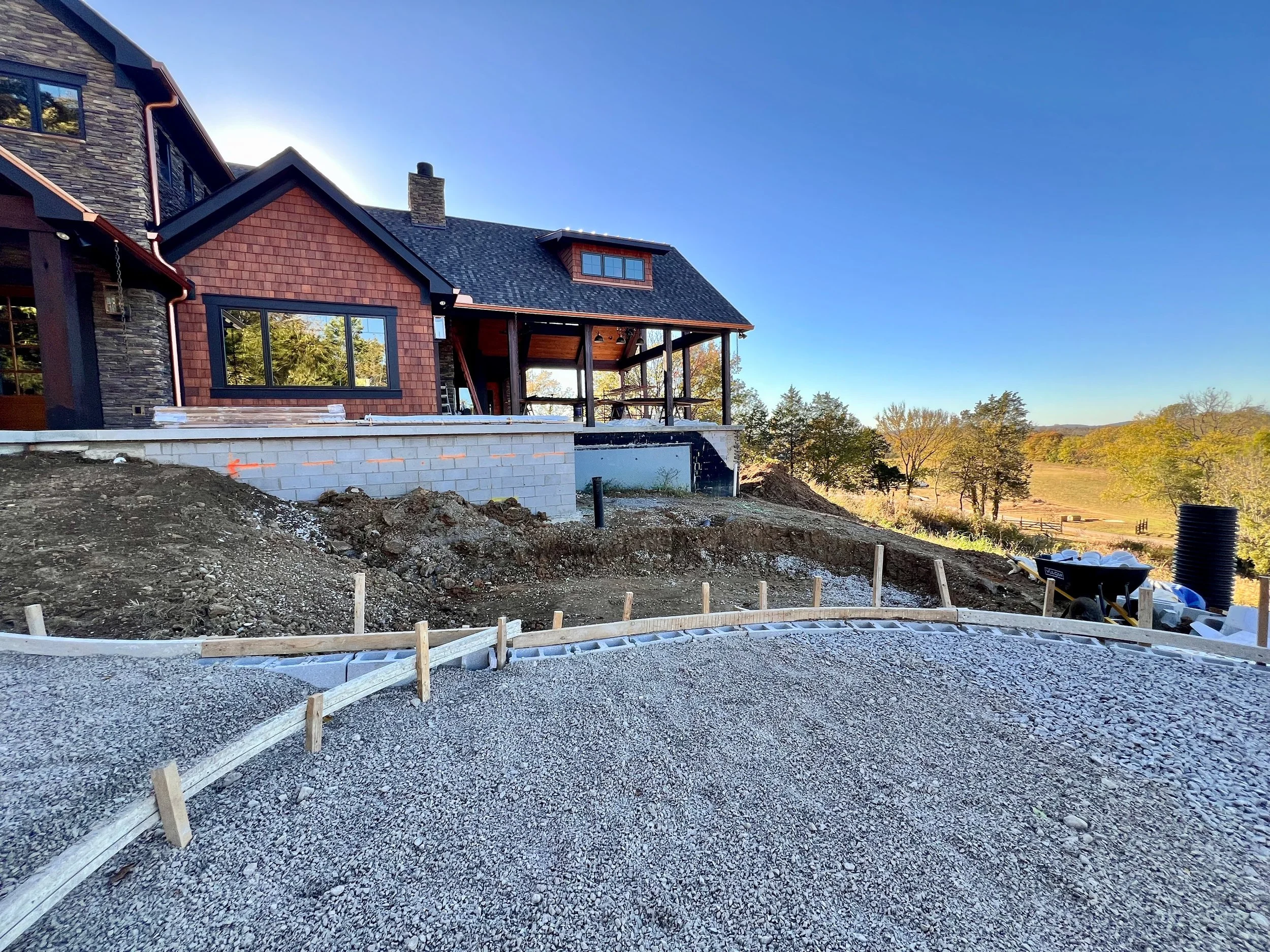
Coordinating hardscape installation while construction is still underway on the home itself. Because we were involved early, every retaining wall elevation, every patio curve, and every transition between the house and the land was designed as one continuous vision — not pieced together after the fact. The views across this property informed every decision about where outdoor living spaces were placed and how the hardscape would guide you through them.
Step 3: The Design
I develop a comprehensive landscape plan that includes everything: plant selections with Nashville-specific varieties I know will thrive in your exact conditions, hardscape concepts (patios, pathways, walls, edges), outdoor living areas, lighting design, irrigation and drainage strategy, and a phasing plan if you want to implement the design over time.
Every plant in the plan is chosen for a reason. I’m thinking about what blooms in March and what has structure in January. I’m thinking about fragrance near the entry, texture in the borders, movement from ornamental grasses in the fall breeze. I’m thinking about how this garden will look in five years, in ten years, in twenty years. Because a well-designed landscape doesn’t peak on installation day; it gets better.
Step 4: Installation Oversight
I partner with trusted contractors to bring the design to life, and I’m on site during critical phases of installation. This matters because the difference between a design on paper and a design in the ground often comes down to the details: the exact placement of a specimen tree, the angle of a stone pathway, the depth of a planting bed. I’m there to make sure the vision translates.
This is something that larger landscaping companies don’t typically offer. When you hire a big firm, you get a sales consultant who designs, then hands it off to a crew who installs. The person who understood your vision isn’t the person with their boots in the dirt. At The Grass Girl, I am both.
The Real Cost of Waiting: Numbers You Should Know
I’m going to be transparent with you about money because I believe you deserve to make informed decisions.
A landscape design consultation during the architectural phase typically costs a few hundred dollars for a site visit and initial input. That small investment can influence grading decisions, utility routing, tree preservation, and site orientation that would cost thousands to fix after the fact.
A full landscape design for a new construction property in Nashville generally runs between $2,000 and $6,000+, depending on the size and complexity of the property. This is the comprehensive plan — planting design, hardscape layout, irrigation and lighting strategy, and phasing recommendations.
The cost of retrofit fixes when landscape planning was deferred can add dramatically to total project costs. Re-grading a compacted lot, installing post-construction drainage systems, trenching for irrigation and lighting through finished surfaces, amending destroyed soil across an entire property, replacing trees that died from construction damage; these costs add up fast.
On average, a residential landscape project in Nashville ranges from $40,000 to $60,000 or more. A general rule of thumb is to budget around 10% of your home’s value for landscaping. If you’re building a $500,000 home, a $50,000 landscape investment is appropriate, and that investment will return 5 to 15 percent in property value.
Early planning doesn’t just save money on avoided retrofits. It means more of your landscape budget goes toward the beautiful things, the plants, the stone, the features that make your outdoor space extraordinary, rather than fixing problems that didn’t need to exist.
If You’re Reading This in Late Winter: Your Timing Is Perfect
I want to speak directly to you if you’re reading this in February or early March and you have a new build in progress or about to start.
Late winter is the ideal time to engage a landscape designer. Here’s why:
The ground is dormant, which means I can read the bones of your property clearly, the topography, the drainage patterns, the tree canopy structure, without the visual clutter of summer foliage. It’s like seeing the skeleton of a space before the muscle and skin go on. It’s incredibly revealing.
We have the full spring ahead of us to develop a design, coordinate with your builder if needed, and prepare for installation during the optimal planting windows. Trees and shrubs planted in fall have the highest success rate in Nashville, so a design process that begins now puts us right on schedule.
And frankly, designers are less booked right now than we will be in April and May. Spring is when everyone suddenly remembers they have a yard. The clients who reach out in winter get more of my time, more of my attention, and first priority on the spring and fall installation schedule.
What I Wish Every Nashville Homeowner Knew
When I started The Grass Girl, I named it after a garden I worked on early in my career, a small space that taught me something I’ve carried with me ever since: that a garden is not just a collection of plants. It’s a relationship between a person and a place. It holds memory. It changes with you. It’s alive in a way that no room inside your house will ever be.
Your new home is a tremendous investment of money, time, and emotion. The landscape around it deserves the same care. Not a Pinterest board and a trip to the garden center. Not “we’ll figure it out after we move in.” It deserves someone who will walk the land with you, listen to what you want your life outside to feel like, and design a space that makes you stop in your driveway just to look at it.
That’s what I do. And the best time to start is right now.
Ready to talk about your new build?
If you’re building a new home and you want your landscape to be part of the plan from the beginning, I’d love to hear from you. Reach out through our contact page and tell me about your project, even if it’s early, even if you’re not sure what you need yet. Especially then. The earlier we start the conversation, the more beautiful the result.
If you’d like to learn more about how to plan and design for large acreage, read: Large Property Landscape Design: How to Plan a Farm, Estate, or Acreage Before You Build Anything.
Not building new but want to reimagine your existing property? We do that too. Read more about what a landscape designer actually does and whether it’s the right fit for your project.