
How to Actually Design a Low-Maintenance Garden in Nashville
It’s not about picking “easy” plants from a list. It’s about making a hundred small design decisions that add up to a garden that almost runs itself.
“Low-maintenance” is the number one thing homeowners ask me for. And I get it. Nobody dreams of spending every Saturday hunched over their landscape pulling weeds, pruning things that won’t stop growing, and replacing plants that keep dying in the same spot for reasons they can’t figure out.
But here’s the thing most people don’t realize: a low-maintenance garden isn’t built by picking plants with “easy” on the tag. It’s built by design. The decisions that determine how much work your yard demands happen long before the first plant goes in the ground — and most of them have nothing to do with the plants themselves.
A well-designed landscape in Nashville should need one serious maintenance push in late February, a couple of light grooming sessions through the growing season, and not much else. By year three or four, it should be living mostly off the sky. That’s the goal. And it’s absolutely achievable — if you set it up right from the start.
The “Low-Maintenance Plant List” Myth
You can find a hundred lists online that promise you the “best low-maintenance plants for Nashville.” The problem with just having a list is that it treats low-maintenance as a quality of individual plants, when it’s actually a quality of the whole system.
The toughest, most forgiving plant in Tennessee will still become high-maintenance if you put it in the wrong spot, plant it in unprepared soil, space it wrong, or pair it with neighbors that have completely different water needs. A Dwarf Yaupon Holly is one of the easiest shrubs alive — until you plant it in deep shade in wet clay where it slowly declines and you spend three years trying to figure out why. An ornamental grass is carefree — until you plant it 18 inches from a walkway and spend every summer cutting it back so people can get to the front door.
Low-maintenance is a design outcome, not a plant characteristic. Let me walk you through the decisions that actually create it.
Start With the Soil, Not the Plant Catalog
This is the least glamorous and most important step in building a low-maintenance landscape. In Nashville — across Wilson, Williamson, Davidson, Sumner, and Cheatham counties — you’re almost certainly dealing with heavy clay soil. It holds water when it’s wet and cracks when it’s dry. It’s dense, it’s challenging, and it is the single biggest factor in whether your landscape thrives or becomes an ongoing headache.
If you skip soil preparation and just dig holes in raw clay, you create what I call the bathtub effect: the amended soil inside the planting hole holds water, the clay walls around it won’t let it drain, and the roots drown. The plant doesn’t die from neglect. It dies from drowning in a hole you dug for it.
Proper bed preparation — breaking up the clay, incorporating organic matter across the entire planting area rather than just individual holes, ensuring drainage paths exist — is the unglamorous foundation of everything else. It costs money upfront. It saves you years of replacing dead plants, troubleshooting mystery failures, and fighting soil that’s working against you.
Get a soil test through the UT Extension Soil, Plant and Pest Center before you plant anything. Know your pH, your nutrient levels, your drainage. Then prepare the soil once, do it right, and everything you plant into it has a head start that compounds every single year.
Design for the Plant’s Grown-Up Size, Not the One in the Pot
This is maybe the most common and most avoidable mistake in residential landscaping. You buy a shrub in a three-gallon pot. It’s 18 inches tall and adorable. The tag says it matures at six feet wide. You plant it two feet from the house because right now it looks right. In three years, you’re out there with hedge shears every month fighting a plant that’s just trying to be what it is.
That’s not a low-maintenance plant problem. That’s a spacing problem. And it turns an easy plant into a high-maintenance nightmare.
When I design a planting plan, I’m designing for what the landscape looks like in year five and year ten, not the day the contractor pulls away. Yes, it looks a little sparse the first year. New plantings always do. But within two to three seasons, the plants fill in to their natural forms, they meet their neighbors without crowding, and nobody has to hack anything back just to walk to the mailbox.
If you want a shrub that stays three feet wide and you’re looking at a plant that grows to six, the answer isn’t constant pruning. The answer is a different plant. There are compact cultivars of almost everything — that’s what cultivar selection is for. The right plant in the right space at the right size eliminates half the pruning work in a typical Nashville landscape.
Group Plants by What They Need, Not How They Look at the Garden Center
This principle alone will save you more time, water, and frustration than almost anything else. Plants that need regular moisture go in one zone. Plants that want to dry out between waterings go in another. You do not mix a hydrangea with a Russian sage and then try to make them both happy. One wants a drink. The other wants to be left alone. You will either overwater the sage or underwater the hydrangea, and you’ll spend the whole summer trying to split the difference.
In a good design, hydrozones — areas grouped by water needs — are planned from the start. The thirstier plants go in the spots that naturally hold more moisture, often closer to the house where downspouts concentrate water, or in low areas of the yard. The drought-tolerant plants go on the slopes, the sunny exposures, the spots that dry out first. This isn’t just a water-saving strategy. It’s a maintenance strategy. When every plant in a zone needs the same thing, you’re not running around babysitting individual plants. You water a zone, or you don’t. Simple.
Nashville’s 47 inches of annual rainfall is actually generous. A well-designed landscape with proper hydrozoning should need supplemental watering only during establishment (the first one to two growing seasons) and during genuine droughts. By year three or four, the sprinklers should be in the garage gathering dust.
Mulch Is Doing More Work Than You Think
Two to three inches of mulch across all planting beds, pulled back a few inches from trunks and crowns. That’s the standard I specify on every project. It’s not decorative. It’s functional. Mulch suppresses weeds (which means less weeding). It moderates soil temperature (which means less root stress). It retains moisture (which means less watering). It breaks down slowly and feeds the soil (which means less fertilizing). Every inch of exposed bare soil in your beds is an invitation for weeds and erosion. Mulch is the answer to both.
Two things to get right: thickness and placement. Too thin and weeds push through. Too thick and you suffocate roots and create habitat for fungal problems. And never pile mulch against tree trunks or plant crowns — the “mulch volcano” you see everywhere in Nashville is slowly girdling and killing trees. A flat, even layer with a little breathing room around each plant. That’s it.
On slopes — and in Nashville, everybody has a slope somewhere — mulch also controls erosion. I pay special attention to mulch depth on hillsides and slope beds, especially after spring rains when bare ground washes downhill and takes your topsoil with it.

Thick mulching and strategically placed rocks help stabilize the soil and suppress weeds on a newly planted sloped bed.
Fewer Varieties, Bigger Drifts, Less Work
The most high-maintenance gardens I walk onto are the ones where someone bought one of everything at the garden center. Fourteen different perennials, eight types of shrub, three random trees. Each one has different pruning needs, different water needs, different timing, and different problems. You need a different care plan for every square foot of your yard. That’s a full-time job disguised as a hobby.
A designer’s approach is different. I use fewer varieties, planted in larger groupings. Three to five of the same perennial in a drift, not one lonely specimen. Multiple hollies of the same cultivar forming a cohesive foundation, not a sampler platter. This isn’t boring — it’s compositionally stronger. It reads as intentional, not chaotic. And it means you can care for an entire section of the garden the same way, at the same time, with the same approach. That’s how a landscape designed for low-maintenance actually works — repetition creates rhythm and efficiency.
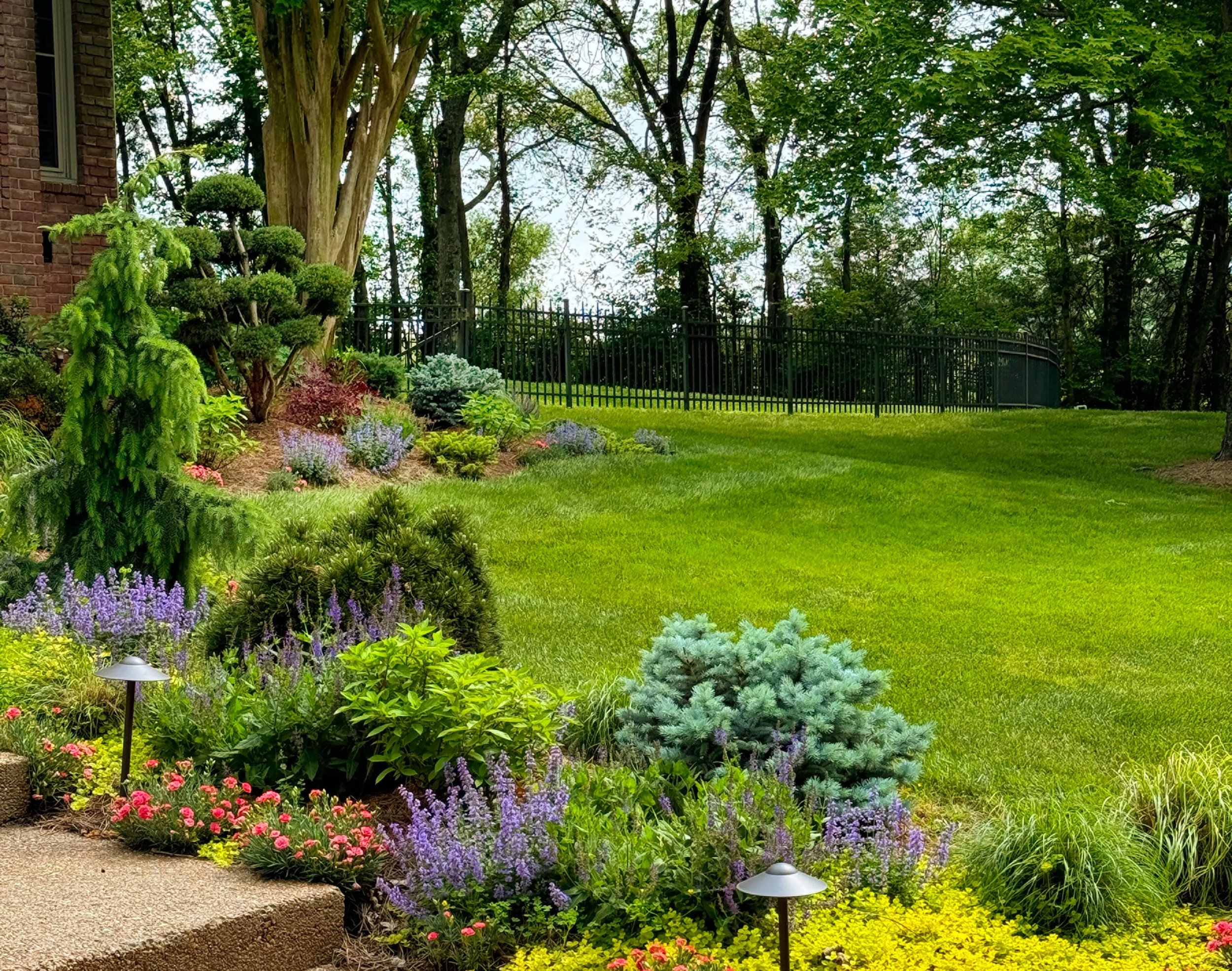
This project used a total of five perennials, repeated throughout the entire property, to maintain visual consistency and repeatable property-wide maintenance.
Choose Plants That Belong in Nashville, Not Plants That Survive Nashville
There’s a meaningful difference between a plant that can technically survive in Zone 7a clay and one that genuinely thrives in it. A plant that’s just surviving requires more water, more amendment, more protection, more attention. A plant that’s thriving requires almost nothing once it’s established, because it’s adapted to the conditions you’re giving it.
I wrote a detailed guide to the specific trees, shrubs, and perennials that actually perform in Nashville’s clay soil — with cultivar names, honest opinions, and notes on what to avoid. If you’re looking for plant recommendations, that post is the companion piece to this one: Best Plants for Nashville’s Clay Soil: A Designer’s Honest List for Zone 7a. Read it after this one.
The principle here is simple: the right plant in the right conditions becomes low-maintenance by nature. It doesn’t need you to compensate for its shortcomings. It just grows.
The First Two Years Are an Investment, Not a Lifestyle
I’m honest with every client about this: a newly installed landscape is not low-maintenance. Not yet. The first growing season requires regular watering — typically two to three times a week for the first few weeks, tapering to once a week through the first summer and fall. You’re helping roots establish in their new home. That’s non-negotiable if you want the plants to survive.
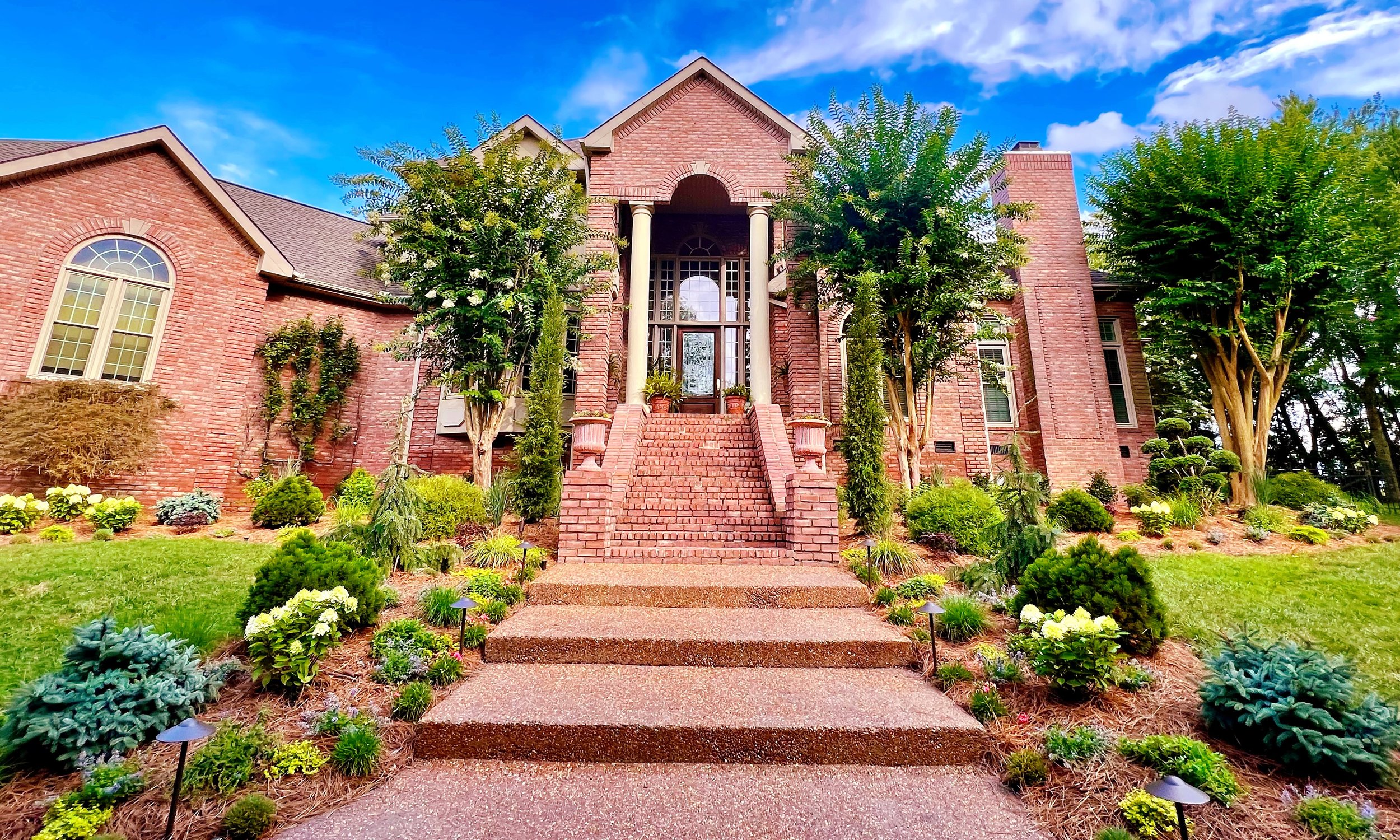
A well-spaced landscape entry design in year one.
By the second growing season, watering drops to dry-spell-only. You’re checking on things weekly, but you’re mostly watching, not intervening. By year three, a well-designed Nashville garden starts to hit its stride. Root systems are deep and wide. Plants are filling into their mature forms. The ecosystem you planted is becoming self-sustaining. By year four, your maintenance calendar looks like this: one thorough late-February cleanup and cutback, a couple of quick weeding passes in spring, light deadheading if you feel like it in summer, and leaf management in fall. That’s the payoff for doing the design right and being patient through establishment.
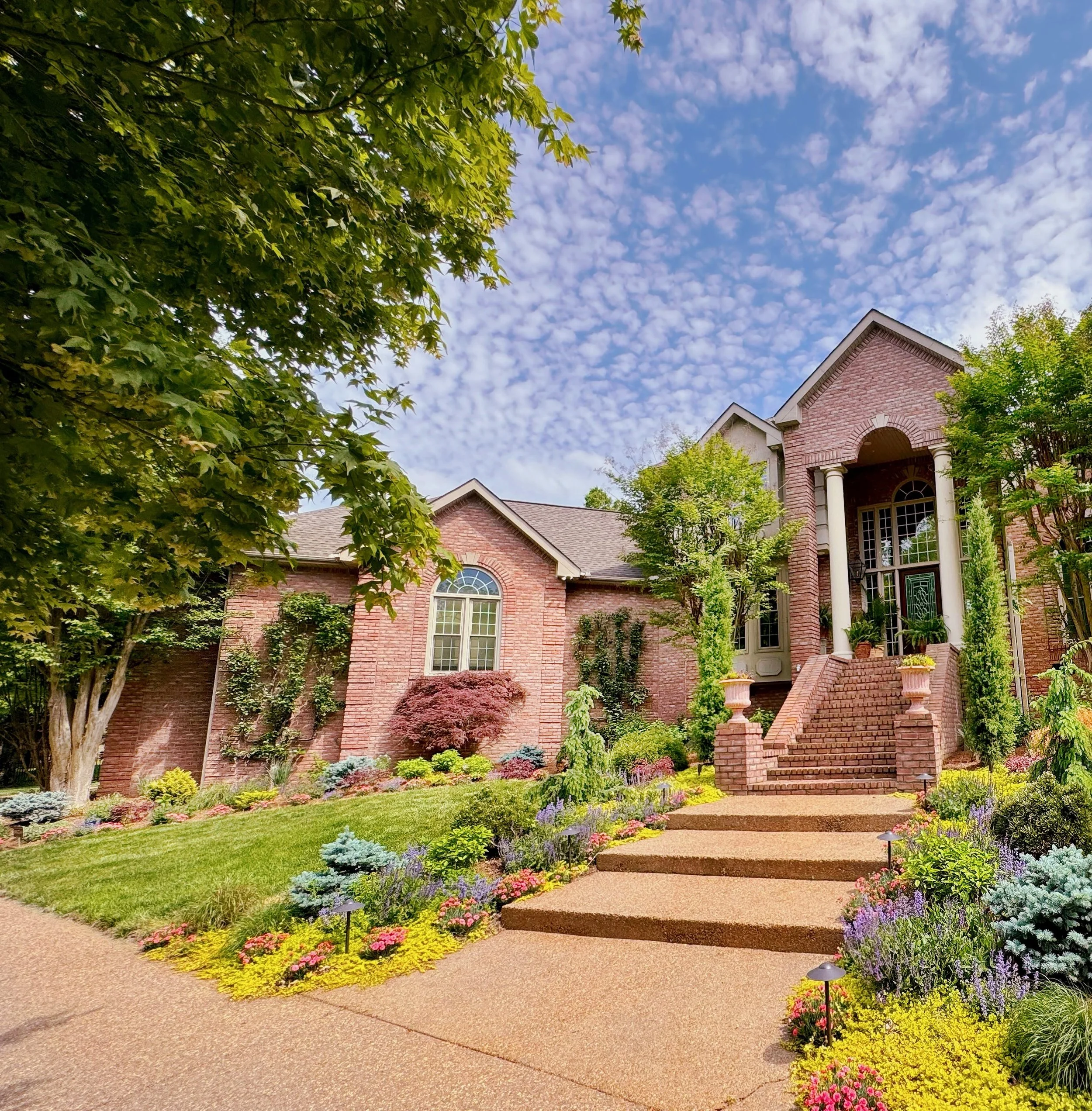
The same entry garden in year two.
The mistake I see is homeowners who want low-maintenance on day one and skip the establishment care. Then they’re replacing dead plants every spring, which is the most expensive and most frustrating version of high-maintenance there is.
One Big Push: Why Late February Is the Most Important Weekend of the Year
If you do one thing right for your Nashville landscape every year, make it the late February maintenance push. This is the window — usually late February into early March — where you set the tone for the entire growing season. It’s so integral to the success of a garden that I wrote an entire playbook for it.
Cut back ornamental grasses to a few inches above the ground before new growth emerges. Shear spent perennial stems down to the basal foliage. Prune shrubs that bloom on new wood. Remove dead, damaged, and crossing branches from trees and evergreens. Clean leaf debris off crowns. Re-edge beds. Top up mulch to 2–3 inches. Apply one single round of slow-release fertilizer. Apply pre-emergent to suppress weeds before they germinate.
That’s the big annual push. It takes a day or two for a typical residential property, either by a homeowner who knows what they’re doing or a maintenance crew who’s been given a clear plan. After that, the rest of the year is light-touch grooming. That’s the rhythm of a well-designed Nashville landscape: one concentrated effort when the garden is still dormant, then let the design do the work.
Low-Maintenance Costs More Upfront. That’s the Honest Truth.
Here’s the part nobody wants to hear but everyone needs to. A landscape designed to be truly low-maintenance costs more at installation than a landscape where someone just sticks plants in the ground and hopes for the best. Proper soil preparation costs money. Specifying the right cultivars instead of grabbing whatever’s cheapest at the box store costs money. Spacing for mature size — which means more ground to cover with mulch instead of plants in year one — costs money. A designer who thinks through drainage, hydrozones, sun exposure, and long-term maintenance implications costs money.
But the alternative costs more. It just spreads the cost over years of replacing dead plants, paying maintenance crews to fight overgrown shrubs, running irrigation systems that are compensating for poor plant placement, and eventually hiring someone to rip it all out and start over.
I tell clients: you’re either investing in design now or paying for mistakes later. The most expensive landscape is the one you have to do twice.
What a Low-Maintenance Nashville Garden Does Not Need
Because half of low-maintenance is knowing what to skip:
It doesn’t need constant fertilizing. One light application of slow-release fertilizer in late February is enough for the entire year. Over-fertilizing makes plants grow faster, which means more pruning, more water demand, and weaker stems. A lean garden is a strong garden.
It doesn’t need a permanent irrigation system. With the right plant selection and proper soil prep, Nashville gets enough rain for an established landscape in most years. You need a way to water during establishment and severe droughts — tripod sprinklers or a simple drip setup at the spigots. You do not need $15,000 in underground irrigation for a landscape that’s designed to live off the sky.
It doesn’t need annual flowers. Annuals give you instant color, and I understand the appeal. But they need to be planted every year, watered all summer, fertilized regularly, and pulled out when they’re done. That’s the definition of high-maintenance. A well-designed perennial garden gives you color from March through November without replacing a single plant.
It doesn’t need weekly pruning. If you’re out there with shears every weekend, the problem isn’t the plants. The problem is the plan. The right plant in the right space at the right size barely needs to be touched.
The Real Secret to a Low-Maintenance Garden
It’s the design. It’s always the design.
Anyone can hand you a list of easy plants. I’ve done it myself. But the list alone doesn’t solve the problem. What solves the problem is someone who understands your specific property — your soil, your light, your drainage, your slopes, your views — and designs a planting plan where every plant is doing a job it’s suited for, in a spot that supports it, at a size that doesn’t require you to fight it.
That’s what I do. I walk the property, read the site, and build a plan that works with your land instead of against it. My background is in fine art — I think in composition, color, and how light moves through a space across seasons. The gardens I design are meant to be beautiful and to earn that beauty without demanding your weekends in return.
If you’re tired of a yard that takes more than it gives, book a consultation. We’ll look at what you have, talk about what you want, and figure out how to build a landscape that practically runs itself. For specific plant recommendations, start with my guide to the best plants for Nashville’s clay soil.