
Garden Design for Kids: What a Garden Gives Your Kids That Nothing Else Can
What a garden gives a child that no screen, classroom, or scheduled activity can—a Nashville garden designer on designing outdoor space for how children actually play.
I want to talk about something I see on nearly every family property I consult on in Nashville.
The parents call me because they want to "do something with the yard." They have kids — usually between three and twelve — and they want the outdoor space to be usable. So at some point in the conversation, they mention a swing set. Or a trampoline. Or a play structure. Or "some kind of area for the kids." They're thinking about their children the way the outdoor industry has trained them to think: kids need equipment. Kids need designated zones. Kids need surfaces and structures and features designed specifically for them.
I understand this instinct. But I want to push back on it. Gently. Because I think the most important thing you can put in your yard for your children isn't a play structure. It's a garden.
Not a children's garden. Not a garden designed to be educational or themed or gamified. A real garden. With real plants and real soil and real insects and real weather and real things happening in it that nobody planned and nobody controls.
Here's why.
The World Your Children Are Growing Up In
I'm going to say this as plainly as I can, because I said it in my 2026 essay and it bears repeating in this context: our children are in trouble.
The data is not ambiguous. Screen time for children has increased dramatically. Rates of anxiety, depression, and attention disorders in children and adolescents have risen in parallel. The capacity for sustained, unstructured attention — the kind of attention that used to be called "play" — is measurably declining. The average American child spends far more time indoors, on screens, in structured activities, than any previous generation. The U.S. Surgeon General has flagged social media as a threat to youth mental health. None of this is controversial. It's documented.
I'm not a psychologist. I'm a garden designer. But I know what I've watched happen when children are given access to a living outdoor space — not a play structure, not a scheduled activity — just a garden. And what happens is so consistent, across so many families, that I've come to believe it's one of the most important things a garden does.
Children slow down.
Not because you told them to. Because there's something worth being slow for.
What a Garden Actually Does to a Child
A play structure is a solved problem. A child figures out the slide, the climbing wall, the swings. They master it. Then they're bored. The structure doesn't change. It doesn't respond. It doesn't surprise. It's engineered to be safe and predictable, which means it's also engineered to be finite. Most backyard play structures are heavily used for one or two seasons and then ignored.
A garden is an unsolved problem. It's different every time a child enters it. Something new is blooming. Something is crawling on a leaf that wasn't there yesterday. The toad is back under the hosta. The butterfly is working the coneflowers. There's a hole in the ground that might be made by something. The seed they planted last month is doing something. The seed they planted the month before that is doing something else.
This is not structured learning. This is not a lesson plan. This is a child in a living system, observing, questioning, touching, discovering — at their own pace, on their own terms, driven by their own curiosity. It's the kind of engagement that no app can replicate because it's not designed to capture attention. It earns it. A child watches a bee move from flower to flower not because an algorithm determined it's engaging content, but because it's genuinely interesting. The real world, when you give a child access to it, still wins.
I've watched a six-year-old spend twenty minutes with a toad. I've watched a ten-year-old become fascinated with the pattern of seeds in a sunflower head — unprompted, no adult suggesting it, just a kid who noticed something mathematical happening in nature and couldn't stop looking. I've watched siblings who fight inside the house work together outside in the garden without being asked, because the space changed the dynamic. Something about being surrounded by living things changes how people — including small people — relate to each other.
These aren't designed outcomes. I didn't install a "nature discovery zone." I planted a garden. The children did the rest.
Design Principles for a Garden That Works for Families
I'm not saying ignore your kids' needs when you design your outdoor space. I'm saying think about their needs differently. Not "what equipment do they need?" but "what kind of space makes them want to be outside?"
Density over features. A garden with layers — groundcover, perennials, shrubs, grasses, trees — gives a child a world to move through. Tall grasses that a five-year-old can disappear into. A path that curves so you can't see the end. A low hedge that creates a room within a room. Children respond to spatial complexity the way they respond to a good story — it draws them in because there's something to discover around every corner. A flat lawn with a swing set has one thing to do. A layered garden has a hundred.
Plants that invite interaction. Lamb's Ear (Stachys byzantina) — kids can't stop touching it. The leaves are as soft as the name promises. Snapdragons — squeeze the flower and it opens like a mouth. Every child discovers this and it never stops being delightful. Sensitive Plant (Mimosa pudica) in a summer container — touch the leaves and they fold closed. Sunflowers — plant seeds in March with your child, watch them grow taller than the child by July. Fennel and dill — plant them and the swallowtail caterpillars will come. A child watching a caterpillar eat and grow and chrysalis and emerge is witnessing something that no screen can replicate because it's happening in real time over real weeks and they have to be patient for it. Patience, it turns out, is something a garden teaches without trying.
A patch of dirt. I'm serious. Leave an area of bare soil — maybe a few square feet near the garden's edge — where a child can dig. Not a sandbox with engineered sand in a plastic frame. Actual ground. With worms in it. This is the most expensive-looking design element that costs nothing, and children will use it more than anything else in the yard under the age of seven. They dig. They find things. They make things. They're in contact with the actual earth. This matters more than we think — research on soil microbes and children's immune development suggests that contact with living soil may have measurable health benefits. But even without the science, watch a kid with a stick and a patch of dirt and tell me they need a play structure.
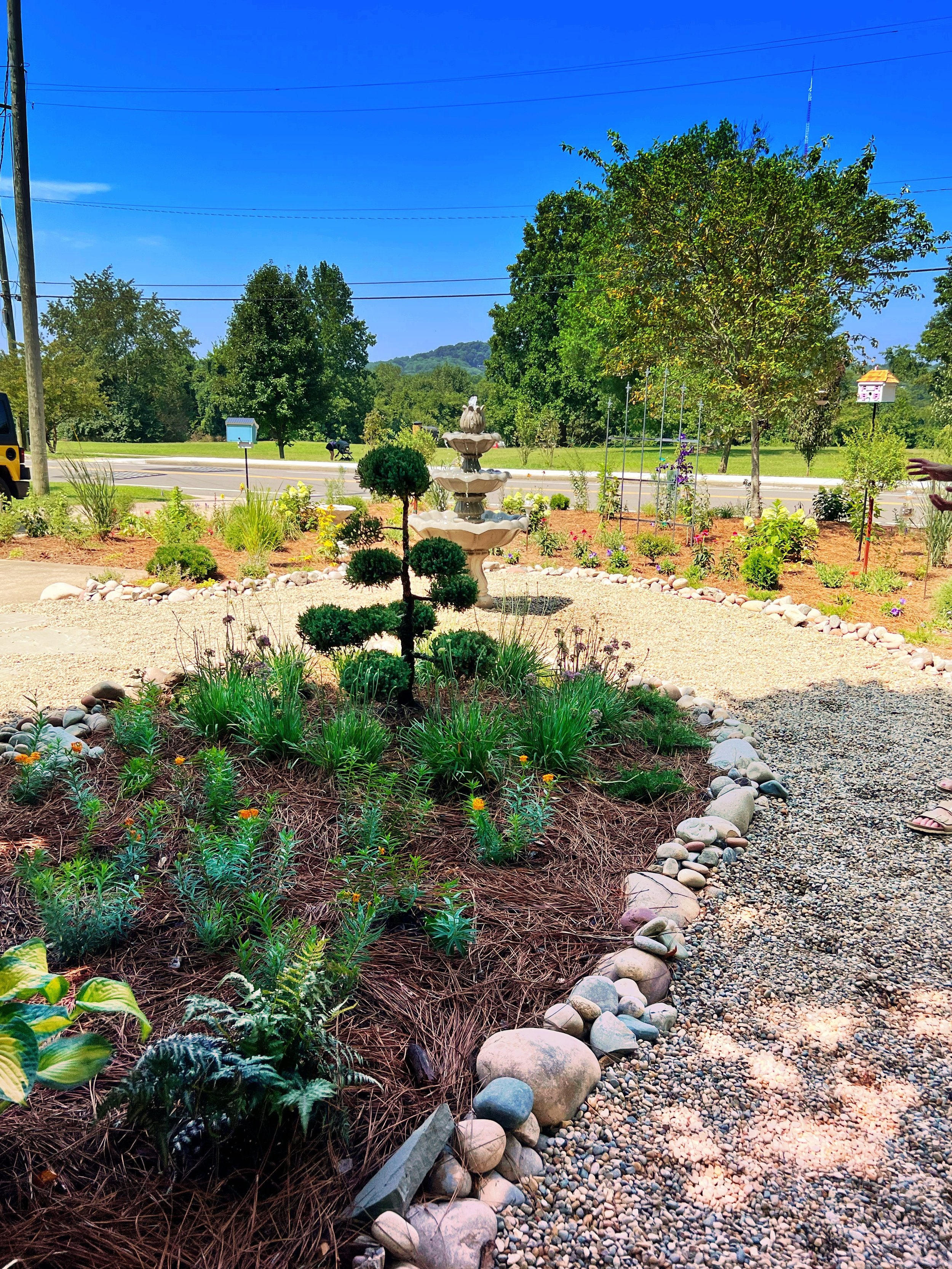
Water. It doesn't have to be a pond or a pool. A bubbling fountain or stone. A small pondless waterfall. A rain chain that the kids can watch during storms. Even a bird bath that they're responsible for filling. Water draws children the way it draws every living thing. And water in a garden is interactive — it reflects, it sounds, it attracts birds, it freezes in winter, it overflows after rain. It's never the same. A child's relationship with a water feature in the garden evolves as they grow — from splashing to watching to thinking.
A place that's theirs. Not an equipped zone. A spot in the garden — maybe under a tree, maybe behind a large shrub, maybe in a small clearing surrounded by grasses — where a child feels like they've found something. Children are territorial and imaginative. A small, semi-enclosed space in the garden that they claim as their own will become the most used square footage on your property. You don't need to build it. You plant it. A few large grasses or shrubs arranged to create an enclosure with an opening — that's a fort, a castle, a hideout, a reading nook, a secret world. Cost of materials: three or four plants. Value to the child: immeasurable.
Let it be a little wild. A perfectly manicured garden is a museum. Children don't thrive in museums. They thrive in spaces that have some give — where a plant can be brushed against without a parent panicking, where a bug can be picked up, where the ground is alive and slightly unpredictable. The naturalistic design direction I've been writing about all year — less control, more collaboration with nature — is also the direction that's best for children. A garden with a slightly wild edge gives a child permission to be a child in it.
What About Safety?
I'm not going to ignore this. You have real concerns. I'll address them honestly.
Toxic plants. Some common garden plants are toxic if ingested — foxglove, lily of the valley, castor bean, oleander. Don't plant these where small children play and put things in their mouths. Most Nashville-native perennials — Echinacea, Rudbeckia, Liatris, Baptisia, Switchgrass — are non-toxic. If you're concerned, I address plant toxicity in every family design and can select a palette that's entirely safe for young children.
Water features. Any standing water is a drowning risk for toddlers. Pondless water features — where the water recirculates through buried basins covered by stone — give you the sound and movement of water with no exposed standing water. For families with very young children, this is the standard I recommend. As children grow older, shallow ponds with gradual edges become appropriate.
Thorns and irritants. I don't plant roses or barberry along pathways where small children walk. Holly gets placed above child height or in areas children don't access. These are basic design decisions, not reasons to avoid gardening.
The surface question. You don't need artificial turf. Please don't install artificial turf. It's hot in Nashville summers — surface temperatures on synthetic turf can exceed 150°F on a sunny day. It provides zero ecological value. It doesn't smell like a garden. It doesn't teach a child anything. A well-maintained natural lawn, or better yet, a mix of groundcovers like clover and creeping thyme that can handle foot traffic, gives children a real surface to play on that's alive, cool, and soft. The soil underneath it is doing things that matter.
The Gift You're Actually Giving Them
I want to end with this, because it's the thing I think about most when I design a family garden.
When you give your child a garden — not a play area, not an activity zone, not a piece of equipment — you're giving them something that can't be taken away by a software update or a changing algorithm or the next platform. You're giving them a relationship with the physical world. With soil and weather and seasons and growth and decay and the slow, irreducible pace of a living thing doing what living things do.
You're giving them the experience of patience — because a seed doesn't germinate on demand. Of wonder — because a chrysalis becoming a butterfly is astonishing no matter how many times you've seen it on a screen, and seeing it on a branch in your own garden is different from seeing it on a screen in a way that matters. Of competence — because a child who plants something and watches it grow has done something real with their hands in the real world, and they know it.
You're giving them memories that are physical — the smell of the soil, the feel of the lamb's ear, the cold of the garden hose, the sound of the frogs at dusk. Not content. Not data. Sensory memories stored in the body, which is where the deepest memories live.
And you're giving them the one thing that I believe is the most important thing a garden gives anyone: presence. The experience of being fully here, in their body, in this moment, in a world that's alive. Not performing for an audience. Not consuming content. Just being a small animal in the air, noticing things.
That's what a garden gives your children. No play structure on earth gives them that.
If you want to design a garden that your whole family lives in — not a yard divided into adult zones and kid zones, but a single living space that holds all of you — I'd love to hear about your property.