
Japanese-Inspired Garden Design in Nashville: The Art of Making a Space Feel Like a Breath
This is the style people request when they don't just want a beautiful garden — they want a quiet one. Here's what Japanese-inspired design actually means, what it takes to do it well in Middle Tennessee, and why it might be the most transformative thing you can do to a property.
Every once in a while, a client will say something to me that cuts straight to the core of what they need. Not "I want a Japanese garden", although some do say that. More often it's something like: "I just want to walk outside and feel like the noise stopped."
That's a Japanese-inspired garden. Not the plant list, not the stone lantern, not the raked gravel, those are elements. The real thing is a feeling. Stillness. Intention. The sense that every single object in the space is exactly where it's supposed to be, and nothing is competing for your attention. Your eye slows down. Your breathing changes. You stop scrolling through your mental to-do list for thirty seconds and just… look.
That might sound like poetry, but it's actually design. And it's the hardest kind of design to get right, because there's nowhere to hide. In a lush cottage border, one awkward plant gets absorbed into the abundance. In a Japanese-inspired garden, every element is exposed. Every stone, every branch, every line of negative space is a deliberate choice. If something is off, you feel it immediately, even if you can't name what's wrong.
This is the style where my fine art training shows up the most. Composition, negative space, visual weight, the relationship between objects; these are the same principles I studied in painting and sculpture. A Japanese garden is essentially an outdoor sculpture. It just happens to be alive.

What "Japanese-Inspired" Actually Means
I want to be precise about language here, because I think it matters.
I don't design traditional Japanese gardens. A traditional Japanese garden is a deeply specific cultural art form with centuries of history, regional variations, and philosophical underpinnings that I respect too much to claim as my own. What I design are gardens inspired by Japanese principles; spaces that borrow the discipline, the restraint, the reverence for natural materials, and the emotional quality of Japanese garden design and translate them into something that works for a Nashville home and a Nashville life.
That distinction matters because it frees the design from rigid rules while honoring the spirit. We can use Japanese maples and cloud-pruned pines alongside Tennessee limestone and native ferns. We can build a fire bowl courtyard with gravel and curved ipe decking that feels meditative without pretending it's a Kyoto temple garden. The goal is the feeling, not the replication.
The Principles That Guide This Style
Japanese-inspired design comes down to a few core ideas, and they're all related:
Restraint. This is the big one. Where most garden styles add, Japanese-inspired design subtracts. Every element earns its place. If a stone doesn't contribute to the composition, it comes out. If a plant is just filling space, it goes. The garden should feel like it has room to breathe, and when it does, you will too.
Asymmetry. Western design tends to default to symmetry: matched planters flanking a door, even beds on either side of a walkway. Japanese design works with asymmetrical balance, which is actually how nature composes itself. A single specimen tree offset by a low mass of groundcover. A boulder on one side of a path balanced by empty space on the other. It creates tension and interest without clutter.
Borrowed scenery. This is one of my favorite principles, and it's wildly underused in Nashville. The idea is that the garden's composition includes what's beyond the garden, a distant treeline, a ridgeline, a neighbor's mature oak that you frame rather than screen. In Middle Tennessee, where so many properties have beautiful rolling views, this principle can make a modest garden feel vast.
Seasonality. A Japanese-inspired garden should be beautiful twelve months a year, and the beauty should change. The fresh green of spring moss. The deep shade of a summer canopy. A Japanese maple turning to fire in October. The bare architecture of branches against a grey January sky. Nothing is wasted, and no season is treated as the one that "doesn't count."
Stone and water as primary materials. Before you think about plants, think about stone. Gravel, boulders, flagstone, stepping stones, these are the bones. Water, whether moving or still, adds life and sound. Even a single basin catching rainwater can give a space the presence that defines this style.
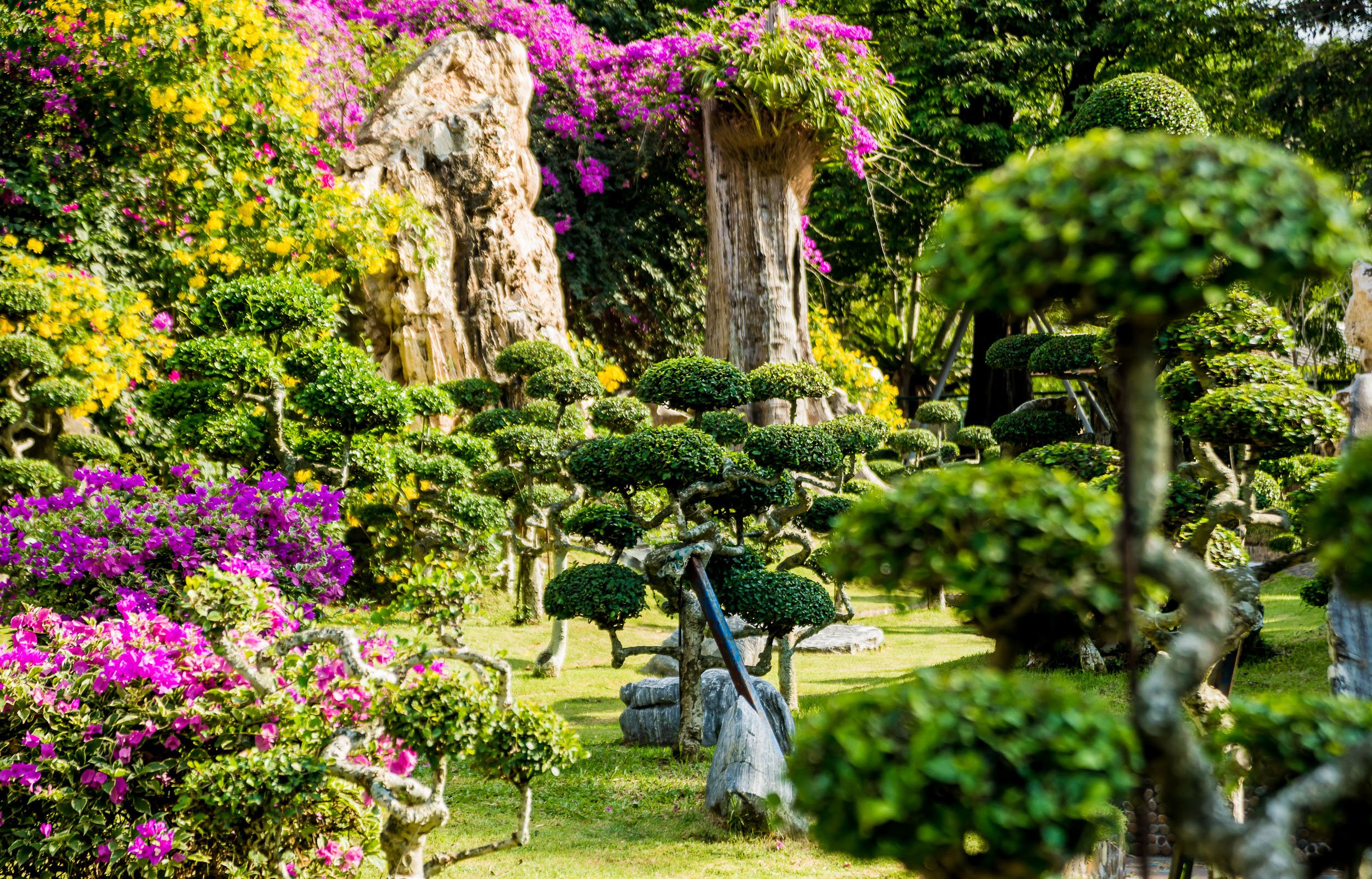
What This Looks Like in Nashville
Middle Tennessee is actually a remarkable place to design Japanese-inspired gardens, and I don't think enough people realize that.
Our native limestone is a beautiful, warm-toned stone that works as naturally in a Japanese-inspired setting as it does in a farmhouse wall. Tennessee fieldstone has the kind of weathered, organic character that this style demands, and it's local, which means it looks like it belongs here rather than being shipped from somewhere else.
Our climate supports an incredible range of Japanese-inspired plant material. Japanese maples thrive in our zone, and we have enough variety available that I can select specimens for very specific qualities of leaf shape, fall color, growth habit, and mature scale. Cloud-pruned pines and hollies are living sculptures that anchor a space the way a painting anchors a room. Native ferns, mosses, and sedges do beautifully in our shade conditions and provide that lush, green, ground-level texture that makes a Japanese-inspired garden feel timeless.
Our humidity, which is the enemy of so many garden styles, actually works in your favor here. Moss loves it. Ferns love it. That soft, green, slightly primordial quality that Nashville's climate naturally produces is exactly the atmosphere a Japanese-inspired garden wants.
And then there's the light. Nashville's winter light, low, warm, golden, is stunning in a garden that has strong bones. When the perennials are dormant and the deciduous trees are bare, a well-designed Japanese-inspired garden doesn't look empty. It looks like a drawing. The architecture of the branches, the texture of the stone, the geometry of the evergreens, winter is when this style is at its most powerful.
Where I've Seen This Style Transform a Property
The projects where clients ask for this feeling tend to share something in common: the homeowner is craving calm, and their current yard is giving them the opposite. Maybe it's a cluttered suburban backyard that feels chaotic and disorganized. Maybe it's a blank slate after new construction. Maybe it's a perfectly nice yard that just doesn't do anything for them emotionally.
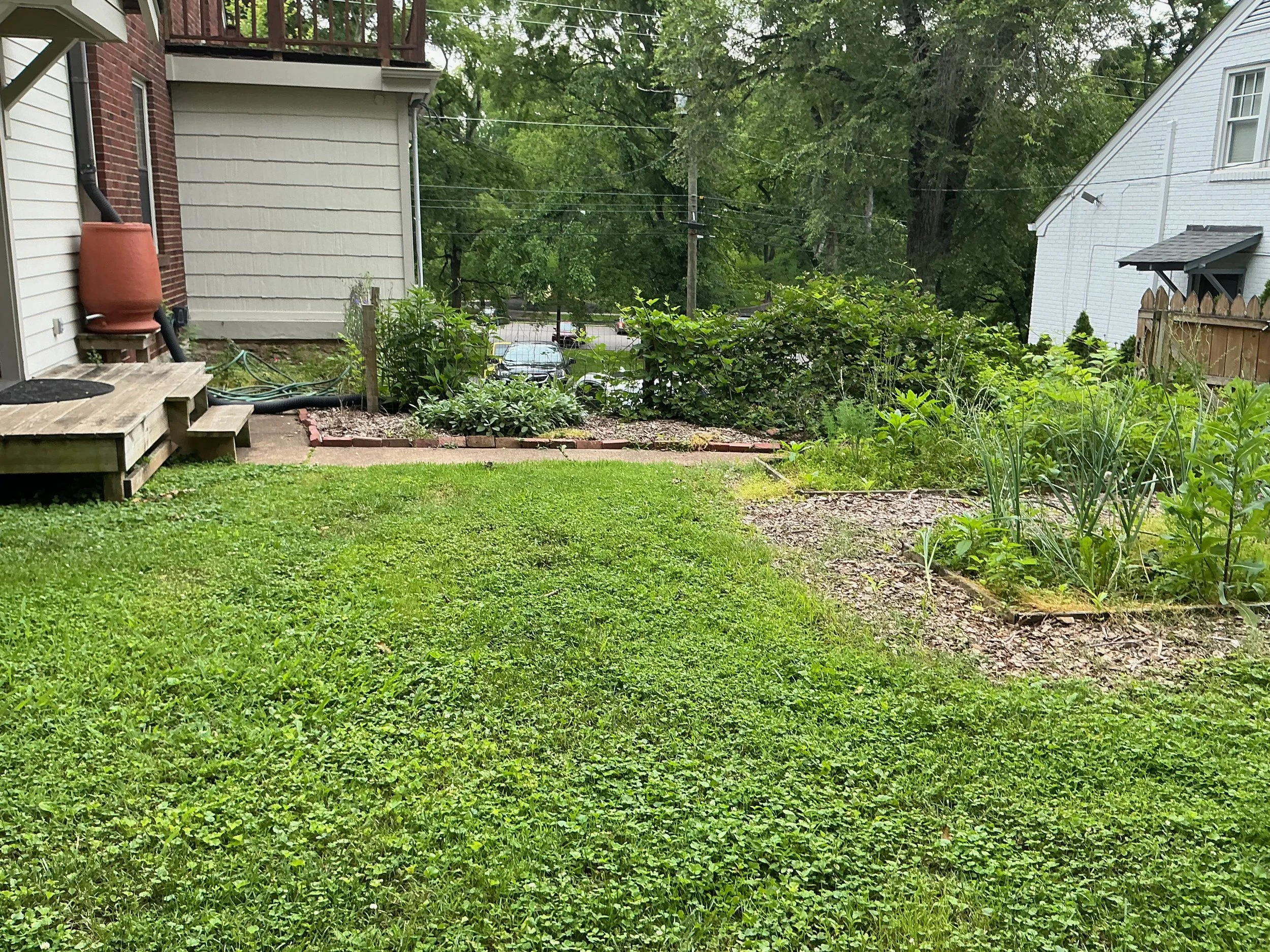
A Nashville backyard before we started. Good bones, no direction.
Japanese-inspired design is the most dramatic transformation I do, and not because it's the most expensive or the most complex, but because the emotional shift is so immediate. You remove everything that's competing. You replace it with intention. And suddenly a backyard that felt like a chore becomes a place someone actually wants to be.
I've designed spaces where the whole concept was built around a single view from a back door, one composition of stone, gravel, a specimen tree, and a fire element, designed so that every time the client looks out their window, the scene is resolved. Complete. Like a painting they get to live inside.
That's not hyperbole. That's what this style does when it's done well.
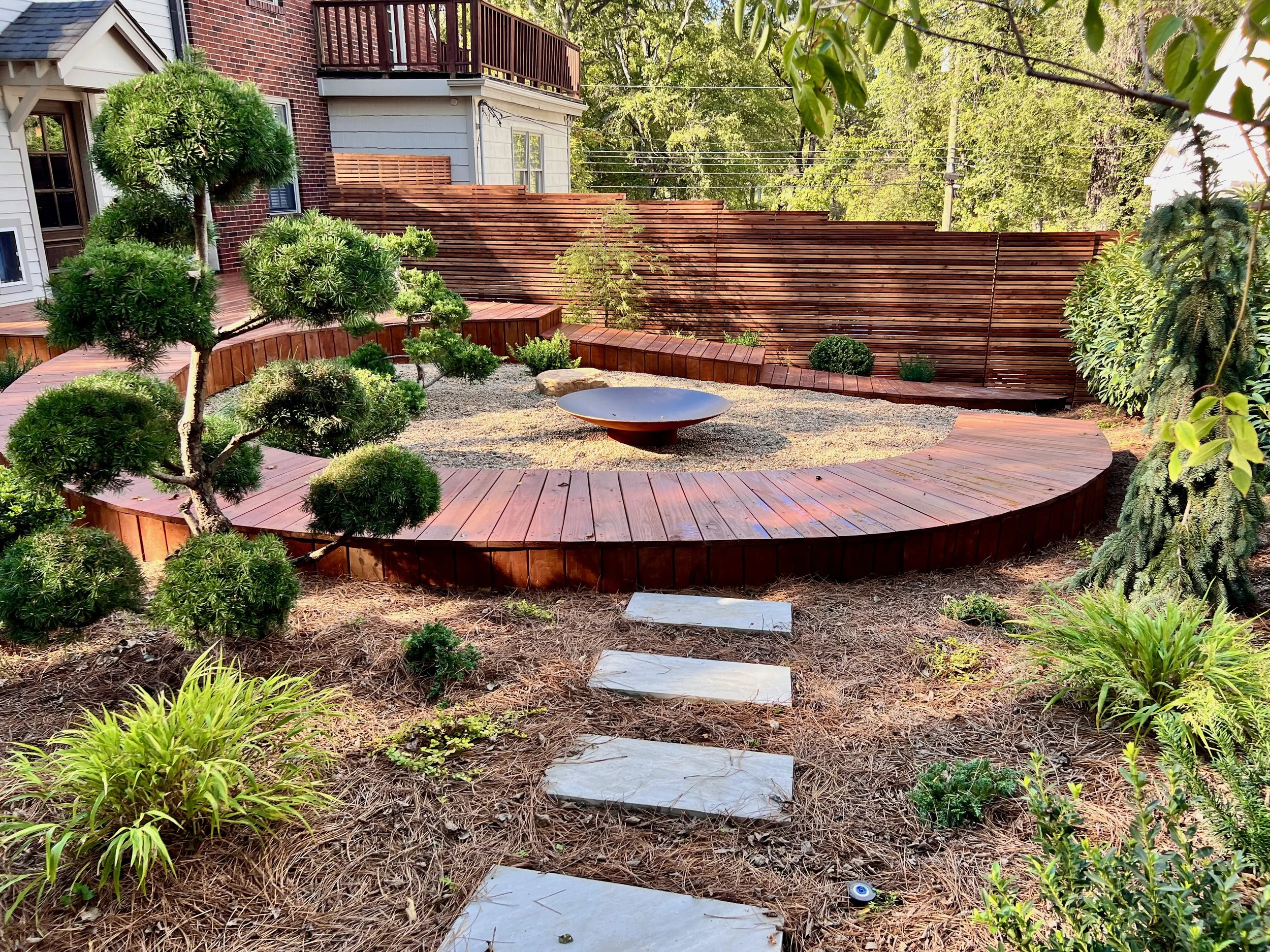
The same space, designed around one principle: everything in its right place.
Why This Style Needs a Designer
I'll be direct: Japanese-inspired design is not a DIY project. It's arguably the most technically demanding garden style there is, because the margin for error is zero.
In a cottage garden, you can move a plant six inches and nobody notices. In a Japanese-inspired garden, six inches changes the entire composition. The placement of a single boulder might take an hour of adjusting — rotating it, settling it, stepping back, looking at it from every angle the client will ever see it from. The grading of a gravel bed has to be precise enough to feel natural. The pruning of a specimen tree is an ongoing act of sculpture that happens over years.
This is also the style where material quality matters most. A cheap stone looks cheap. A hastily placed stepping stone path feels wrong even if you can't articulate why. The craftsmanship of the hardscape, the way stones are set, the way gravel meets turf, the way a timber edge is joined, is fully visible and fully exposed. There's no border of perennials to soften a sloppy edge. Everything is honest.
For me, that's what makes it the most rewarding style to design. There's no faking it. The result is either right or it isn't, and when it's right, you can feel it in your body the moment you step into the space.
How to Start
If this is the feeling you've been looking for: quiet, intentional, a garden that asks you to slow down… I'd love to talk about how it could work on your property.
Every project starts with a conversation about your land, your goals, and whether my approach is the right fit. Get in touch, or if you want to see what working together looks like, read the full walkthrough of my process.
Clare Horne is the founder of The Grass Girl, a fine garden design studio based outside Nashville, Tennessee. She designs residential gardens for clients in Wilson, Williamson, Davidson, Sumner, and Cheatham counties.