
What a Garden Can Become: The Story of a Nashville Property That Got a Second Life
A high-end brick home with everything going for it — except a landscape that matched. Here's how it changed, and why every decision mattered.
I want to tell you about a project that still stops me when I drive past it.
The homeowners had a beautiful house: a substantial brick property in one of Middle Tennessee’s established neighborhoods. Good architecture. Good bones. And a landscape that was doing absolutely nothing for it. Overgrown foundation shrubs that hadn't been shaped in years. Bare mulch beds. No perennials. No color. No structure. No reason to look at it twice. The kind of landscaping that gets installed when a house is built and then slowly declines because nobody ever thought about it as anything more than "the stuff around the house."
The house deserved better. The people living in it deserved better. And the property itself, the light, the topography, the spaces between the house and the street, and the backyard, was asking for something more. You could feel it when you walked the site. There was a garden here. It just hadn't been built yet.

What I Saw That the Client Didn't
The homeowners called me because they wanted the property to "look nicer." That's almost always the starting point. Nice. Presentable. Better than it was. And I understand that — it's a reasonable ask. But when I walked the property for the first time, "nicer" wasn't what I was thinking about.
I was thinking about the fact that this brick home had warm, rich tones that no plant on the property was responding to. The existing shrubs were generic green blobs: no texture, no color relationship with the house, no seasonal interest. The brick was doing all the work, and the landscape was ignoring it.
I was thinking about the backyard, which had space and grade changes that were begging for something dramatic; not a flat patio and a rectangle of sod, but an actual experience. Something you'd walk into and feel a shift.
I was thinking about what this property could feel like at night. Because this family used their outdoor space in the evenings, and after dark the entire garden disappeared. There was nothing to see, nothing to draw you outside, nothing to make the space feel alive once the sun went down.
And I was thinking about sound. The property was in a neighborhood with road noise, not terrible, but present. The kind of ambient noise that makes a backyard feel exposed rather than enclosed. Water fixes that. Moving water doesn't eliminate road noise, but it gives your ear something else to focus on, and that shift in attention changes the entire feeling of the space.
So "nicer" became something much bigger. It became a complete rethinking of how the property met the house, how the garden functioned through all four seasons, and how the space worked after dark and with sound.
The Foundation: Getting the Bones Right
Before a single flower went in, we addressed the structure.
The overgrown foundation shrubs came out. All of them. When a foundation planting has been neglected for years, there's usually no saving it; the plants are leggy, misshapen, and have outgrown their positions. Ripping them out feels dramatic, and there's always a moment when the homeowners look at the bare beds and wonder what they've done. But that blank canvas is exactly what a new design needs. You can't compose on top of someone else's mess.
We replaced the foundation layer with hardy conifer shrubs selected for year-round structure; plants that would hold the garden's shape in January when everything else was dormant. These are the bones. They're the elements that make a Nashville garden work twelve months a year instead of six. I chose varieties with different textures and growth habits: some columnar for vertical line, some mounding for mass, some with blue-green foliage that would play off the warm brick tones of the house. This is the kind of cultivar-level thinking I bring to every project, not just "put evergreens here," but which evergreens, why those specific ones, and how they relate to the architecture and to each other.

Majestic junipers went in for height, both for the scale they bring to the property and for the year-round structure they bring to the entrance. A large property with only low plantings feels flat. The junipers lifted the composition vertically and gave the garden a ceiling.
The Perennials: Where the Life Is
With the evergreen structure in place, we layered in native perennials, and this is where the property went from "improved" to "alive."
I designed the planting beds for continuous bloom from early spring through hard frost. Not one big show in May followed by ten months of green. Succession planting, the staggered timing of different species so something is always blooming, always attracting pollinators, always giving you a reason to look out the window or walk through the garden.
The native perennials were chosen for Nashville's specific conditions: our clay, our heat, our humidity, our alkaline pH. These aren't fussy imports that need babying. They're tough, regionally adapted plants that perform in our soil without constant intervention. They attract swallowtails and monarchs and hummingbirds. They feed the ecosystem. And they look better in year two than year one, and better in year three than year two, because perennial gardens mature and fill in and become more of themselves over time. A perennial garden that's designed well is an appreciating asset; it gets richer every season.
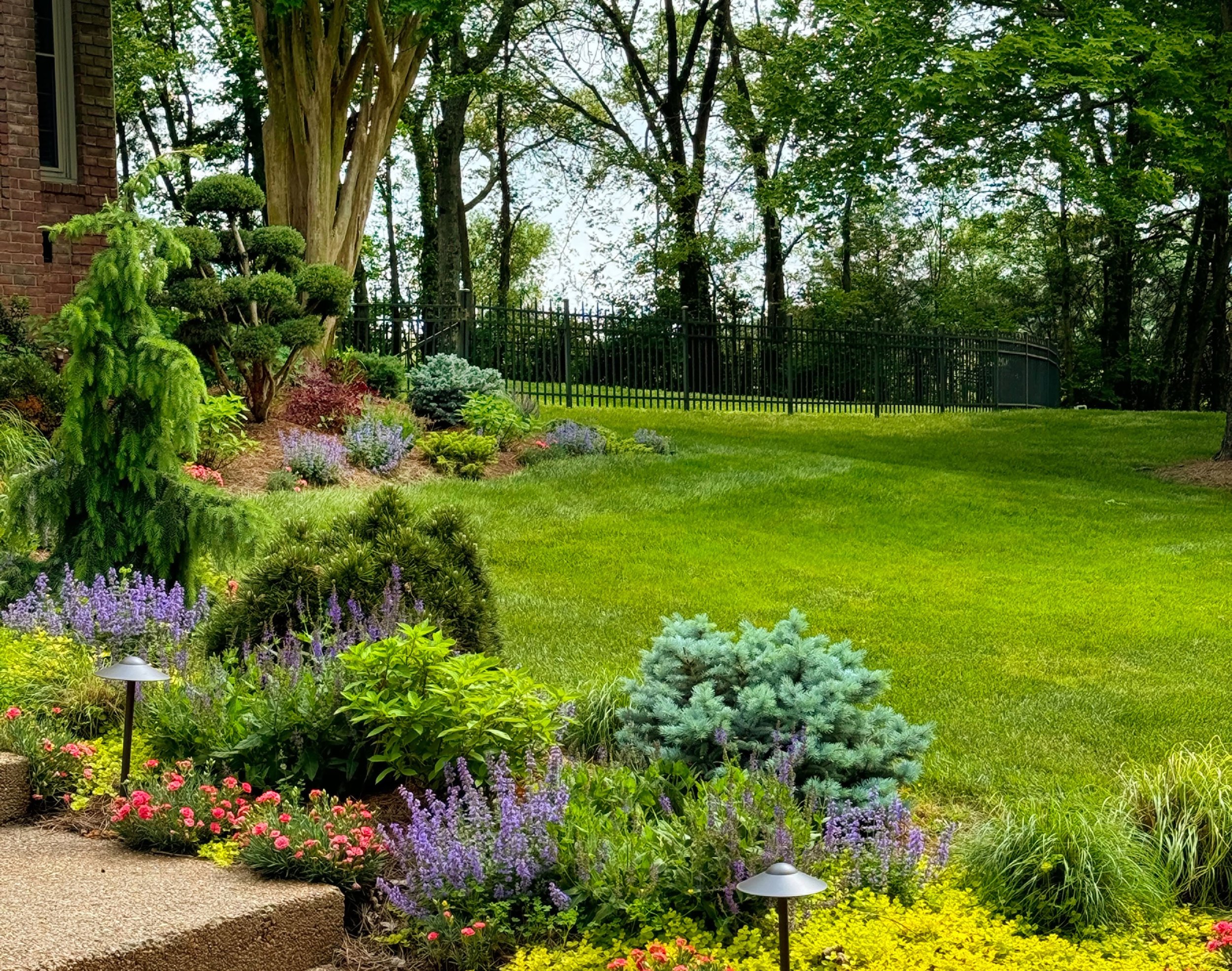
Dense groundcover went in beneath and between the perennials, suppressing weeds, holding moisture, and creating that lush, full, carpet-of-green look that makes a garden feel abundant rather than sparse. I don't like seeing bare mulch between plants. A mature garden should feel full. The ground should be covered. That density is what separates a garden from a landscape.
The Water: Two Koi Ponds and a Fifteen-Foot Waterfall
This was the heart of the project.
I designed two koi ponds connected by a fifteen-foot waterfall; a cascading water feature that became the central experience of the backyard. Not a decorative accent. Not a bubbling fountain tucked in a corner. A real, substantial piece of moving water that you can hear from inside the house, that you can sit beside, that changes the entire atmosphere of the space.
Here's why water matters this much in a Nashville garden: our summers are hot, humid, and loud with cicadas and road noise and leaf blowers. Moving water cuts through all of that. It creates a sound environment that your brain reads as natural and calming. The cascade of a waterfall doesn't just look beautiful, it sounds like peace. It gives the garden a voice.

The koi themselves add life and movement to the garden in a way nothing else can. They're living, responsive creatures that become part of the daily experience of the space. The homeowners' relationship with those fish became something I didn't fully anticipate: the morning feeding ritual, the kids watching them, the way the koi come to the surface when they hear footsteps. That's not landscaping. That's a living system you interact with every day.
The Nightscaping: A Garden That Doesn't Disappear at Sunset
This is where everything came together.
We designed a complete nightscaping system, warm, carefully placed lighting that transforms the property after dark. Uplighting on the specimen trees and the architectural elements of the house. Path lighting along the walkways. Wash lighting across the planted beds so the textures of the perennials and groundcovers are visible in the evening. And lighting on the waterfall and koi ponds, because moving water lit from below or behind at night is one of the most beautiful things you can create in a residential landscape.

The homeowners told me later that the nightscaping changed how they used their property more than anything else in the project. Before, they went inside when the sun went down. After, they stayed out. The garden at night became a completely different experience from the garden during the day, quieter, more intimate, almost theatrical. The lighting doesn't flood the space, it reveals it selectively. You see the texture of bark. The movement of water catching light. The silhouette of a pine against the sky. It's not about making the yard bright. It's about making it present after dark.
The Irrigation: The Invisible System That Makes Everything Possible
This isn't glamorous, but it's essential. We installed a state-of-the-art irrigation system with distinct watering zones, because a koi pond doesn't need the same water management as a perennial bed, and a conifer foundation doesn't need the same moisture as a groundcover mass. In Nashville's clay, overwatering kills as many plants as drought. The irrigation system ensures every zone gets exactly what it needs, adjusted for seasonal conditions.
I mention this because it's the kind of detail that separates a garden that looks good the day it's installed from a garden that looks good five years later. A beautiful design without smart irrigation is a beautiful design on borrowed time. Every project I do includes the infrastructure to keep it alive.
What the Property Became
I want you to understand the scale of what changed here.
Before: a high-end brick home with generic foundation shrubs, bare beds, no color, no sound, no light, and no reason to spend time outside. A property that looked like it was waiting for someone to care about it.
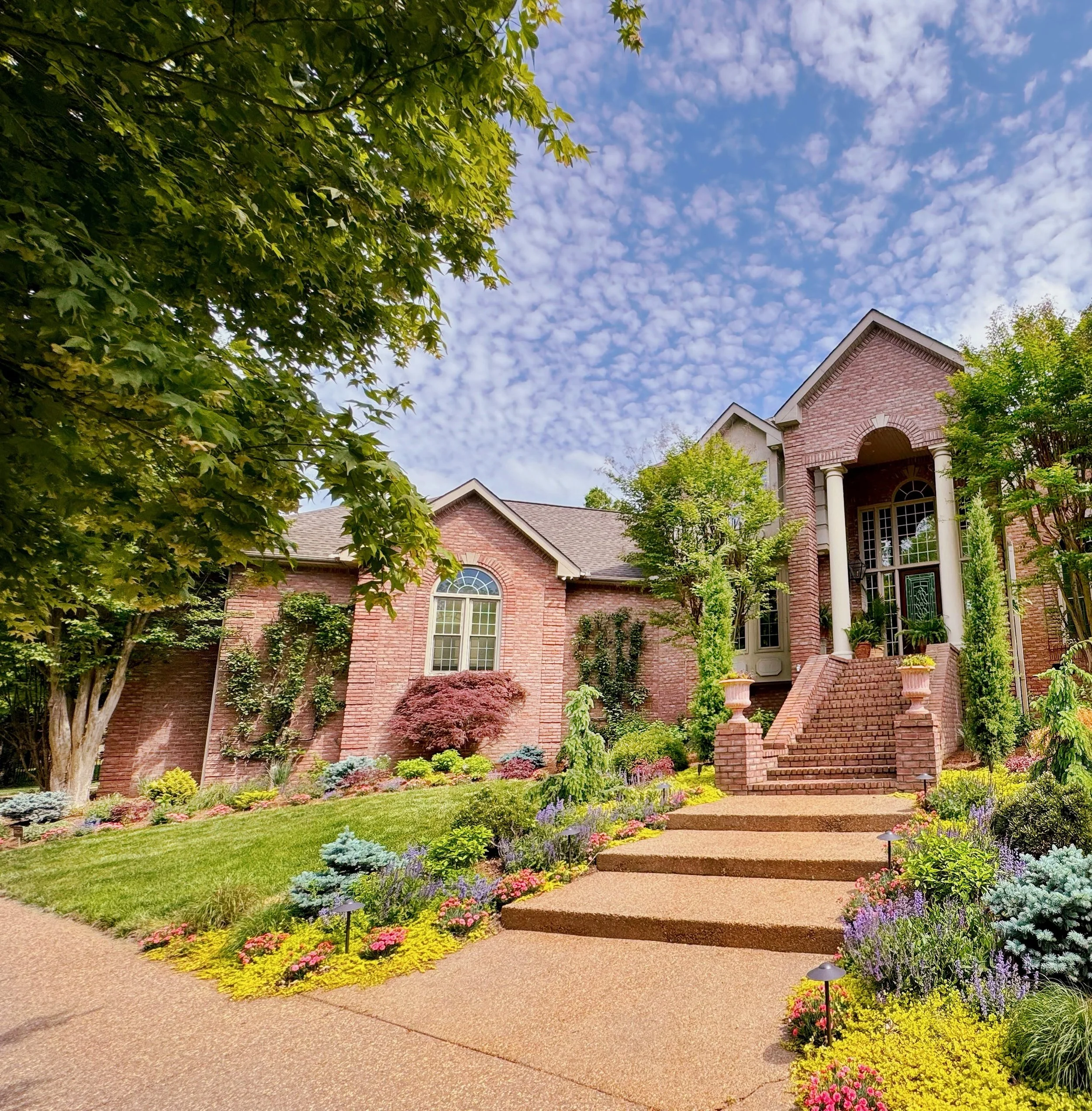
After: a layered, four-season garden with evergreen structure that holds through winter, native perennials that bloom in succession from spring through frost, dense groundcover that makes every bed feel full and alive, two koi ponds connected by a cascading waterfall that gives the garden a voice, and a complete nightscaping system that makes the property as beautiful at 9pm as it is at noon.
The homeowners don't go inside anymore. Not until they have to.
What This Project Taught Me
Every project teaches me something. This one confirmed something I already believed but hadn't seen at this scale: the distance between "nice landscaping" and "a garden you live in" is enormous, and most homeowners don't know the second option exists until they experience it.
The homeowners didn't call me asking for koi ponds and a waterfall and nightscaping. They called me asking for "nicer." The garden they got is a place where their family gathers, where the sound of water replaces the sound of traffic, where the evening doesn't end when the sun goes down. That's not a landscaping upgrade. That's a change in how you live.
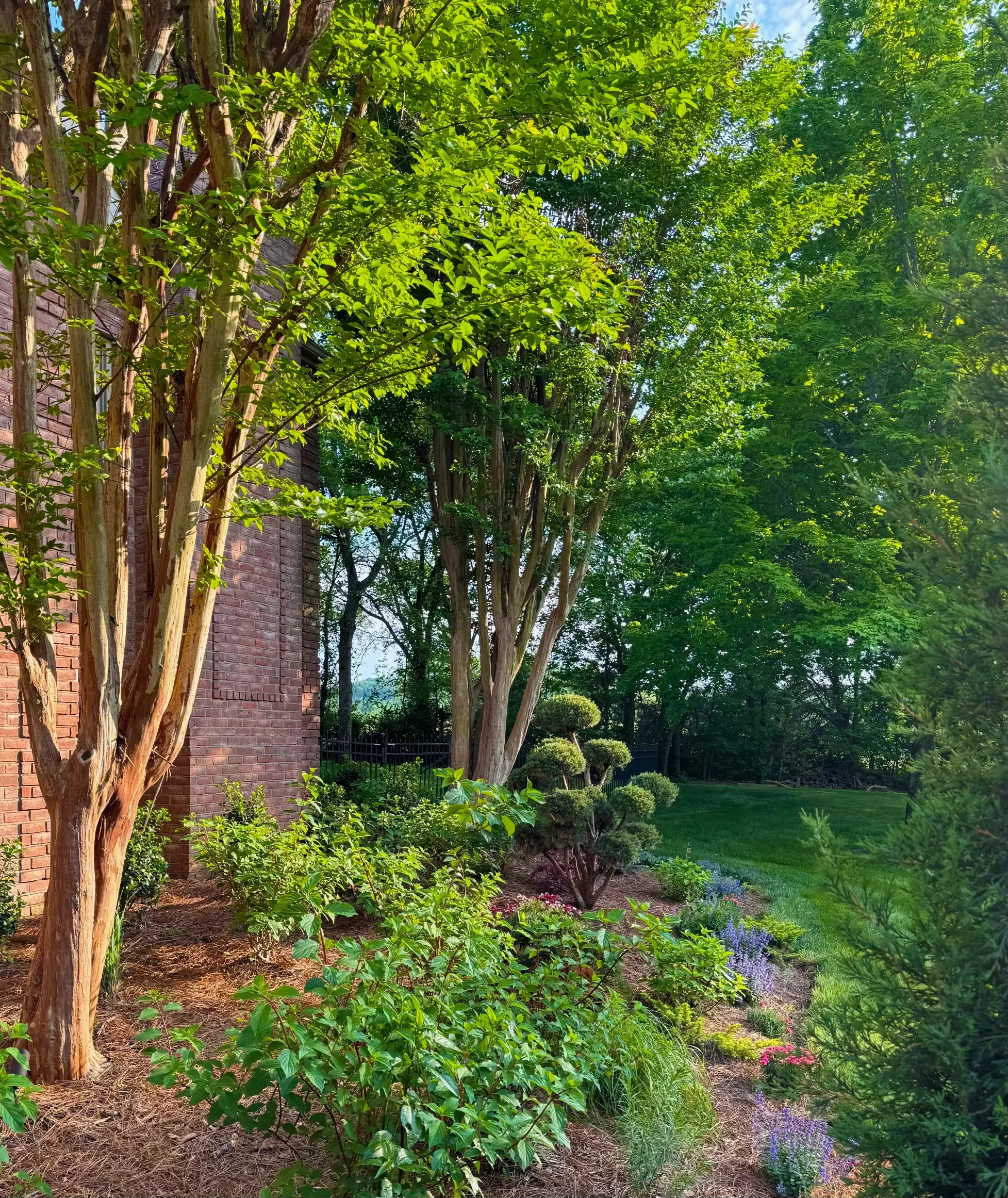
That's what I mean when I say a garden is the most alive medium I've ever worked in. It's not a painting. It's not a sculpture. It's a living system that grows and changes and interacts with the people in it. And when it's designed with intention, when every plant and every stone and every light and every drop of water is placed for a reason, it becomes something that transforms not just the property, but the life that happens on it.

Your Property Has a Version of This Story in It
Every property does. It might not be koi ponds and a waterfall; it might be a cottage garden that makes your front walk feel like a journey. It might be a privacy screen that turns a fishbowl backyard into a room. It might be a single specimen tree in exactly the right spot that changes the entire composition.
The point is: the garden is in there. Waiting. The property already knows what it wants to be. It just needs someone to listen to it.
If you want to find out what your property is asking for, let's talk.